What's inside
As an Amazon Associate I earn from qualifying purchases. This post may contain affiliate links at no extra cost to you.
A coat rack puts more stress on drywall anchors than a light picture does. Every time someone pulls a coat off a hook, the rack gets a short tug outward and downward. A rack loaded with several heavy coats adds steady weight, too. The best anchor depends on the rack’s mounting holes, the drywall thickness, and whether you can hit a wood stud.
As an Amazon Associate we earn from qualifying purchases at no extra cost to you.



What we cover
Check for studs first
A wood stud is the most reliable place to fasten a coat rack. Use a stud finder, then confirm the location with a small pilot hole or by checking for a nearby outlet box that is fastened to a stud. Most studs are spaced 16 inches on center, though 24-inch spacing and unusual layouts are possible. If the rack’s mounting holes line up with one or more studs, drive suitable screws into the studs rather than relying on drywall anchors.
For a rack with holes that do not line up, you can sometimes fasten a short board to two studs, then attach the rack to that board. This is a sturdier choice for a busy entryway or a rack likely to carry backpacks and winter coats. If you need to use drywall anchors, choose ones with a published load rating for your drywall thickness, and treat that rating as a guide—not a guarantee for repeated pulling.
Anchor options at a glance
| Anchor type | Best use | Trade-off |
|---|---|---|
| Plastic expansion anchor | Light rack, low-use location, low cost | Lower holding power; can loosen or pull out under repeated tugs |
| Self-drilling threaded anchor | Quick installation in suitable drywall | Easy to install, but can damage drywall if overtightened or installed crooked |
| Metal hollow-wall toggle | Heavier rack with room behind the wall | Strong when installed correctly; needs a larger hole and careful handling |
| Strap-style toggle | Heavier loads and a more controlled installation | Costs more and leaves a larger hole than a small plastic anchor |
Choose by load and use
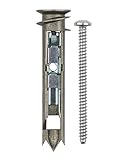
For a decorative rack holding a few light jackets, a properly sized self-drilling drywall anchor can be a reasonable, inexpensive option. It installs with a screwdriver or drill, and avoids the extra steps of a toggle. Check the package for drywall thickness and screw size. These anchors are not a good shortcut for a rack that will regularly carry loaded backpacks or several heavy coats; their threads can chew up drywall if the rack shifts or the screw is overtightened.
For a more heavily used rack, consider a strap-style toggle anchor or a metal hollow-wall toggle. The toggle spreads the load across the back of the drywall rather than relying on a small patch of gypsum around a screw. It still depends on sound drywall, correct installation, and a rack that sits flat against the wall. A toggle can fail if the drywall is cracked, damp, unusually thin, or already weakened by an oversized hole.
Do not add up the individual anchor ratings and assume that total is the safe capacity of the rack. Load may not be shared evenly, especially if the rack is flexible or its holes are close together. Repeated outward pulls and unevenly hung coats also make real use harsher than a static load test.
Install carefully
Measure the rack’s hole spacing and level it before drilling. Check the wall for pipes and wiring, particularly near outlets, switches, and plumbing fixtures. Use the hole size specified by the anchor maker: too small can prevent a toggle from opening, while too large can let the anchor spin or pull through. A drill and the correct bit make cleaner holes, but a hammer drill is not needed for drywall.
For a self-drilling anchor, turn it straight into the drywall and stop when its flange is flush. Drive the screw until the rack is snug; do not keep tightening after the rack contacts the wall. For a toggle, follow the package directions for the pilot-hole diameter and insertion. Make sure the toggle opens behind the wall, then tighten the screw while keeping the rack level. A basic cordless drill and driver is useful for pilot holes and screws, but use a low clutch setting or finish by hand to avoid stripping the anchor.
With any anchor, stop if it spins without tightening, the drywall crumbles, or the rack rocks when you pull it gently. A spinning anchor has lost its grip; tightening harder usually enlarges the damage. Move to a fresh location, use a larger suitable toggle if the wall allows it, or mount a board across studs. Do not reuse a damaged hole for a new anchor of the same size.
When a toggle is worth the extra work
Choose a toggle when the rack will carry heavier items, see frequent use, or be installed where a falling rack could damage a door, floor, or wall. A strap-style toggle is often easier to position than a traditional spring toggle because its channel can be held against the back of the drywall while the screw is tightened. A traditional metal hollow-wall toggle can also work well, but it usually requires a larger hole and the bolt may fall into the wall if removed.
For a lightly loaded rack in a low-traffic room, a small plastic anchor may be adequate if its rating and installation instructions suit the wall. For a family entryway, use studs where possible or a properly installed toggle. The extra effort is usually cheaper than repairing torn drywall after an anchor loosens.