What's inside
As an Amazon Associate I earn from qualifying purchases. This post may contain affiliate links at no extra cost to you.
Hanging a small coat rack on drywall is usually a light-duty fastening job, but the rack creates more leverage than a picture frame. Coats pull outward from the wall, and people often add bags, hats, or backpacks over time. The best anchor depends on the rack’s total load, the number and spacing of mounting holes, and whether you can hit a wall stud.
As an Amazon Associate we earn from qualifying purchases at no extra cost to you.


What we cover
Start With the Wall Stud
A wood stud is the strongest and simplest mounting point. If one of the rack’s holes lines up with a stud, drive a screw at least 1 1/4 inches into the stud after accounting for the thickness of the rack and any bracket. You do not need a drywall anchor at that location. A stud-mounted screw can usually handle far more abuse than a plastic anchor, provided the screw is centered in solid wood.
Use a stud finder, then confirm the location with a small drill bit or by measuring from a nearby outlet box. Electrical boxes are normally attached to a stud, so this measurement can help—but do not drill close to an outlet, switch, or plumbing fixture without understanding what is behind the drywall. A stud-mounted screw is especially worthwhile for a rack that will hold heavy winter coats or bags.
The Best Drywall Anchor Types
When a stud is unavailable, choose an anchor designed for hollow drywall. The ratings printed on packages are useful for comparison, but they are not guarantees. Ratings depend on drywall thickness, installation quality, load direction, and whether the load is static or repeatedly pulled.
| Anchor type | Typical useful load per anchor | Best use | Main drawback |
|---|---|---|---|
| Self-drilling plastic anchor | About 10–25 lb | Light racks, hats, and a few garments | Can strip or loosen in soft drywall |
| Plastic expansion anchor | About 10–25 lb | Very light-duty mounting | Often spins or pulls out if overloaded |
| Hollow-wall metal anchor | About 25–50 lb | Medium-duty racks with a rigid bracket | Needs a larger, accurately drilled hole |
| Toggle bolt or strap toggle | About 40–70 lb | Heavier loads spread across hollow drywall | Requires a large hole and clearance behind the wall |
These figures are conservative working ranges, not manufacturer test ratings. Use multiple anchors when the rack allows it, but do not simply add the ratings together. A rack can still fail if its bracket bends, the screws pull through the mounting holes, or the load is concentrated on one end.
Best Choice for a Light Coat Rack
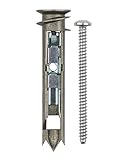
For a small rack holding several light coats, a quality self-drilling drywall anchor is usually the economical choice. Search for self-drilling drywall anchors with a screw included and a load rating appropriate for your rack. These anchors install with a screwdriver or drill-driver and do not require a separate pilot hole in most drywall.
They work best when the drywall is in good condition and the rack has two or more mounting holes. Keep the load to roughly 15–20 pounds total unless the manufacturer gives a more specific rating and the rack is firmly supported. A few coats and hats are fine; several full backpacks are not.
Do not use a self-drilling anchor if it spins while being installed. Spinning enlarges the hole and removes the drywall paper that helps the anchor grip. Remove it, move the rack slightly if possible, and install a larger or stronger anchor.
When Metal Hollow-Wall Anchors Make Sense
Metal hollow-wall anchors, often called Molly-style anchors, are a better middle ground for a rack that will see regular use. They clamp against the back of the drywall, distributing force over a wider area than a small plastic anchor. Look for metal hollow-wall anchors sized for your drywall thickness.
Installation normally requires drilling a hole to the specified diameter, then tightening the anchor so its rear section folds or expands behind the wall. Follow the package instructions carefully. If the hole is too large, the anchor may rotate; if it is too small, the anchor may crush the drywall or fail to seat.
These anchors are a good choice for a rack carrying approximately 20–40 pounds total, particularly when the rack has a solid mounting plate. They are less suitable for very thin, damaged, or patched drywall. The bracket should sit flat against the wall; spacers or a narrow contact area can concentrate the load and reduce holding power.
Use Toggles for Heavier or Repeated Loads
A toggle bolt or strap toggle provides the broadest load distribution in hollow drywall. Search for toggle bolts for drywall when the rack will hold heavy coats, bags, or anything frequently pulled away from the wall.
Toggles need a larger hole—often around 1/2 inch or more—and there must be enough open space behind the drywall for the toggle to unfold. Avoid placing one where a stud, pipe, wiring, or blocking may interfere. Strap-style toggles are easier to position than traditional wing toggles, but once a traditional toggle is removed, its wing usually falls into the wall and cannot be reused.
For a small coat rack, toggles may be unnecessary if you can use two metal anchors or one stud plus one drywall anchor. They become worthwhile when the rack has a wide mounting rail and a realistic load above about 35–40 pounds.
Drilling and Installation Tips
Use a cordless drill with a sharp bit and the lowest practical speed. For a plastic self-drilling anchor, a cordless drill-driver is easier to control than an impact driver. An impact driver can overdrive the screw, crack the anchor, or strip the drywall.
Mark every hole with the rack held level. Drill only as deep as required, and use the anchor’s specified bit size for metal anchors and toggles. Tighten screws until the rack is secure, then stop. Excessive torque can crush drywall or pull the anchor flange into the surface.
Before loading the rack, pull it outward firmly by hand. It should not rock, rotate, or make cracking sounds. Start with a light load and inspect the fasteners after a day or two. If the drywall around an anchor becomes soft, cracked, or cone-shaped, remove the load and remount the rack farther away using a stronger anchor or a stud.
A Practical Buying Decision
Choose a stud-mounted screw whenever the layout permits. For a light rack and sound drywall, self-drilling plastic anchors are cheap and adequate. Choose metal hollow-wall anchors for a more secure everyday installation, and use toggles when the load is heavy or the rack will be pulled on repeatedly. The anchor is only one part of the system: a rigid rack, correctly sized screws, flat contact with the wall, and a realistic load limit matter just as much.