What's inside
As an Amazon Associate I earn from qualifying purchases. This post may contain affiliate links at no extra cost to you.
Building planter boxes is a good job for an impact driver: it can drive a lot of deck screws without the wrist-twisting reaction of a drill. But maximum torque is rarely the deciding factor. For typical outdoor planters, control, battery compatibility, and the right screw matter more than buying the most powerful tool.
As an Amazon Associate we earn from qualifying purchases at no extra cost to you.



What we cover
What the job actually needs
A planter made from 1-inch-thick boards and 2-by-2 corner supports usually calls for 2½- to 3-inch exterior-rated screws. A compact 12-volt impact driver can handle that work, and an 18- or 20-volt model offers more headroom for dense lumber, longer screws, or repeated projects. Either can be adequate; the larger tool is not automatically better.
Impacts deliver short bursts of rotational force. That helps drive screws, but makes it easier to snap a small screw or bury its head too far. Choose a driver with a low-speed mode or variable trigger, especially if you have little fastening experience. A clutch-equipped drill gives more predictable shutoff near the end of a screw, so it may be the easier tool for delicate work.
Features worth paying for
For a one- or two-box project, a comfortable grip, a usable trigger, and a belt hook are more useful than a high advertised torque figure. Brushless motors can improve runtime and tool life, but a brushed driver is a reasonable budget choice for occasional use. Compare bare tools only if you already own compatible batteries; otherwise, compare complete kits, including charger and battery capacity.
Battery platform is often the practical tie-breaker. If you already own cordless tools, staying with that system saves money and avoids another charger. If you are starting from scratch, a compact kit is enough for planter construction. A larger battery can add runtime, but also makes the driver heavier; a 2.0- to 4.0-Ah pack is generally manageable for this kind of work.
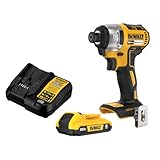
Browse cordless impact driver kits if you need a battery and charger too. If you already have batteries, compare 12-volt impact drivers sold as bare tools against compatible 18- or 20-volt options.
Compare the options
| Option | Best fit | Trade-off |
|---|---|---|
| 12-volt impact driver | One or two boxes, lighter-duty screws | Less reserve for long screws and dense wood |
| 18- or 20-volt impact driver | Several boxes, longer screws, general DIY use | Often heavier; a kit may cost more |
| Drill/driver with clutch | Careful fastening near board edges | Slower driving and more wrist reaction under load |
| Basic brushed impact driver | Occasional projects on a tight budget | May have fewer speed settings and shorter runtime |
For most builders who already own an 18- or 20-volt battery platform, a basic compatible driver is the sensible buy. If you are purchasing your first tool and expect to assemble only one small planter, a lower-cost 12-volt kit is enough. A premium brushless model makes more sense for frequent building, not just because its specification sheet lists a larger torque number.
Choose screws and wood for outdoor use
Use exterior-rated screws—typically coated deck screws or stainless steel—rather than drywall screws. Drywall screws are brittle and can snap under impact or seasonal movement. Match the fastener to the lumber and exposure; stainless costs more but is useful where corrosion is a concern. For cedar or other softwood boards, a compatible coated screw is often adequate. Check the screw maker’s guidance for treated lumber.
Wood near board ends is prone to splitting. Drill a pilot hole through the face board, especially when using 3-inch screws, working close to an edge, or fastening hardwood. A pilot hole roughly matches the screw’s solid shank diameter, not its threads. Keep screws at least about ¾ inch from a board edge when the design allows. If the lumber is wet or warped, expect more resistance and avoid forcing a screw that stops suddenly.
Use a quality ¼-inch hex-shank driver bit that fits the screw recess snugly. A worn or poorly fitting bit can cam out, chew up the head, and leave the screw stuck halfway in. Keep a spare bit on hand; bits wear, particularly when driving many screws.
Drive with control
Clamp or hold the boards securely, line up the driver with the screw, and start at low speed. Let the bit stay seated before increasing pressure. Stop when the head is flush with the board surface; driving it deep weakens the hold and can create a pocket that collects water. For a test, drive a screw into scrap of the same wood and adjust your trigger pressure before assembling the box.
Common failures have straightforward fixes. A screw that stalls may be too long, may have hit a knot, or may lack a pilot hole; back it out and inspect rather than leaning harder on the driver. A stripped head often means the bit was mismatched, worn, or held at an angle. A snapped screw may indicate a brittle fastener, a knot, or excessive force. Replace damaged screws instead of trying to reuse their heads.
When a drill is the better choice
An impact driver is for driving, not drilling large holes. Use a regular drill with the appropriate bit for drainage holes, pilot holes, or countersinks. For a planter, drainage holes are important, but their number and size depend on the base design; make sure water can escape without weakening narrow rails. A drill’s clutch is also useful if you want consistent screw depth or are fastening thin trim.
In short, buy for the lumber and the number of projects: a compatible, lower-cost driver will build ordinary planter boxes just fine. Spend more for brushless construction, multiple speed settings, or a larger battery when those features will see regular use—not simply because the tool can produce more force than the job requires.