What's inside
As an Amazon Associate I earn from qualifying purchases. This post may contain affiliate links at no extra cost to you.
An impact driver can install subfloor screws quickly, but speed is not the main buying criterion. For plywood over joists, the useful features are a controllable trigger, enough battery capacity for repeated fastening, and a driver that is comfortable to hold while working close to the floor. A basic 18V or 20V cordless impact driver is plenty for ordinary subfloor screws; a premium model is worthwhile mainly if you already use its battery platform or need finer control.
As an Amazon Associate we earn from qualifying purchases at no extra cost to you.



What we cover
What the job needs from an impact driver
Subfloor screws commonly range from about 1-5/8 to 2-1/2 inches, depending on the panel thickness and framing. The screw must pass through the plywood and penetrate the joist sufficiently to hold the panel; follow the flooring or screw manufacturer’s instructions for length and spacing. A driver with a standard 1/4-inch hex chuck accepts common impact-rated bits, including square-drive and Torx styles.
Impact drivers deliver rotational blows when resistance rises. That helps drive long screws without the strong wrist-twisting reaction of a drill, but it can also make it easy to overdrive a screw or damage a bit. Choose a tool with a variable-speed trigger and, ideally, a low-speed or assist setting. Multiple modes are helpful, not essential: an experienced user can do the job with a single-speed driver by easing off the trigger near the surface.
Compare the main options
| Option | Best for | Trade-off |
|---|---|---|
| Entry-level 18V/20V impact driver | Occasional subfloor repairs or one room | May have fewer speed controls and a basic battery |
| Brushless impact driver with multiple modes | Several rooms, frequent remodeling, or better control | Costs more; extra power is rarely needed for plywood screws |
| Cordless drill/driver | Short screws, delicate work, or users who want direct speed control | More wrist reaction and slower driving in dense framing |
If you own batteries already, staying on that platform is often the sensible purchase. Otherwise, compare the cost of a tool-and-battery kit rather than judging by the bare-tool price. A compact kit with a roughly 2.0Ah battery is usually sufficient for a small repair; a 4.0Ah battery reduces charging interruptions on a larger floor, at the cost of added weight.
What to buy
For occasional work, a reputable entry-level cordless driver with a variable trigger is usually enough. Look for a kit with a battery and charger, a comfortable grip, and a belt hook if you will be moving around a room. You do not need the highest advertised torque rating. Manufacturers measure and report torque differently, and very high output does not make a screw install straighter.
For repeated renovation work, a brushless driver with two or more speed modes is a useful upgrade. Brushless tools generally use battery power more efficiently and can run cooler under sustained use, though the improvement may not justify replacing a working tool for a single floor. Compare 18V cordless impact driver kits by battery size, trigger control, included charger, and warranty—not just claimed torque.
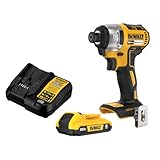
If you are starting without batteries, a compact 18V/20V impact-driver kit is a practical all-around choice. A small drill/driver kit may be cheaper and is fine for light fastening, but the driver is generally less tiring when installing many long screws. See brushless impact drivers with multiple speed modes if controlled starts matter to you. For a one-time repair, borrowing or renting can be more economical than buying a premium tool.
Use the right screws and bits
Choose screws rated for subfloor installation and compatible with the panel and joists. Drywall screws are a poor substitute: they are brittle and may snap under movement. Confirm the required length and spacing for your flooring system, and check for pipes, wiring, or radiant heat before driving into a floor. A screw that is too long can hit hidden services; one that is too short may not hold well in the framing.
Use the exact bit type and size specified for the screw, preferably an impact-rated bit. A loose-fitting bit cams out, rounds the screw recess, and can leave a screw stuck partly proud. Replace worn bits rather than pressing harder. Keep spare bits nearby: a damaged tip wastes more time than changing it.
Drive screws without damaging the panel
Mark joist locations and follow the panel or flooring instructions for fastener spacing. Keep the driver aligned with the screw and start slowly. As the head approaches the plywood, ease off the trigger and stop when it is seated flush or at the specified depth. Do not bury the head deeply just to make the surface look neat; overdriving can crush the plywood’s face veneer and weaken the local hold.
Common problems have straightforward causes. A screw that spins without tightening may have missed the joist, stripped the wood, or been overdriven; check alignment and use the appropriate repair method rather than repeatedly driving into the same damaged hole. A screw that stalls may be too long, the bit may be worn, or the material may be unusually dense. Back it out, inspect the bit and location, and avoid leaning hard enough to bend the driver off-axis.
Match the tool to the project
For one small section of subfloor, a basic kit or an existing cordless drill may do the job. For a full room, an impact driver with a variable trigger and a spare battery makes sustained fastening easier. Pay for multiple modes or brushless construction if you expect to use the tool regularly; otherwise, put the savings toward proper subfloor screws, fresh bits, and a battery kit that fits your other tools.