We research everything we recommend. When you buy through our links, we may earn a commission. As an Amazon Associate we earn from qualifying purchases.
Best Rotary Tool Accessory Kits: Five Sets Compared
Compare the best rotary tool accessory kits by shank fit, wheel speed rating and storage, from the Dremel 710-08 to the 618-piece EZUVITA set.
Format: 70-piece accessory kit in a reusable storage bin with lift-out trays
Contents: 10 EZ Lock cutting wheels including carbide and diamond wheels, 40 sanding bands, 12 EZ Lock sanding discs and 2 EZ Lock finishing abrasive buffs per the maker’s manual
As an Amazon Associate I earn from qualifying purchases. This post may contain affiliate links at no extra cost to you.
⭐ Key Takeaways
Quick answer: Our top pick is Dremel 710-08 160-Piece Rotary Tool Accessory Kit, with Dremel EZ725 70-Piece All-Purpose Accessory Kit as a strong alternative.
If you want one answer up front: the Dremel 710-08 is the strongest default in this group, because it is the only kit here that pairs a full spread of cutting, sanding, grinding, polishing and carving accessories with the maker’s own quick-change hardware, an EZ Lock mandrel and an EZ Twist nose cap wrench, in a cased set whose contents are published piece by piece with part numbers. If the work is mostly cutting and sanding with constant accessory changes, the considered alternative is the Dremel EZ725, a smaller kit built entirely around the EZ Lock and EZ Drum quick-change systems. The EZUVITA 618PCS is the high-count mid-range kit, the SE 228-piece set is the budget general kit, and the Oruiiju 41-piece set is the specialist, a diamond cutting wheel set bought by people whose rotary work is cutting tile, glass and stone.
One boundary before the picks, because this category sells two different things under one shelf label. Every kit in this guide is accessories only: no rotary tool is included in any of the five, and each assumes a host tool with a collet that grips a 1/8 inch shank, the standard fit across Dremel corded and cordless tools and most other brands. Piece counts in this class are consumables counts, dominated by discs, bands and wheels used up by design, so the counts below read as resupply depth rather than capability. One maker note belongs up front as well: Dremel appears twice in this guide, once with its large general kit and once with its quick-change kit, two different products bought for different reasons; the other three sellers appear once each.
As an Amazon Associate, we earn from qualifying purchases.
Buy the Dremel 710-08 if one kit has to cover the whole rotary bench: the fullest published contents list in the group, the maker’s EZ Lock mandrel and EZ Twist nose cap in the box, and a reusable case with lift-out trays. Buy the Dremel EZ725 if cutting and sanding dominate and changes are constant, because every wheel and band in it swaps without a wrench. The EZUVITA 618PCS covers the same ground with the deepest consumables stock here, the SE 228-piece set is the budget general kit in a wooden case, and the Oruiiju set is the cutting specialist’s add-on, diamond discs and resin wheels only.
Quick Comparison
Kit
Tier
Format
Headline contents
Shank
Dremel 710-08 Accessory Kit
Premium
160-piece set in a storage case
Cutting, sanding, grinding, polishing, carving, EZ Lock mandrel
1/8 inch
Dremel EZ725 Accessory Kit
Mid-range
70-piece set in a storage bin
EZ Lock cutting wheels, EZ Drum sanding bands and discs, buffs
1/8 inch
EZUVITA 618PCS Accessory Kit
Mid-range
618-piece set in a transparent storage box
Sanding papers and bands, cut-off wheels, grinding stones, diamond points
Shank and collets first: 1/8 inch is the standard fit. The shank is the first spec to settle, because it decides whether an accessory can be chucked at all. Four of the five kits here are built on the 1/8 inch shank, the size Dremel collets and most other rotary tools grip as standard; the EZUVITA kit adds spare collets in 3/32 inch and 1/16 inch for its smaller bits. The exception in this guide is the Oruiiju cutting set, whose mandrels carry a 3 mm shank, a fraction under 1/8 inch; most 1/8 inch collets close down on it, but a collet that grips off-center makes a cutting wheel wobble, and wobble in a cut-off wheel is a breakage risk, so that set’s fit wants a slow test spin before work. The host tool matters as much as the shank, and the checks section covers the one host-tool recall this category carries.
Piece count is a consumables count. Kit sizes in this class run from 41 pieces to 618, and the spread is mostly paper. The EZUVITA headline number includes 386 sanding papers and 52 sanding bands; the SE set’s 228 includes 60 sanding discs and 40 soft wool polishing wheels; even the Dremel 710-08 carries 75 sanding discs and 45 sanding bands inside its 160. That is not padding in a dishonest sense, since discs and bands are spent by the hour, but it means piece count compares resupply depth, not range. Range is the count of distinct accessory families: cutting wheels, grinding stones, sanding bands, sanding discs, polishing wheels, brushes, drill bits, diamond points and mandrels. Read the contents list family by family before crediting any headline number, and note which families a kit leaves out entirely, because the missing family is a separate purchase.
Wheel speed ratings are a hard limit, not a guide. Every wheel, disc and stone in these kits has a maximum rated speed, and a rotary tool that spins past it can burst the wheel; the one accessory recall in this category’s wider family, covered in the checks section, was issued for exactly that failure, wheels whose printed speed ratings were wrong. The working rules follow from the physics. Never run an accessory above the lower of the tool’s setting and the accessory’s printed rating, and treat an unmarked wheel from the bottom of a bulk kit with suspicion, running it at the tool’s lower speeds. Inspect every wheel before chucking: a cut-off wheel with a chipped edge, a crack at the center hole or a bent mandrel is retired on sight, not tested at speed.
Abrasive families decide the work. The grinding and cutting media in these kits divide by material, and the division is functional rather than cosmetic. Aluminum oxide, the pink and brown stones and wheels in the Dremel and SE kits, is the general metal abrasive: sharpening, deburring and grinding on steel. Silicon carbide, the green and black stones, is the harder, sharper abrasive for stone, glass, ceramics and non-ferrous metals, the second stone family in the SE and EZUVITA kits. Diamond, coated on the Oruiiju discs, the EZUVITA cutting wheels and grinding points, and the Dremel EZ545 wheel, is the cutting medium for tile, stone, glass and other hard, brittle stock where abrasive wheels chip or stall. Felt and wool wheels are carriers for polishing compound rather than abrasives, and wire and nylon brushes are cleaning tools, for rust, scale and residue. A kit whose grinding side is all one family is a kit aimed at one material, whatever its title says.
Quick-change systems versus screw mandrels. The traditional mount is the screw mandrel, a threaded post the wheel is clamped onto with a small screw. It is universal and slow. Dremel’s EZ Lock system replaces it with a spring-loaded mandrel the wheel locks onto with a pull, insert and twist, which the maker publishes as up to six times faster than a standard mandrel, and the EZ Drum does the same job for sanding bands at up to five times the standard drum’s change speed. Both Dremel kits here carry EZ Lock hardware; the 710-08 mixes it with conventional mandrels, while the EZ725 is built around it. The trade is ecosystem: EZ Lock wheels fit only the EZ Lock mandrel, so a bench on the system reorders inside one maker’s wheel line, while screw-mandrel kits take any maker’s wheels. The choice, change speed or open sourcing, should be made once, before the reorder habit sets in.
Cases, wear and retirement. Small accessories live or die by their storage: loose wheels chip and loose mandrels vanish, while the cased kits here, the Dremel case and bin with lift-out trays, the EZUVITA transparent box and the SE wooden case, keep families separated and make the missing piece visible. Wear management is the rest of the story. Grinding stones load and glaze, and two kits here include a dressing stone to clean and reshape them; sanding bands are spent when the grit smooths; cut-off wheels are spent by diameter. What cannot be dressed is damage: a cracked wheel, a bent shank, a brush shedding wires. Those are retirement signs, and the bin, not the collet, is where they belong.
The Dremel 710-08 is the default pick: a 160-piece kit from the maker of the host tools most benches run, its contents published piece by piece and part number by part number. The spread is the argument. Cutting is covered by EZ Lock fiberglass-reinforced wheels, two EZ456 metal wheels and an EZ476 wheel for plastic. Sanding is the deep bench: sanding bands in three grits across two drum sizes, 45 bands in total, and 75 sanding discs in three grits. Grinding and sharpening rest on three stones, two aluminum oxide and one silicon carbide, carving on a single high-speed carving bit, and polishing on ten felt wheels in two sizes, a carbon steel brush and a tub of polishing compound. The hardware is the maker’s own: an EZ402 EZ Lock mandrel, an EZ495 EZ Twist nose cap wrench, plus standard and screw mandrels and a wrench. Everything stores in a reusable case with lift-out trays. The limits are the flip side of its balance. The cutting side is three wheels deep, so a cutting-heavy bench burns through it and reorders; the carving side is one bit; and the listing’s published weight field is corrupt, so the Specs block records weight as not stated. Within those limits it is the considered tool of the five, the kit whose maker documents what is in the box down to the last disc.
Format: 70-piece accessory kit in a reusable storage bin with lift-out trays
Contents: 10 EZ Lock cutting wheels including carbide and diamond wheels, 40 sanding bands, 12 EZ Lock sanding discs and 2 EZ Lock finishing abrasive buffs per the maker’s manual
The EZ725 is the quick-change pick: a 70-piece Dremel kit in which nearly every working accessory mounts on the maker’s two fast systems, the EZ Lock mandrel for wheels and the EZ Drum mandrel for sanding bands, so a session that alternates cutting and sanding never reaches for a wrench or a screwdriver. The cutting shelf is the kit’s center of gravity: a carbide cutting wheel, a diamond wheel for tile and stone, a plastic cut-off wheel, four reinforced metal cut-off wheels and three thin cut wheels, ten cutting wheels in all, every one an EZ Lock fit. Sanding runs to 40 bands in two grits on the EZ Drum and 12 EZ Lock sanding discs in two grits. Finishing is two abrasive buffs, one coarse and one fine, for deburring and surface conditioning. The bin is a reusable storage bin with lift-out trays. The honest limits are scope: no grinding stones, drill bits, brushes or felt wheels, so sharpening, drilling and true polishing sit outside it, and buyers who need them are buying the 710-08 above or a second kit. One maker note repeats the introduction’s disclosure: this is the second Dremel kit in the guide, a different and narrower product. Choose it when the job list is cutting and sanding and the change count per session is high.
The EZUVITA 618PCS is the volume pick: the largest kit in this group by a wide margin, sold as a universal-fitment set for Dremel and other rotary tools, with the pinned listing being the red-case version. Of the 618 pieces, 386 are sanding papers and 52 are sanding bands, so the kit is best understood as a full accessory range carrying a very deep stock of its most-consumed family. The range itself is complete: 83 cut-off wheels across fiberglass, diamond, heavy-duty and standard types; grinding wheels and stones in aluminum oxide, silicon carbide and rubber; eight diamond grinding points; six HSS drill bits in 1/8 inch, 3/32 inch and 1/16 inch; steel, brass and nylon brushes; felt wheels and points with polishing compound; flap wheels; and the working hardware, mandrels, a dressing stone, a spanner and four collets covering three shank sizes. Storage is a transparent box the listing describes as waterproof and moisture-proof, with a hanging design for wall storage. The limits are documentation: no item weight and no warranty term in the data reviewed, so the Specs block records both gaps, and the listing data behind this pick comes from crawls some months old, so the offer and box contents want confirming on the listing before ordering, as the checks section sets out.
Specs
Model: EZ132008
Tier: Mid-range
Format: 618-piece accessory kit in a transparent storage box, red case on the pinned listing
Contents: 386 sanding papers, 52 sanding bands, 83 cut-off wheels, grinding wheels and stones, 8 diamond grinding points, 6 HSS drill bits, 9 brushes, felt wheels and polishing compound per the listing
Hardware: 2 mandrels, 3 sanding band mandrels, felt wheel mandrel, dressing stone, spanner and 4 collets in 1/8 inch, 3/32 inch and 1/16 inch per the listing
Shank: 1/8 inch, with smaller collets included
UPC: 647581750476 per the listing data
Weight: Not stated in the data reviewed
Warranty: Not stated in the data reviewed
4. SE 228-Piece Rotary Tool Accessories Kit, RA9228
4. SE 228-Piece Rotary Tool Accessories Kit, RA9228
Model: RA9228
Tier: Budget
Format: 228-piece accessory kit in a wooden storage case
Contents: 46 cut-off wheels, 21 grinding stones, 60 sanding discs, 20 sanding bands, 45 wool polishing wheels and points, 5 diamond burrs, 8 HSS burrs and drills, 6 brushes, dressing stone and polishing paste per the maker’s manual
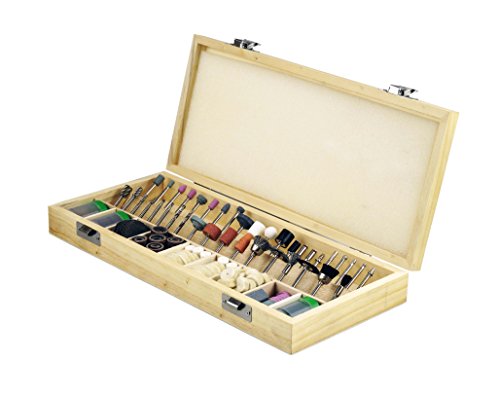
The SE set is the budget general kit, and its argument is range with old-fashioned storage: 228 pieces from Sona Enterprises in a latched wooden case, the only wood case in this group. The contents cover the full family list. Cutting runs to 46 wheels, ten fiberglass and 36 silicon cut-off wheels. Grinding is the deepest stone shelf here: nine pink aluminum oxide stones, four green aluminum oxide stones and eight silicon oxide stones, with a dressing stone to maintain them. Sanding is 20 bands on two rubber mandrels and 60 discs. Polishing is 40 soft wool wheels, five hard wool points, three rubber polishing wheels and a pot of polishing paste. The detail shelf holds five diamond burrs and eight HSS burrs and drills, and cleaning is covered by three stainless steel and three nylon brushes. Every family a first rotary kit needs, in a case that will outlast the plastic bins elsewhere in this guide. The documentation is thinner than the Dremel kits’: the listing publishes a model number, a UPC, weight and case dimensions, but no warranty term, and the crawl behind this pick is some months old, so confirming the seller, contents and offer on the listing itself matters here, as the checks section sets out. Buyers who want the full range at the budget tier and a case worth keeping have found their pick.
The Oruiiju set is the specialist single-purpose pick: 41 pieces that do one job, cutting hard material, bought alone by readers whose rotary work is tile, glass, stone and ceramic and who already own a general kit. The box is 25 diamond cutting discs, 22 mm across and 0.7 mm thick, for the hard and brittle materials that chip abrasive wheels; ten resin cut-off wheels, 24 mm across, for lighter cutting; five mandrels with 3 mm shanks; and a small screwdriver for the mandrel screws. The listing publishes a maximum speed of 35,000 RPM for the set, and the discs’ thin kerf is the point of the format: a 0.7 mm diamond edge parts glazed tile and glass with a narrower cut and less chipping than a general kit’s reinforced wheel. Two cautions belong with this pick. The mandrel shank is 3 mm rather than the 1/8 inch standard of the other four kits, so the buying guide’s fit check, a slow test spin for wobble, applies every time a disc is mounted. And the listing’s summary area shows no featured offer available in the crawl behind it, so confirm the live offer before ordering, as the checks section sets out. Within those cautions it is the cutting shelf the general kits gesture at, bought on its own.
Specs
Model: Not stated in the data reviewed
Tier: Budget
Format: 41-piece specialist cutting set
Contents: 25 diamond cutting discs, 22 mm diameter and 0.7 mm thick; 10 resin cut-off wheels, 24 mm diameter; 5 mandrels; 1 screwdriver per the listing
Shank: 3 mm mandrels per the listing
Maximum speed: 35,000 RPM per the listing
Seller: Sold by the maker’s marketplace storefront and shipped from the marketplace fulfillment network per the listing crawl
Weight: Not stated in the data reviewed
Warranty: Not stated in the data reviewed
Which Accessory Kit Fits Your Work
For a first kit behind a new rotary tool, covering cutting, sanding, grinding, polishing and light carving in one case, the Dremel 710-08 is the default: the fullest published contents in the group, the maker’s quick-change hardware included, and trays that keep the small pieces findable. For bench work that is mostly cutting and sanding, with accessory changes every few minutes, the EZ725 earns its place on EZ Lock wheels and EZ Drum bands that swap without tools, accepting its narrower range. For a high-throughput hobby bench that burns sanding paper and bands by the session, the EZUVITA 618PCS is the resupply answer, a complete family range in front of the deepest consumables stock here. For a first kit bought on a budget, the SE 228-piece set covers every family in a wooden case, bought with its thinner documentation in view. For a bench that already owns a general kit and cuts tile, glass or stone regularly, the Oruiiju set is the add-on, the diamond cutting shelf the general kits stock only thinly. Two honest boundaries close the section. None of the five includes the rotary tool itself, and none turns one into a die grinder or angle grinder: heavy stock removal and deep masonry cutting are larger tools’ work. None includes a flex shaft or routing attachment either, so guided routing budgets separately whichever pick is chosen.
Checks and Safety Notes
Three checks belong with any of the five. First, the recall check: no accessory kit in this guide, and no rotary tool accessory kit from any of these sellers, appears in the CPSC recall database. The nearest actions are two, and both are different products whose lessons apply directly. The host-tool lesson: Robert Bosch Tool recalled the Dremel MICRO Model 8050 rotary tool, in a joint action with the CPSC and Health Canada covering tools with date codes 407 through 505 sold from July 2014 to May 2015, because the circuit board could overheat and melt the enclosure and some tools could lose speed control, change to high speed in use, turn on by themselves or fail to turn off. That recall covers a tool, not an accessory, and no kit here is affected; it belongs here because a kit is only as safe as the tool spinning it, and a bench holding an 8050 in that date range should retire the tool itself. The wheel lesson: in November 2004 the CPSC and Robert Bosch Tool recalled Type 1 abrasive cut-off wheels sold from September 2003 to August 2004 because their speed rating labels were incorrect, and a wheel run at a wrongly labeled speed can burst. Those were industrial wheels for stationary machines, not rotary tool accessories, and no wheel here is affected; the lesson is the buying guide’s, that a wheel’s printed rating governs and an unmarked wheel is run slow or not at all. A two-minute search of the exact model at saferproducts.gov remains the cheapest confirmation before ordering. Second, the offer check: the listing data behind the EZUVITA kit and the SE set comes from crawls some months old, and data of that age does not by itself establish whether a live offer stands, so confirm the seller, the model and the offer on the listing ordered; the Oruiiju summary showed no featured offer available, a further reason to check that listing live, while both Dremel kits rest on maker manual data crawled on the day of this check. Third, the setup check: eye protection is not optional, since a bursting cut-off wheel throws fragments at tool speed; inspect each wheel for chips and cracks before chucking, seat the shank fully, run a newly mounted wheel briefly pointed away from the body, never apply side pressure to a cut-off wheel, and match tool speed to the accessory, lowering it for plastics that melt. Grinding masonry, tile and stone also produces fine dust, so ventilation or a fitted dust mask belongs with the diamond work in particular.
Frequently Asked Questions
Will these accessories fit a rotary tool that is not a Dremel?
In almost every case, yes, and the shank is the reason. Four of the five kits here are built on the 1/8 inch shank, which is the rotary tool industry’s standard fit, gripped by the standard collet in Dremel corded and cordless tools and in the collets of most other makers’ rotary tools, including the universal-fitment claim the EZUVITA listing makes for its own set. The exception to check is the Oruiiju cutting set, whose mandrels carry a 3 mm shank, slightly under 1/8 inch; most collets close down on it, but the fit wants a slow test spin to confirm the disc runs true before work. The other fit question is quick-change hardware: EZ Lock wheels mount only on an EZ Lock mandrel, included in both Dremel kits. Check the host tool’s collet before ordering, since a minority of compact tools ship with only a 3/32 inch collet fitted.
Why do the piece counts differ so much between kits?
Because piece count in this category counts consumables, and consumables dominate every box. The EZUVITA kit’s 618 pieces include 386 sanding papers; the Dremel 710-08’s 160 include 120 sanding discs and bands; the SE set’s 228 include 60 sanding discs and 40 wool polishing wheels. Sanding paper, bands and cut-off wheels are spent in use, so a large count mostly promises a longer interval before reordering, not a wider capability. Capability is the count of distinct accessory families present: cutting, grinding, sanding, polishing, cleaning, drilling, carving and the mandrels that mount them. On that measure the kits in this guide are closer than their headlines suggest, and the real differences are which families each kit leaves out: the EZ725 has no grinding stones or drill bits, and the Oruiiju set has nothing but cutting. Read the contents list, not the number on the lid.
What speed should a cut-off wheel be run at?
At or below the lower of two numbers: the wheel’s own printed maximum speed and the speed appropriate to the material. A wheel run above its rating can burst, which is why the 2004 recall covered in the checks section, wheels sold with incorrect speed labels, was a burst hazard, not a paperwork error. The Oruiiju set publishes the clearest figure here, a maximum of 35,000 RPM; an unmarked bulk wheel should be run at the tool’s lower settings or set aside. Material pulls the choice the other way: plastics melt and smear at high speed, thin metals cut cleanly at moderate speed with light pressure, and diamond discs in tile and glass want steady speed and no side load. Set the speed before the wheel touches the work, let the tool reach it, and never lean on a cut-off wheel to make it cut faster.
When should a grinding stone or a cut-off wheel be replaced?
A cut-off wheel is replaced on size and on damage: as it cuts it shrinks, and when its diameter no longer reaches the work with the mandrel clear, it is spent; any chip at the edge, crack at the center hole or wobble on the mandrel retires it immediately, whatever its size. A grinding stone is maintained before it is replaced: stones load with material and glaze over, and the dressing stone included in the EZUVITA and SE kits cleans and reshapes the face, restoring the cut. A stone is replaced when it has dressed down to an unusable shape, when it cracks, or when it runs out of true on its shank. Sanding bands and discs are spent when the grit feels smooth to a fingertip, and felt wheels when they harden with dried compound. In every family the rule is the same: wear is a schedule, damage is a stop.
Conclusion
The five picks divide first by format and only then by tier, because a rotary accessory kit is bought as a set of families before it is bought as a piece count. The Dremel 710-08 is the considered default, a 160-piece maker’s kit with the fullest published contents and its own quick-change hardware in the case. The Dremel EZ725 is the quick-change specialist, narrower and faster to work from, and the EZUVITA 618PCS covers the full range with the deepest consumables stock at the same tier. The SE 228-piece set is the budget general kit in a wooden case with the deepest stone shelf here, and the Oruiiju 41-piece set is the diamond cutting shelf that a general kit’s owner adds when tile, glass and stone become regular work. Match the shank to the collet, the abrasive family to the material, and the wheel’s printed speed rating to the tool’s setting, and confirm the offer on the listing before ordering.
M
Miller the Driller Editorial Team
We compare specs, warranty terms, long-term owner feedback and street pricing before anything earns a spot. Rankings are never paid.
Affiliate disclosure. As an Amazon Associate we earn from qualifying purchases at no extra cost to you. Prices accurate as of the date shown.
Three wireless routers for small offices compared on device capacity, network separation, wired speed, and coverage, with specs taken from their Amazon listings.
Compare 5 mechanic tool sets for car repairs: a 247-piece DEWALT kit, a 450-piece CRAFTSMAN set, a drawer-box GEARWRENCH set, a 170-piece Crescent set and a 450-piece WORKPRO set.
Four splitting axes and mauls that actually split firewood: a long 36-inch axe for tall users, a shorter 28-inch option, and two 8 lb mauls for knotty rounds.
Learn whether a 20V rechargeable drill battery can be repaired, which faults you can check safely at home, and when replacing the pack is the safer choice.
A specs-based review of the officially licensed Retro-Bit Sega Saturn 2.4 GHz wireless controller: dual receivers, Genesis Mini and Switch support, battery, layout, limits, and FAQs.
Find the best drill battery for Power Wheels ride-on toys for families, with DeWalt, Milwaukee and Ryobi adapters, voltage and safety guidance in this guide.
Find the best hole saw for noching dom pipe: bi-metal saws, deep cups, and the right sizes for clean, tight notches in DOM tube for fabrication shops today.
Find the best diy tile saws for home tiling projects. Compare wet tile saws by blade size, cutting capacity, and features for ceramic and porcelain tile.