We research everything we recommend. When you buy through our links, we may earn a commission. As an Amazon Associate we earn from qualifying purchases.
Best RPM for Concrete Saws
Best rpm for concrete saws explained: compare listed no-load speeds, wheel sizes, and blade-speed matching across three verified Amazon US picks.
DEWALT DCS692X2 60V MAX 9-in Cordless Cut-Off Saw Kit
Best for: Contractors and masons who score joints, cut pavers, and trim block on sites where cords and exhaust are a problem. Skip if: You need single-pass cuts through 4-inch or thicker slabs, or you work far from a charger for full days.
Best for: Cutting slabs, block walls, and pavers to full depth from a powered site, especially long straight cuts where the skid plate earns its keep. Skip if: You need cordless freedom, or your work is short scoring cuts where a lighter saw would be quicker.
SKILSAW SPT79A-10 7-in MEDUSAW Walk Behind Worm Drive
Best for: Scoring control joints, cutting shallow grooves, and trimming pavers and block while standing, especially on long runs where a walk-behind saw saves the operator’s back. Skip if: You need to cut through a slab, or you want a saw you can carry in one hand.
As an Amazon Associate I earn from qualifying purchases. This post may contain affiliate links at no extra cost to you.
There is no single best rpm for concrete saws, because the right speed depends on the size of the wheel the saw spins. A 9-inch wheel and a 14-inch wheel do different work at the same revolutions per minute, and every maker publishes a spindle speed for its own machine. The question that matters is not how fast a saw spins in isolation, but whether the speed it is built to run matches the wheel mounted on it. This guide compares three concrete saws sold on Amazon US, each with a different listed no-load speed and a different wheel size, so you can see how speed, wheel diameter, and cutting depth fit together before you buy. Picks are based on manufacturer specifications and Amazon listing details.
OUR TOP PICK
DEWALT DCS692X2 60V MAX 9-in Cordless Cut-Off Saw Kit
Disclosure: As an Amazon Associate, we earn from qualifying purchases. Product details and availability can change; check the Amazon listing before you buy.
DEWALT DCS692X2 60V MAX 9-in Cordless Cut-Off Saw Kit
B0BLY9CCLF
Cordless scoring and shallow cuts on site
Evolution R300DCT 12-in Concrete Saw
B08NXH7K7Q
Deep single-pass cuts from a corded electric saw
SKILSAW SPT79A-10 7-in MEDUSAW Walk Behind Worm Drive
B07BMS66F8
Precise scoring and control joints while standing
What matters most for concrete saw speed
Spindle speed is not engine speed. On a gas power cutter the engine may turn at 9,000 rpm or more while the blade shaft turns far slower, because a belt and pulley step the speed down. On a cordless or corded electric saw the listed no-load speed is the speed of the wheel itself. When you compare saws, compare the spindle or no-load speed figures the maker publishes for the wheel, not the engine figure, because the wheel figure is the one that has to match the blade.
Wheel diameter sets the speed band. A larger wheel covers more ground at its rim for every revolution, so makers run larger wheels slower. That is why a 7-inch scoring saw can list 5,100 rpm while a 12-inch disc cutter lists 4,400 rpm, and both are correct for their own wheels. A higher rpm number on its own does not mean a faster or better cut; it means the saw is built around a smaller wheel.
Match the wheel to the saw, every time. Every diamond or abrasive wheel carries a maximum operating speed stamped on the wheel itself. That figure must be at or above the spindle speed of the saw it mounts on. A wheel rated below the saw speed is a mismatch that should never be run. Check the number on the wheel before the first cut, and check it again whenever you change wheel brands or sizes.
Cutting depth follows wheel size. Depth is set by how much of the wheel can reach below the foot or guard. A 9-inch wheel reaches about 3-1/4 inches, a 12-inch wheel reaches about 4-1/2 inches, and a 7-inch wheel reaches about 2 inches. If your work is mostly scoring joints and cutting pavers, depth matters less than control. If you need to cut through a slab in one pass, depth decides the saw before speed does.
Power source shapes the workday. A cordless saw starts instantly, runs without exhaust, and suits indoor scoring and short cuts, but every cut draws down a battery. A corded electric saw holds full speed as long as it has power, which suits long straight cuts. A gas saw goes anywhere and cuts deepest, but it needs fuel, produces exhaust, and is louder. Speed figures do not change these trade-offs; they only tell you how fast the wheel turns once the saw is running.
Dust and water handling are part of the speed picture. Cutting concrete dry at full speed throws up fine dust, and every saw in this guide has some form of dust handling, from a water feed to a vacuum port. Wet cutting keeps the wheel cooler and the air clearer, and it is the standard approach for long cuts. Plan the water supply or the vacuum hookup before you plan the cut.
DEWALT DCS692X2 60V MAX 9-in Cordless Cut-Off Saw Kit
Top Pick
DEWALT DCS692X2 60V MAX 9-in Cordless Cut-Off Saw Kit
Best for: Contractors and masons who score joints, cut pavers, and trim block on sites where cords and exhaust are a problem. Skip if: You need single-pass cuts through 4-inch or thicker slabs, or you work far from a charger for full days.
Contractors and masons who score joints, cut pavers, and trim block on sites where cords and exhaust are a problem. Skip if: You need single-pass cuts through 4-inch or thicker slabs, or you work far from a charger for full days.
The DEWALT DCS692X2 is the fastest-spinning saw in this guide, and the reason is its wheel: at 9 inches, the wheel is the smallest of the three, and DEWALT lists a no-load speed of 6,600 rpm for it. This is the current-generation replacement for the earlier DCS690 kit, with a larger battery box that accepts the higher-capacity FLEXVOLT packs. It is a cordless saw built for scoring, cutting pavers, slicing rebar, and making shallow cuts in concrete where a gas saw would be awkward or unwelcome.
Why it fits: The 6,600 rpm figure is the highest no-load speed here, and it pairs with the smallest wheel, which is exactly the pattern this guide is about. The high wheel speed keeps a 9-inch diamond wheel cutting aggressively through pavers and block, while the cordless platform means the saw is ready the moment the battery clicks in, with no fuel mixing and no cord to manage. The dual-sided water feed and the heavy-load indicator light are practical touches for concrete work, and the latched, sealed battery box keeps dust and water away from the pack terminals.
Trade-offs: A 9-inch wheel cuts only 3-1/4 inches deep, so a standard 4-inch slab needs a second pass from the other side or a different saw. Runtime is bounded by the two included 9.0Ah packs, so a long day of scoring needs a charging plan. The saw is also the lightest here at 11.29 lb for the tool alone, which is easy on the arms but means the operator supplies more of the down pressure than a heavier saw would.
Evolution R300DCT 12-in Concrete Saw
Runner-Up
Evolution R300DCT 12-in Concrete Saw
Best for: Cutting slabs, block walls, and pavers to full depth from a powered site, especially long straight cuts where the skid plate earns its keep. Skip if: You need cordless freedom, or your work is short scoring cuts where a lighter saw would be quicker.
Cutting slabs, block walls, and pavers to full depth from a powered site, especially long straight cuts where the skid plate earns its keep. Skip if: You need cordless freedom, or your work is short scoring cuts where a lighter saw would be quicker.
The Evolution R300DCT is the deep-cutting pick in this guide, and its speed figure tells the story of its wheel. The US 120V model lists a no-load speed of 4,400 rpm for its 12-inch wheel, a lower figure than the smaller saws, because a 12-inch wheel does not need to spin as fast to cut. The saw runs on a 15-amp corded motor, comes with a premium diamond masonry blade, and rides on a wheeled skid plate that keeps long straight cuts steady at ground level.
Why it fits: The 4,400 rpm figure is the honest number for a 12-inch wheel on a US 120-volt supply, and it is the figure to use when checking blade compatibility for this saw. The depth is the best in this guide at 4-1/2 inches, which covers a standard slab in a single pass. The wheeled skid plate is a real advantage for long cuts: it carries the saw along the line and keeps the blade from digging in, while the soft start and electric brake make the saw easier to manage at the start and end of each cut.
Trade-offs: The 20-minute maximum duty cycle stated by the maker means this saw is built for cutting in runs with cool-down breaks, not for continuous all-day ripping. It needs a cord and a suitable circuit, so it is not the saw for a site with no power. The lower rpm figure can look slow next to the cordless pick, but it is the correct speed for a 12-inch wheel, and comparing the two numbers directly would be comparing two different wheel sizes.
SKILSAW SPT79A-10 7-in MEDUSAW Walk Behind Worm Drive
SKILSAW SPT79A-10 7-in MEDUSAW Walk Behind Worm Drive
Best for: Scoring control joints, cutting shallow grooves, and trimming pavers and block while standing, especially on long runs where a walk-behind saw saves the operator’s back. Skip if: You need to cut through a slab, or you want a saw you can carry in one hand.
Scoring control joints, cutting shallow grooves, and trimming pavers and block while standing, especially on long runs where a walk-behind saw saves the operator’s back. Skip if: You need to cut through a slab, or you want a saw you can carry in one hand.
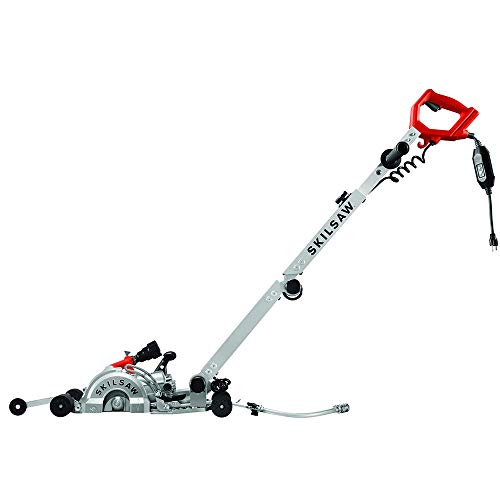
The SKILSAW SPT79A-10 is the specialist in this guide: a walk-behind worm-drive saw built for scoring concrete while standing upright. Its 15-amp Dual-Field motor lists a no-load speed of 5,100 rpm for its 7-inch wheel, the middle speed figure of the three picks and the smallest wheel. The adjustable handle extends to a comfortable height and folds for transport, and the saw is designed to be pushed along a chalk line rather than carried through a cut.
Why it fits: The 5,100 rpm figure suits a 7-inch wheel, and the worm-drive gearing delivers steady torque at that speed for scoring work. The walk-behind format is the point of this saw: for control joints and long scoring runs, pushing a saw on its wheels beats carrying one, and the adjustable handle and pivoting pointer help hold a straight line. The built-in GFCI protection matters here, because this saw is often run wet, and the wet/dry dust system lets the operator choose water or a vacuum depending on the site.
Trade-offs: Two inches of depth is the shallowest cut in this guide, so this saw scores and trims rather than cutting through slabs. At 31.7 lb it is the heaviest pick, though the weight rides on its wheels during a cut. The blade is not included, so a 7-inch diamond wheel with a 7/8-inch arbor must be bought separately, and its maximum operating speed must be checked against the 5,100 rpm figure before use.
How to choose between these picks
Start with the depth your work needs, then check the speed. If your cuts are 4 inches or deeper, the Evolution R300DCT is the only pick here that reaches that depth in one pass, and its 4,400 rpm figure is the speed to match blades against. If your work is scoring, trimming, and cutting pavers, depth stops deciding and the choice turns on power source: the DEWALT cordless kit at 6,600 rpm suits sites with no power and short, scattered cuts, while the SKILSAW walk-behind at 5,100 rpm suits long scoring runs where pushing beats carrying.
Next, confirm the blade. For whichever saw you choose, read the maximum operating speed stamped on the wheel and confirm it is at or above the saw’s listed spindle speed: 6,600 rpm for the DEWALT, 4,400 rpm for the Evolution on US voltage, and 5,100 rpm for the SKILSAW. A wheel rated below the saw speed does not belong on that saw, whatever the wheel diameter. Also confirm the arbor size, 7/8 inch on all three picks, and the wheel diameter the saw is built for.
Finally, weigh the workday. The cordless saw needs charged packs and a charging plan. The corded saws need power and, for the Evolution, respect for its stated 20-minute duty cycle. The walk-behind saw needs a 7-inch wheel bought separately. None of these is a flaw; each is the cost of what the saw does well.
Setup and care
Before the first cut, fit the wheel and check three things: the wheel diameter matches the saw, the arbor size matches, and the maximum operating speed stamped on the wheel is at or above the saw’s listed speed. Spin the wheel by hand with the saw unplugged or the battery removed and confirm it runs true without wobble. Set the guard, connect the water feed or vacuum, and mark the cut line before starting the saw.
During cutting, let the wheel speed do the work. Forcing a saw through concrete loads the motor, heats the wheel, and slows the cut. Keep the water flowing on wet cuts so the wheel stays cool and the dust stays down, and keep the cord or the battery box clear of the cut line. On the corded saws, check the GFCI or the power connection before each session, and on the cordless saw, swap packs before the saw slows noticeably.
After cutting, clean the saw while the slurry is still wet. Rinse the guard and the wheel, clear the water ports, and wipe down the handles and vents. Store wheels flat, dry, and away from knocks, and inspect each wheel for chips or cracks before the next use. A damaged wheel is retired, not repaired. Keep the blade guard in place during storage, and keep the saw itself dry and out of standing water.
Frequently asked questions
What rpm should a concrete saw run at?
It depends on the wheel size. The saws in this guide list 6,600 rpm for a 9-inch wheel, 5,100 rpm for a 7-inch wheel, and 4,400 rpm for a 12-inch wheel on US voltage. There is no one figure for all concrete saws; the correct speed is the one the maker lists for the wheel size the saw is built around.
Does a higher rpm mean a concrete saw cuts faster?
Not on its own. A higher rpm on a smaller wheel can give similar rim speed to a lower rpm on a larger wheel, and the cut depends on the wheel, the material, and the pressure applied. Compare rpm figures only between saws built for the same wheel size, and compare depth and power source as well.
How do I match a blade to my saw’s rpm?
Read the maximum operating speed stamped on the blade and confirm it is at or above the spindle speed listed for your saw. For the saws here, that means 6,600 rpm for the DEWALT, 4,400 rpm for the Evolution on US voltage, and 5,100 rpm for the SKILSAW. Also confirm the wheel diameter and the 7/8-inch arbor size.
Why is the Evolution R300DCT listed at different speeds in different places?
The maker publishes different rated speeds for different voltages: the US 120-volt model is listed at 4,400 rpm, while the UK 240-volt version is listed at 5,090 rpm. Use the figure for the voltage your saw runs on, and check the number on your own saw and wheel rather than relying on a listing from another market.
Can I use a 14-inch gas saw blade on one of these electric saws?
No. These three saws are built for 9-inch, 12-inch, and 7-inch wheels, and a wheel of the wrong diameter will not fit the guard or the arbor setup. Use only the wheel size the maker lists for your saw, and check the speed figure on the wheel against the saw’s listed speed.
Conclusion
The best rpm for a concrete saw is the speed its maker lists for its wheel size, and the three picks here show the range clearly. Choose the DEWALT DCS692X2 if you want cordless freedom and the highest listed speed at 6,600 rpm for scoring and shallow cuts. Choose the Evolution R300DCT if you need the deepest cut at 4-1/2 inches and accept its lower 4,400 rpm figure as the correct speed for a 12-inch wheel. Choose the SKILSAW SPT79A-10 if your work is mostly scoring and control joints, where its walk-behind format and 5,100 rpm worm-drive setup are built for long, straight runs. Whichever saw you choose, confirm the wheel’s maximum operating speed against the saw’s listed speed before the first cut, and let depth, power source, and the job itself make the final call.
M
Miller the Driller Editorial Team
We compare specs, warranty terms, long-term owner feedback and street pricing before anything earns a spot. Rankings are never paid.
Affiliate disclosure. As an Amazon Associate we earn from qualifying purchases at no extra cost to you. Prices accurate as of the date shown.
Find the best golf headcovers for woods, driver, fairway wood, and hybrid clubs. Compare knit, nylon, and leather sets that protect clubheads and fit modern woods.
Compare the best Porter-Cable routers for woodworking, from the compact 450 to the 691 D-handle router and the 693LRPK two-base kit, by motor and base.
Compare the best wood spoon sets in teak and sheesham, from 7-piece and 10-piece cooking sets with spatulas and ladles for nonstick pans and daily use.
Compare four tool box sets, from a stackable three-piece tower to steel boxes on wheels, with drawer, latch and capacity checks for home and site work.
Current Windows laptops for photographers chosen by colour-accurate screens, RAM, SSD storage and card readers, with a clear note on Windows 7 support.
Compare four insect repellent sprays for beach days, from picaridin and DEET aerosols to a plant-based pump, with sizes, coverage times and beach-bag fit.