What's inside
- Best Screwdriver Sets for Computers and Electronics
- Quick picks by situation
- What matters more than the bit count
- Comparison: what a practical kit should cover
- Choose by your workbench and repair habits
- Case layout and handling can prevent mistakes
- Ownership: what wears out and how to avoid it
- Bottom line
- Related Guides
- Best Screwdriver Sets for Computers and Electronics
- Quick picks by situation
- What matters more than the bit count
- Comparison: what a practical kit should cover
- Choose by your workbench and repair habits
- Case layout and handling can prevent mistakes
- Ownership: what wears out and how to avoid it
- Bottom line
- Related Guides
As an Amazon Associate I earn from qualifying purchases. This post may contain affiliate links at no extra cost to you.
What we cover
- Best Screwdriver Sets for Computers and Electronics
- Quick picks by situation
- What matters more than the bit count
- Comparison: what a practical kit should cover
- Choose by your workbench and repair habits
- Case layout and handling can prevent mistakes
- Ownership: what wears out and how to avoid it
- Bottom line
- Related Guides
Best Screwdriver Sets for Computers and Electronics
For most computer maintenance, the best screwdriver set for computers is a precision kit with a sturdy 4 mm bit holder, common Phillips and Torx sizes, a long reach, and a case that keeps tiny bits easy to identify; choose an ESD-safe set if you regularly handle exposed circuit boards.
Quick picks by situation
- Best all-round choice: A 4 mm precision kit with at least 30 bits, including Phillips PH000–PH1 and Torx T2–T8. This covers most laptops, desktops, controllers, and small peripherals.
- Best for occasional repairs: A compact 10–20-bit kit focused on PH00, PH0, PH1, and Torx T5–T8. Fewer bits mean less clutter if you mainly open PCs for upgrades.
- Best for frequent bench work: A larger kit with a separate handle, extension, flexible shaft, and clearly indexed storage. It saves time when working across multiple device types.
- Best for exposed electronics: An ESD-safe kit or screwdriver with a documented dissipative design, used alongside proper grounding and handling practices. A magnetic bit alone is not ESD protection.
What matters more than the bit count
Computer screws are small, and the wrong bit can cam out, damage the head, or slip into nearby components. Match the bit to the screw before applying force: a correctly sized Phillips bit should seat fully with minimal wobble, while a Torx bit should engage all its lobes without rocking. A kit with 100 bits is not automatically more useful than one with 30 well-chosen sizes.
As an Amazon Associate we earn from qualifying purchases at no extra cost to you.


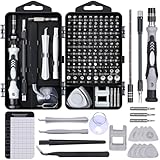

Prioritize useful sizes and a secure fit
For PC cases and many desktop components, PH1 and PH2 are common; laptops and compact electronics more often call for PH00, PH0, or smaller. Torx T5 and T6 appear in some laptops and peripherals, while T8 is useful for certain enclosures. Exact fasteners vary by model, so check the service manual or inspect the screw before buying a kit.
Some devices use security fasteners, such as Torx TR screws with a pin in the center. A standard Torx bit will not fit those. If you service varied equipment, look for the specific security bits you need rather than assuming every “precision” set includes them.
Magnetism: helpful, but not a substitute for care
A lightly magnetized tip helps hold a screw when placing it in a narrow laptop chassis or retrieving it from a case. It can also make screws easier to manage over a tray. For ordinary computer repair, this is generally a practical convenience; avoid letting the driver drag across circuit-board components, and follow the device maker’s guidance for sensitive equipment. A demagnetizer can reduce magnetism if a task calls for it.
ESD claims need context
ESD (electrostatic discharge) control is about preventing static buildup and providing a safe path for charge—not simply using a non-magnetic tool. If you often work on bare motherboards, memory, or other exposed boards, pair an ESD-rated tool with a properly grounded work surface or wrist strap. A dissipative handle can be useful, but it does not make an ungrounded bench safe by itself. For occasional upgrades, careful handling and a grounded workspace may matter more than paying extra for an ESD label on the screwdriver.
Comparison: what a practical kit should cover
The figures below describe useful kit specifications, not measurements of individual products. Confirm the exact bits and dimensions in a manufacturer’s listing, since kit contents change between versions.
| Kit type | Useful bit coverage | Typical bit count | Typical weight | Best fit |
|---|---|---|---|---|
| Compact PC kit | Phillips PH00–PH2; Torx T5–T8 | 10–20 | About 100–250 g | Desktop upgrades and occasional laptop access |
| General electronics kit | Phillips PH000–PH1; Torx T2–T10; flat 1.5–4 mm | 30–60 | About 250–600 g | Mixed computer, controller, and small-device repairs |
| Expanded repair kit | Common precision sizes plus security Torx, tri-point, and extension options | 60–100+ | About 400–900 g | Frequent repair work across different brands and device types |
Weight and bit count are only rough ranges: handles, extension rods, and molded cases account for much of the variation. A compact kit is easier to keep near a desktop, while a large kit is worthwhile only if its less-common bits save you from buying separate tools.
Choose by your workbench and repair habits
| Your situation | What to buy | Why |
|---|---|---|
| Low budget; mostly desktop upgrades | Compact kit with PH1, PH2, PH0, and a few Torx sizes | These sizes cover many common case and component screws without paying for rarely used bits. |
| New to repairs; working on laptops too | Mid-size kit with PH000–PH1, T2–T8, and a magnetic handle | More size options reduce the temptation to force a poor-fitting bit. |
| Little storage space | Flat, labeled case with a removable 4 mm driver | A slim layout stays organized in a drawer and is easier to carry than a bulky assortment. |
| Frequent mixed-device work | Expanded kit with an extension and clearly indexed bits | Broader coverage helps when device fasteners vary, and a good layout speeds up size selection. |
| Regular work on exposed boards | ESD-conscious tools plus a grounded work setup | Static control depends on the whole setup, not one screwdriver feature. |
Case layout and handling can prevent mistakes
Look for labeled slots that hold bits securely when the case is opened, with enough spacing to remove them without tipping neighboring bits out. A magnetic bit rail or a small labeled tray helps keep removed screws sorted by location. This matters when a laptop uses several similar-looking screw lengths: returning a long screw to the wrong hole can damage internal parts.
A 4 mm hex bit standard is common in precision kits and makes replacement bits easier to find. A handle with a rotating cap supports controlled fingertip turning; a knurled grip helps when more torque is needed. An extension can reach recessed screws, but use the shortest practical setup for better control. Flexible shafts are useful in awkward spaces, though they can twist under load and are a poor choice for loosening a stubborn fastener.
Ownership: what wears out and how to avoid it
Small driver tips wear or deform first, particularly when used on an undersized screw or turned at an angle. Stop if the bit rocks, slips, or leaves fresh marks in the screw head. Replace the bit rather than trying to compensate with extra pressure. The handle usually lasts longer, but a loose bit holder or cracked case can make a kit frustrating to use.
- Keep bits dry and wipe off dust or oily residue before returning them to the case.
- Use a parts tray for removed screws; do not rely on magnetism to keep a screw safely parked on a board.
- Start screws by hand with light pressure. If the screw resists, back it out and check alignment rather than forcing it.
- Do not use precision drivers as pry bars or high-torque tools. Their small tips can snap or damage fasteners.
- Check that replacement bits match the holder size and profile; a loose-fitting bit can slip even if its label looks right.
Bottom line
For a single kit that handles most computer and electronics maintenance, choose a 30–60-piece precision set with a 4 mm holder, PH000–PH1, Torx T2–T8, a controlled magnetic tip, and a labeled case. Go smaller if you only open desktop PCs, and spend more on broader security-bit coverage or ESD-conscious equipment only when your repair work actually calls for it.