What's inside
- Top 3 Picks
- Quick Comparison
- How We Chose
- 1. Ohio Stoneware High Bristol Pickling and Fermenting Crock, 2 Quart – Best for Small Batches and First-Timers
- 2. HFOXGO Fermentation Crock 3.8 Liter – Best Budget One-Gallon Water-Seal Crock
- 3. Ohio Stoneware Pickling Fermentation Crock, 1 Pint – Best for Single-Serve Batches and Tiny Experiments
- 4. Seeutek Fermentation Crock Jar 1.3 Gallon – Best for Whole Cucumbers and Pickle Season
- 5. Ohio Stoneware 5 Gallon Fermentation & Preservation Crock – Best for Bulk Batches and Big Gardens
- 6. Nuenen 2 Set 1/2 Gallon Fermentation Crocks – Best for Running Two Batches at Once
- 7. HomeBuddy Ivory Fermentation Crock, 1 Gallon – Best Turnkey Kit for Beginners
- 8. 1-Gallon Stoneware Pickling Crock Complete Kit (Gardener’s Supply Company) – Best Overall
- Top 3 Picks
- Quick Comparison
- How We Chose
- 1. Ohio Stoneware High Bristol Pickling and Fermenting Crock, 2 Quart – Best for Small Batches and First-Timers
- 2. HFOXGO Fermentation Crock 3.8 Liter – Best Budget One-Gallon Water-Seal Crock
- 3. Ohio Stoneware Pickling Fermentation Crock, 1 Pint – Best for Single-Serve Batches and Tiny Experiments
- 4. Seeutek Fermentation Crock Jar 1.3 Gallon – Best for Whole Cucumbers and Pickle Season
- 5. Ohio Stoneware 5 Gallon Fermentation & Preservation Crock – Best for Bulk Batches and Big Gardens
- 6. Nuenen 2 Set 1/2 Gallon Fermentation Crocks – Best for Running Two Batches at Once
- 7. HomeBuddy Ivory Fermentation Crock, 1 Gallon – Best Turnkey Kit for Beginners
- 8. 1-Gallon Stoneware Pickling Crock Complete Kit (Gardener’s Supply Company) – Best Overall
As an Amazon Associate I earn from qualifying purchases. This post may contain affiliate links at no extra cost to you.
The best stoneware pickling crock for most home fermenters is the 1-Gallon Stoneware Pickling Crock Complete Kit from Gardener’s Supply Company: one gallon holds roughly 4–5 lb of shredded cabbage, which finishes as about 3–4 quarts of sauerkraut, and the kit arrives with the lid and weighting stones already sorted so there is nothing to improvise on day one. It suits a household that ferments a handful of times a year and wants one vessel that handles kraut, cucumber pickles and kimchi without a steep learning curve. If the entry price is what matters most, the Ohio Stoneware High Bristol 2 Quart crock is the classic low-cost starting point for small batches of about 2 lb. If you ferment by the crate — a garden’s worth of cucumbers or cabbage bought in bulk — the Ohio Stoneware 5 Gallon Fermentation & Preservation Crock is the bulk answer, and it is genuinely heavy to move once full. Everything below compares capacity, glaze, seal design, weights, cleaning requirements and realistic batch sizes so you can match a crock to the amount you actually ferment rather than the amount you imagine you will.
What we cover
- Top 3 Picks
- Quick Comparison
- How We Chose
- 1. Ohio Stoneware High Bristol Pickling and Fermenting Crock, 2 Quart – Best for Small Batches and First-Timers
- 2. HFOXGO Fermentation Crock 3.8 Liter – Best Budget One-Gallon Water-Seal Crock
- 3. Ohio Stoneware Pickling Fermentation Crock, 1 Pint – Best for Single-Serve Batches and Tiny Experiments
- 4. Seeutek Fermentation Crock Jar 1.3 Gallon – Best for Whole Cucumbers and Pickle Season
- 5. Ohio Stoneware 5 Gallon Fermentation & Preservation Crock – Best for Bulk Batches and Big Gardens
- 6. Nuenen 2 Set 1/2 Gallon Fermentation Crocks – Best for Running Two Batches at Once
- 7. HomeBuddy Ivory Fermentation Crock, 1 Gallon – Best Turnkey Kit for Beginners
- 8. 1-Gallon Stoneware Pickling Crock Complete Kit (Gardener’s Supply Company) – Best Overall
Our Top Picks
 Ohio Stoneware High Bristol Pickling and Fermenting Crock2 Quarts6 x 6 x 4 inches3.2 poundsCheck on Amazon
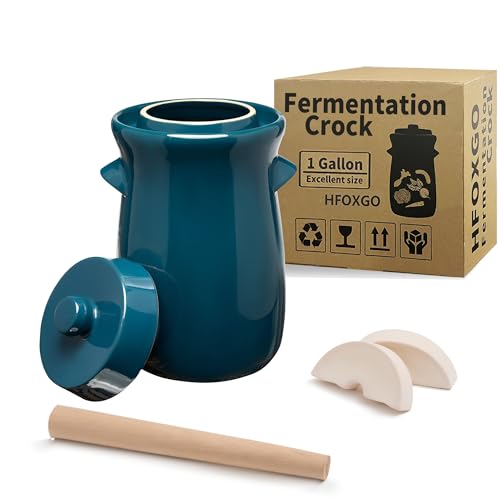 HFOXGO Fermentation Crock 3.8Liter/1 Gallon Stoneware Pot for3.8Liter/1 Gallon7.4 poundsCheck on Amazon
 Seeutek Fermentation Crock Jar 1.3 Gallon for Sauerkraut5L10.63 x 10.63 x 11.82 Inches10.6 poundsCheck on Amazon
 Ohio Stoneware 5 Gallon Fermentation & Preservation Crock5 gallons18.5 x 18.5 x 29.2 InchesCheck on Amazon
 Nuenen 2 Set 1/2 Gallon Fermentation Crock Sauerkraut1/2-gallon15.75 x 12.6 x 7.87 inchesCheck on Amazon

Top 3 Picks
Best overall: 1-Gallon Stoneware Pickling Crock Complete Kit (Gardener’s Supply Company)
One gallon is the size that fits the most households: about 4–5 lb of shredded cabbage per batch, roughly 3–4 quarts of finished kraut, and a footprint no wider than a large mixing bowl. It ships as a complete kit with a lid and weighting stones, so the two things beginners get wrong — keeping vegetables submerged and keeping air out — are handled out of the box. It is the crock to buy if you want one vessel that will still be in use a decade from now.
Best budget: Ohio Stoneware High Bristol Pickling and Fermenting Crock, 2 Quart
American-made stoneware with a lead-free glaze at the lowest entry point here, and two quarts is a genuinely useful size — one head of cabbage, a pound and a half of cucumbers, or a jar of preserved lemons. It has no water moat, so you supply a weight and keep an eye on the brine line, but that is a small amount of attention for a crock that costs a fraction of a water-seal kit.
Best for bulk: Ohio Stoneware 5 Gallon Fermentation & Preservation Crock
Five gallons takes around 25 lb of shredded cabbage at a time and comes with the lid and stones. This is the crock for a large garden, a CSA share you cannot keep up with, or a family that goes through sauerkraut by the quart. Budget for two people to move it when full, and for a permanent spot on a sturdy shelf or floor.
Quick Comparison
Capacities are given in the units the listings use, with the practical batch estimate alongside, because a crock’s nominal volume and the amount of vegetables you can actually ferment in it are not the same number. Shredded cabbage packs at roughly 5 lb per gallon; whole cucumbers and other brined items pack looser because brine fills the gaps.
| Product | Best for | Capacity | Seal design | What is included | Price tier |
|---|---|---|---|---|---|
| Ohio Stoneware High Bristol 2 Quart | Small batches, first crock | 2 qt / 1.9 L — about 2 lb shredded cabbage | Open crock with lid; separate weight required | Crock and lid | Budget |
| HFOXGO Fermentation Crock 3.8 L | Budget one-gallon fermenting | 3.8 L / 1 gal — about 4–5 lb shredded cabbage | Lidded stoneware pot; water-seal style common in this class | Crock, lid, weights (per listing) | Budget |
| Ohio Stoneware 1 Pint Crock | Single-serve tests and tiny batches | 1 pt / 0.47 L — about 1 lb or less | Open crock; cloth cover or small weight | Crock | Budget |
| Seeutek Fermentation Crock Jar 1.3 Gallon | Whole cucumbers and pickle spears | 1.3 gal / 4.9 L — about 6–7 lb of vegetables with brine | Water-seal style lid with weights | Crock, lid, weights | Mid-range |
| Ohio Stoneware 5 Gallon Crock | Bulk kraut and family-scale batches | 5 gal / 18.9 L — about 25 lb shredded cabbage | Open crock with lid and stones | Crock, lid, weighting stones | Premium |
| Nuenen 2 Set 1/2 Gallon Crocks | Two parallel batches at once | 2 × 0.5 gal / 1.9 L each — about 2–2.5 lb per crock | Water-seal style lids with weights | Two crocks, two lids, weights, pounder | Premium |
| HomeBuddy Ivory Fermentation Crock 1 Gallon | Turnkey beginner kit with tools | 1 gal / 3.8 L — about 4–5 lb shredded cabbage | Water-seal style lid with weights | Crock, lid, weights, acacia wood pounder, recipe book | Mid-range |
| Gardener’s Supply 1-Gallon Complete Kit | One crock that does everything well | 1 gal / 3.8 L — about 4–5 lb shredded cabbage | Traditional lidded crock with weighting stones | Crock, lid, weights | Premium |
| Ohio Stoneware 1gal Set | Traditional look at a mid-range price | 1 gal / 3.8 L — about 4–5 lb shredded cabbage | Open crock with lid; set includes weights | Crock, lid, weights (per bundle) | Mid-range |
| LIYYOO Fermentation Crock 2 Liter | Budget half-gallon starter | 2 L / 0.53 gal — about 2–2.5 lb shredded cabbage | Water-seal style lid with weights | Crock, lid, weights, pounder | Budget |
A note on this table: where a listing does not state a detail outright — whether a lid seals with a water moat, whether weights are included, whether the glaze is described as lead-free — the entry describes the product class rather than inventing a figure. Confirm the specific configuration on the listing before buying, because the same brand name can appear on several bundles with different contents.
How We Chose
The selection criteria here are practical rather than promotional. Capacity came first: every crock was mapped to a realistic batch size using the working figure of about 5 lb of shredded cabbage per gallon and a looser pack for brined whole vegetables, because a crock that is too small for your garden is a wasted purchase and one that is too large ferments slowly and awkwardly. Seal design came second — whether a crock uses a water moat, a plain lid with a weight, or both — because seal type drives how much daily attention a ferment needs. Glaze and material came third: food-safe, lead-free glazes on vitrified stoneware are the baseline, and the descriptions below stick to what each listing states rather than assuming. We also weighed what comes in the box, since a missing weight is an extra purchase and a workaround. Handling and cleaning matter more than they sound: a five-gallon crock is a two-person lift when full, and an unglazed exterior rim needs different care from a glazed interior. Finally, each pick was checked against its upgrade path — what you would move to if you outgrow it — so the list works as a ladder rather than ten isolated options. This research draws on manufacturer specifications and published product information; no crock here was tested hands-on.
1. Ohio Stoneware High Bristol Pickling and Fermenting Crock, 2 Quart – Best for Small Batches and First-Timers
As an Amazon Associate we earn from qualifying purchases at no extra cost to you.

Ohio Stoneware has made crocks in Zanesville, Ohio for generations, and the High Bristol line is the version most people meet first: a two-quart stoneware crock with a lead-free glaze and a matching lid. Two quarts is a deliberate size. It holds roughly 2 lb of shredded cabbage — one small-to-medium head — which finishes as about 1½–2 quarts of sauerkraut, and it will take a pound and a half of small cucumbers packed upright. If you ferment for one or two people, or you want to find out whether you enjoy this before giving a gallon of counter space to a crock, this is the sensible first purchase.
It also earns its place as a second crock in a larger kitchen. Two quarts is the right size for experiments that would waste a gallon: a hot sauce mash, a pint of giardiniera, preserved lemons, a small batch of kimchi made with one napa cabbage. Because it has no water moat, there is nothing to top up and nothing to clean out of a channel, which makes it the simplest crock on this list to own.
Key specs
- Capacity: 2 quarts / 1.9 L (8 cups)
- Realistic batch: about 2 lb shredded cabbage, or 1½–2 lb of small cucumbers packed vertically
- Material: American-made stoneware with a lead-free, food-safe glaze
- Seal: open crock with a lid — no water moat, so you supply a weight and keep vegetables below the brine line
- Cleaning: hand wash; the exterior and rim are less glossy than the interior, so skip abrasive pads
- Footprint: roughly the base of a large stockpot; fits under standard upper cabinets
The strengths are simplicity and material quality. Stoneware this thick holds temperature steadily, which means a ferment in a cool kitchen does not swing wildly between day and night, and the weight of the walls keeps the crock from skidding while you pack cabbage with a pounder. The lid is a dust cover rather than a seal, and that is fine — a cabbage leaf or a brine-filled bag under the lid does the real work of excluding air. It is also the least fussy thing to store, since there is no gasket to lose and no channel to dry.
Pros
- Lowest-cost way to start fermenting in genuine stoneware rather than glass or plastic
- Two-quart size makes small experiments affordable in both money and vegetables
- Lead-free glaze and thick walls typical of American-made stoneware
- No water moat to refill or scrub, so upkeep is minimal
- Doubles as a storage crock for utensils, salt, or sourdough tools when not fermenting
Cons
- No weights included, so you must buy or improvise a way to keep vegetables submerged
- Two quarts is limiting during a cucumber glut — you will be running back-to-back batches
- The lid does not create an anaerobic seal on its own
- Stoneware is heavy for its size; a full two-quart crock is a two-hand carry
How it compares
The nearest alternative is the LIYYOO 2 Liter crock, which is almost the same working volume (2 L versus 1.9 L) but includes a lid, weights and a pounder, and uses a water-seal design. If you want a seal and a complete kit at a budget price, the LIYYOO covers more of the job out of the box. If you would rather have the heavier, traditional American stoneware and are happy to use a glass weight or a brine bag, the Ohio Stoneware crock is the more durable object. Compare it next to the Ohio Stoneware 1 Gallon Set and the choice is purely about volume: twice the capacity for a modest step up, at the cost of a larger footprint.
2. HFOXGO Fermentation Crock 3.8 Liter – Best Budget One-Gallon Water-Seal Crock
This is the value play on the one-gallon size: a 3.8 L (1 gallon) stoneware fermenting pot sold for pickling, kimchi, cucumbers and mixed vegetables. One gallon is the most useful single capacity for home fermentation, holding about 4–5 lb of shredded cabbage, and a water-seal lid in this class lets carbon dioxide escape while keeping oxygen out — the practical difference between checking a ferment every day and checking it every few days. It suits someone who wants the one-gallon workflow without paying mid-range or premium prices for it.
The trade-off with any budget crock is consistency of what arrives in the box. Some bundles in this class include one or two weighting stones; others expect you to provide your own. Read the listing carefully for the contents, and if weights are not included, budget for a pair of glass or ceramic weights sized to the mouth diameter. Even with that extra purchase, the total stays in budget territory.
Key specs
- Capacity: 3.8 L / 1 gallon (4 quarts)
- Realistic batch: about 4–5 lb shredded cabbage, or 3–4 lb of cucumbers with brine
- Material: glazed stoneware body; food-safe glaze per listing
- Seal: lidded stoneware pot; water-seal design is common in this size class
- Cleaning: hand wash; if a water moat is present, rinse and dry the channel after every batch
- Weight: light enough for one person to lift and move when empty, unlike a five-gallon crock
Where this crock wins is on volume-per-price. You get the full one-gallon batch size — the point at which fermentation becomes a routine rather than a novelty — for a budget outlay. A one-gallon crock also fits the standard recipe rhythm: 5 lb of cabbage, 2–2½% salt by weight, a weight on top, and a three-to-four-week ferment at typical kitchen temperatures. There is no need to scale recipes or split a cabbage across two vessels.
The realistic caveats are finish and longevity. Budget stoneware can show more variation in glaze coverage, particularly along the rim and the underside, and the interior may have a slightly rougher surface than a premium crock, which makes thorough rinsing more important. None of that affects the fermentation as long as the glaze is intact and food-safe, but inspect the crock on arrival for chips or unglazed patches before the first batch.
Pros
- Full one-gallon capacity at the lowest price point in that size
- Water-seal design reduces oxygen exposure and daily maintenance
- Manageable weight and footprint for a small kitchen
- Good size match for standard 5 lb cabbage recipes
- Low risk as a first water-seal crock if you later upgrade
Cons
- Included accessories vary by bundle — weights may not be part of the deal
- Glaze finish and rim detail are less predictable than premium American stoneware
- Brand support and replacement parts are harder to source than for established crock makers
- Water moats in this class often hold under a cup of water, so they need checking every few days in dry or warm rooms
How it compares
The obvious head-to-head is with the HomeBuddy Ivory 1 Gallon, which is the same capacity at a mid-range price but adds a wood pounder and a recipe book. If you already own a pounder or are happy to use a clean jar or your hands, the HFOXGO gets you to the same fermentation result for less. Against the Seeutek 1.3 Gallon, the choice is volume versus price: the Seeutek takes about 25–30% more vegetables per batch, which matters if you are packing whole cucumbers rather than shredded cabbage.
3. Ohio Stoneware Pickling Fermentation Crock, 1 Pint – Best for Single-Serve Batches and Tiny Experiments

A one-pint crock looks like a novelty until you use one. Sixteen fluid ounces is roughly the volume of a large mug, which means it ferments about a pound of shredded cabbage or a single large cucumber’s worth of pickle spears — enough for one or two servings, and enough to test a recipe before committing a gallon to it. Ohio Stoneware’s pint crock is handmade for food preserving and general kitchen storage, with the same lead-free glaze and heavy stoneware body as the larger crocks in the line.
Who it suits: the cook who wants fermented garnishes rather than bulk kraut. A pint is right for a small batch of pickled onions, a single head of garlic fermented in brine, a few slices of turnip, or a test run of a new spice blend. It is also the least intimidating way to learn the rhythm of fermentation — salting, packing, weighting, waiting — because a failed pint costs almost nothing.
Key specs
- Capacity: 1 pint / 0.47 L (2 cups)
- Realistic batch: about 1 lb shredded cabbage or a handful of small cucumbers
- Material: handmade stoneware, lead-free food-safe glaze
- Seal: open crock — cover with a cloth, a small lid, or a small weight; no water moat
- Cleaning: hand wash; small enough to rinse thoroughly in a sink
- Storage: also works as a utensil crock, salt cellar or garlic keeper between batches
The strength of a pint crock is speed of learning. Because the volume is small, a batch reaches the target acidity quickly, mold problems are visible immediately, and you can taste the ferment daily without spoiling a large batch. It is also the cheapest way to own genuine American stoneware, and it stacks neatly with the larger Ohio Stoneware crocks if you later build out a set.
The limitation is obvious: a pint is a garnish jar, not a pantry strategy. If your household eats sauerkraut weekly, a pint will be empty before the next batch is ready, and running several pint crocks in parallel is more work than one gallon. Keep a pint for testing and for small condiments; do not expect it to replace a full-size crock.
Pros
- Very low cost of entry for real stoneware
- Ideal for recipe testing and small condiment batches
- Fast ferments and easy visual inspection
- Lead-free glaze and handmade construction consistent with the brand
- Useful as general kitchen storage when not fermenting
Cons
- Too small for meaningful sauerkraut or pickle production
- No weights or seal included; you must improvise both
- Wide surface-to-volume ratio makes it more prone to surface yeast if the room is warm
- Easy to over-salt or over-pack given the tiny volume
How it compares
The nearest alternative is the Nuenen 2 Set of 1/2 Gallon Crocks, which gives you two vessels of four times the volume each, plus weights and a pounder, for a premium price. If you want to run parallel experiments, the Nuenen set is the better tool. If you want a single small crock for garnish-scale work at the lowest possible cost, the Ohio Stoneware pint is unmatched. Compared with the High Bristol 2 Quart, the pint is a test bench rather than a production vessel — many owners end up with both.
4. Seeutek Fermentation Crock Jar 1.3 Gallon – Best for Whole Cucumbers and Pickle Season
One and three-tenths gallons — about 4.9 L or 5 quarts — is a size chosen by pickle makers rather than kraut makers. Whole cucumbers are long, and they pack inefficiently: you cannot shred them to fill the gaps, so a crock that holds 5 lb of cabbage may only hold 6–7 lb of cucumbers plus brine. The extra quarter-gallon over a standard one-gallon crock is exactly the difference between fitting a full picking session’s worth of cucumbers upright and having to cut them into spears.
This Seeutek crock is aimed at sauerkraut, pickles and kimchi, with a lid and weights in the kit and a water-seal design typical of mid-range ceramic fermenters. It suits the gardener who harvests cucumbers in waves and wants to ferment them whole, and it also handles a large napa cabbage kimchi batch comfortably because the extra headroom reduces the risk of brine overflowing during the first active days.
Key specs
- Capacity: 1.3 gallons / 4.9 L (about 5 quarts)
- Realistic batch: about 6–7 lb of cucumbers or mixed vegetables with brine; roughly 5–6 lb shredded cabbage
- Material: glazed ceramic stoneware body
- Seal: water-seal lid with weighting stones in the kit
- Cleaning: hand wash; the moat channel needs rinsing and drying after each batch
- Handling: heavier than a one-gallon crock when full, but still a one-person carry when empty
The strength here is pickle geometry. Tall, narrow-ish crocks let you stand cucumbers on end, pack them shoulder to shoulder with a leaf or two on top, and hold them under brine with a single weight — the classic presentation for whole sour pickles. The extra capacity also gives you a margin for the brine that vegetables release, so you are less likely to find overflow on the counter on day three.
The trade-off is that the same extra volume makes the crock a little more awkward to store and to wash, and a water moat adds a maintenance step: check it every two to three days, top it up, and clean it out at the end so nothing grows in the channel. Mid-range crocks in this class generally hold up well for years of seasonal use as long as the glaze is not chipped.
Pros
- Extra capacity over one gallon is genuinely useful for whole cucumbers
- Weights and lid included, so the kit is complete
- Water-seal design keeps oxygen out during long brines
- Handles both kimchi and kraut batches without overflow
- Good middle ground between a starter crock and a bulk vessel
Cons
- Odd size — recipes written for one gallon need small adjustments
- Moat maintenance is an ongoing chore, not a one-time setup
- Heavier and bulkier to store than a one-gallon crock
- Ceramic weights can chip if dropped on a hard floor
How it compares
The nearest alternative is the HFOXGO 3.8 L crock: same job, slightly smaller, budget rather than mid-range. Choose the Seeutek if whole cucumbers are your priority, since the extra 0.3 gallon and the included weights are worth the step up. Against the Gardener’s Supply 1-Gallon Complete Kit, the Seeutek offers more volume while the Gardener’s kit offers a more traditional lidded-crock workflow with weighting stones and no moat to maintain.
5. Ohio Stoneware 5 Gallon Fermentation & Preservation Crock – Best for Bulk Batches and Big Gardens

Five gallons is the traditional farmhouse size, and it is a different category of object from everything else on this list. The crock holds around 25 lb of shredded cabbage — roughly 20–25 quarts of finished sauerkraut — or a serious quantity of brined cucumbers, and it arrives with a lid and weighting stones because nothing else will hold the contents down. It suits a large garden, a CSA share that outpaces the refrigerator, or a household that gives away jars of kraut at the holidays.
Before buying, be honest about two practical constraints: space and weight. A five-gallon crock occupies a permanent footprint on a sturdy shelf or the floor, and once full it is a two-person lift with no good way to move it across a kitchen. Empty, it is already heavy enough that most people will not want to carry it up stairs. Plan where it will live before it arrives, and plan for it to live there all season.
Key specs
- Capacity: 5 gallons / 18.9 L (20 quarts)
- Realistic batch: about 25 lb shredded cabbage, or 20–25 lb of brined cucumbers with brine
- Material: heavy American-made stoneware, lead-free food-safe glaze
- Seal: open crock with a lid plus weighting stones — the traditional plate-and-weight method
- Cleaning: hand wash only; too large for a sink, so use a bathtub or an outdoor hose and a soft brush
- Handling: a two-person lift when full; keep it on the floor or a reinforced shelf
The strength of this crock is thermal mass and tradition. Thick stoneware walls hold temperature so steadily that a five-gallon ferment tends to be more stable than several small ones, and the large volume buffers against temperature swings in a cellar or garage. The open-crock design also makes skimming straightforward: you can see the whole surface, remove scum with a spoon, and replace the weight without disturbing the pack.
The drawbacks are proportional to the size. A five-gallon batch is a lot of commitment — if something goes wrong with salt ratio or temperature, you lose 25 lb of cabbage rather than 5. Cleaning takes real effort because the crock does not fit in a standard sink, and the wide surface area means a large brine surface to monitor for surface yeast in warm weather. For a first crock, this is the wrong starting point.
Pros
- Best capacity-per-batch for anyone fermenting at scale
- Thick stoneware holds temperature steadily through long ferments
- Lid and weighting stones included; nothing extra to buy
- Open design makes skimming and inspecting easy
- Durable American stoneware that should outlast several kitchen remodels
Cons
- Very heavy — a two-person lift when full and awkward when empty
- Requires permanent storage space and a reinforced surface
- Does not fit in a standard kitchen sink for washing
- A failed batch wastes a large quantity of produce
- Slow to fill and slow to finish; not suited to small households
How it compares
The nearest alternative in this list is the Gardener’s Supply 1-Gallon Complete Kit — the same traditional lidded-crock approach scaled down to a fifth of the volume. If you want the classic method but not the commitment, run two or three one-gallon crocks instead; you get more flexibility and easier cleaning at the cost of more vessels to manage. Choose the five-gallon crock only when you consistently have more vegetables than a gallon can take.
6. Nuenen 2 Set 1/2 Gallon Fermentation Crocks – Best for Running Two Batches at Once

Two half-gallon crocks, each with its own lid, weights and a shared pounder, is an unusual configuration and a smart one. Half a gallon holds about 2–2.5 lb of shredded cabbage — roughly 1½ quarts finished — so a pair gives you the output of a single gallon crock while letting you run two different recipes at the same time. That matters if you want to compare salt levels, test a spice blend against a plain batch, or keep a mild kimchi separate from a hot one.
It suits the cook who treats fermentation as a set of experiments rather than a single household staple, and it also suits a two-person household where one person likes sour pickles and the other does not. Because the vessels are small, they are easy to move, easy to wash, and easy to tuck into a cupboard between batches.
Key specs
- Capacity: 2 × 0.5 gallon / 1.9 L each (1 gallon total)
- Realistic batch: about 2–2.5 lb shredded cabbage per crock
- Material: glazed ceramic stoneware with food-safe glaze
- Seal: water-seal style lids with ceramic weights in each crock
- Extras: wooden pounder included for packing vegetables
- Cleaning: two small crocks to wash rather than one large one; both fit in a standard sink
The main advantage is parallel capacity. Running two half-gallon ferments side by side is functionally like running one gallon, but you get independent control over each batch — different brine strengths, different vegetables, different start dates — and you can pull one crock when it is ready without disturbing the other. Small crocks also reach target acidity faster than large ones, so the first batch is edible sooner.
The compromises are surface area and price. Two small crocks have more total surface area than one large one, so there is more brine surface exposed and more chance of surface yeast in a warm kitchen. The set also carries a premium price tier despite the modest total volume, which you are paying for the accessories and the paired configuration rather than for capacity.
Pros
- Two independent ferments running at once with separate seals
- Weights, lids and a pounder included — a complete setup in one purchase
- Small vessels are easy to lift, wash and store
- Fast ferments due to small volume
- Ideal for side-by-side recipe comparisons
Cons
- Premium price for a modest total capacity
- Two moats to maintain and clean instead of one
- More total surface area means more exposure to airborne yeast
- Two crocks take more shelf space than a single gallon vessel
How it compares
The nearest alternative is the HomeBuddy Ivory 1 Gallon, which delivers the same total volume in a single vessel at a lower price tier, with a pounder and recipe book included. Choose the Nuenen set if running parallel batches is the point; choose the HomeBuddy if you want one crock, one clean-up and one place to look. Compared with the LIYYOO 2 Liter, the Nuenen set doubles your volume and your flexibility for a step up in price.
7. HomeBuddy Ivory Fermentation Crock, 1 Gallon – Best Turnkey Kit for Beginners
The HomeBuddy crock is a one-gallon ivory-glazed ceramic fermenter sold as a bundle: crock, lid, weights, an acacia wood pounder and a recipe book. That combination is aimed squarely at the person who has never fermented anything and does not want to assemble a setup piece by piece. The one-gallon capacity is the sweet spot for home batches — about 4–5 lb of shredded cabbage, finishing as 3–4 quarts — and the pounder is not a gimmick: packing cabbage firmly enough to release its own brine is the step beginners most often rush, and a proper pounder makes it easier to do well.
Who it suits: a first-time fermenter who wants everything in one box, and anyone who prefers a lighter, brighter kitchen look. The ivory glaze is a deliberate aesthetic choice compared with the brown and grey of traditional American crocks, and it makes the brine level easy to see against the wall of the vessel.
Key specs
- Capacity: 1 gallon / 3.8 L (4 quarts)
- Realistic batch: about 4–5 lb shredded cabbage, or 3–4 lb of cucumbers with brine
- Material: glazed ceramic stoneware; ivory finish
- Seal: water-seal style lid with weighting stones
- Included extras: acacia wood pounder and a recipe book
- Cleaning: hand wash; keep the wood pounder out of the dishwasher and out of long soaks
The bundle is the real strength. A pounder, a lid and correctly sized weights remove the three most common improvisations — a jar of water, a plastic bag of brine, a plate that does not fit — and the recipe book gives a starting salt ratio rather than leaving you to guess. For a beginner, that structure is worth more than a slightly heavier crock body.
The cons are mostly about materials and price. The wood pounder needs care: wipe it, do not soak it, and oil it occasionally with food-grade mineral oil so it does not crack. The crock sits at a mid-range price, and for the same money a buyer focused purely on durability might prefer American-made stoneware without the extras. The ivory glaze also shows brine stains more than a dark glaze does, though stains are cosmetic and come out with a baking soda paste.
Pros
- Complete kit — crock, lid, weights, pounder and recipes in one purchase
- One-gallon capacity suits standard 5 lb cabbage recipes
- Light-colored glaze makes the brine line easy to monitor
- Wood pounder improves packing and brine release
- Mid-range price for a fully equipped setup
Cons
- Wood pounder requires hand care and occasional oiling
- Ivory glaze shows stains more readily than darker finishes
- Less thermal mass than heavy traditional crocks
- Accessories add cost if you already own a pounder and weights
How it compares
The nearest alternative is the HFOXGO 3.8 L crock — identical capacity, budget price, fewer accessories. If you want the pounder and the recipe book, the HomeBuddy bundle is the more complete purchase; if you already have those tools, the HFOXGO saves money for the same fermentation. Against the Gardener’s Supply 1-Gallon Complete Kit, the HomeBuddy is lighter and comes with a pounder, while the Gardener’s kit leans toward the traditional weighted-crock method.
8. 1-Gallon Stoneware Pickling Crock Complete Kit (Gardener’s Supply Company) – Best Overall

This is the crock to buy if you want one vessel that does everything reasonably well and nothing badly. It is a one-gallon stoneware pickling crock sold as a complete kit with a lid and weighting stones, in the traditional lidded-crock style rather than a water-seal design. One gallon is the capacity that matches most recipes: 5 lb of shredded cabbage, 2–2½% salt by weight, a weight on top, three to four weeks, and you have 3–4 quarts of sauerkraut. The same crock takes a batch of cucumber pickles, a napa cabbage kimchi, or fermented hot peppers.
Who it suits: the household that ferments several times a year and wants a durable, unfussy crock from a supplier known for garden and kitchen equipment. It also suits anyone who dislikes maintaining a water moat — with a weighted lid there is no channel to top up, no evaporation to track, and no moat to scrub. You trade a small amount of convenience in oxygen exclusion for a simpler object with fewer parts.