What's inside
As an Amazon Associate I earn from qualifying purchases. This post may contain affiliate links at no extra cost to you.
What we cover
Start with the fixture, not the anchor
A hollow-drywall anchor is suitable only when the fixture’s weight and mounting design are within the anchor’s rating. First check the fixture instructions and weigh the fixture if its weight is not listed. Include the shade, bulbs, and any parts that will hang from it. Then check whether the fixture’s mounting plate spreads the load across one or more fasteners, and whether it could be pulled or bumped.
Wall anchors are for fixtures designed to mount on a wall. They are not a safe substitute for an electrical box or structural support when the fixture instructions call for one. Ceiling fixtures, chandeliers, heavy sconces, and anything that can swing or be tugged need support attached to framing or a properly installed fixture box. When in doubt, stop and ask an electrician.
As an Amazon Associate we earn from qualifying purchases at no extra cost to you.
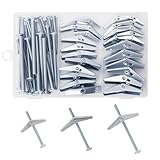


Before drilling, locate studs and check for wiring and plumbing. A stud finder can help, but it does not guarantee a clear drilling path. Switch off the relevant circuit if the work involves electrical parts, and follow the fixture maker’s instructions. Never drill near a likely wire path without a safe way to verify what is behind the wall.
Which anchor type makes sense?
For a light wall-mounted fixture on hollow drywall, a metal self-drilling anchor is often the simplest upgrade over a plastic expansion plug. It installs with a screwdriver or drill and grips the drywall itself. A toggle bolt or strap-style toggle can carry more load in suitable conditions, but it needs a larger hole and enough open space behind the wall. Ratings vary by brand, drywall thickness, and installation, so use the package rating for your exact anchor and leave a generous margin.
| Anchor type | Best use | Trade-off |
|---|---|---|
| Plastic expansion plug | Very light, low-consequence loads in sound drywall | In hollow drywall it can pull loose; generally a poor choice for a fixture |
| Metal self-drilling anchor | Light fixtures with a flat mounting plate and modest load | Fast to install, but can crush or strip drywall if overtightened |
| Hollow-wall toggle | Higher loads where the toggle can open fully behind the wall | Larger hole, more installation steps, and harder to remove cleanly |
| Fastener into a stud | Fixtures with a mounting hole that aligns with framing | Strong option, but the fixture plate may not line up with the stud |
What to buy
For a small, lightweight sconce with a broad mounting plate, a quality metal self-drilling anchor may be enough if its stated working-load rating comfortably exceeds the fixture’s load. For a heavier fixture, or one that sticks out from the wall and can be bumped, use a toggle-style hollow-wall anchor where the manufacturer allows it—or fasten into a stud. The farther a fixture projects, the more leverage it puts on its fasteners; weight alone does not tell the whole story.
Compare ratings carefully. Some packages list a maximum load under ideal conditions rather than a conservative working load. Ratings may assume a particular drywall thickness, installation method, or evenly shared load. Do not add two anchor ratings together as if the load will divide perfectly. If the fixture has two mounting points, uneven contact or a loose screw can make one anchor take most of the force.
For light-duty installations, compare metal self-drilling drywall anchors. If the fixture is heavier or exposed to bumps, look at hollow-wall toggle anchors, checking the required hole size and drywall-thickness range before buying. A cheap plastic plug can be fine for a small picture, but it is a false economy for a fixture that could fall and break or injure someone.
Install without damaging the wall
Read the anchor package before starting. Confirm that the anchor suits your drywall thickness, and use the specified hole size. Mark the fixture holes, then check that the mounting plate sits flat and that the fasteners will not interfere with wiring or the fixture hardware.
For a self-drilling anchor, turn it straight into the drywall with a screwdriver or a drill on low speed. Do not drive it at full speed with an impact driver: the extra torque can spin the anchor, enlarge the hole, or crush the gypsum. Stop when the head is seated flush. If the anchor spins without advancing, the hole is damaged; move to a new location if the fixture allows it rather than trusting the loose anchor.
For a toggle, drill the specified hole, fold or position the toggle as directed, and make sure it opens fully behind the wall. Keep the fixture plate close to the wall as you tighten. A toggle that catches on insulation, lands in a stud cavity obstruction, or fails to open is not installed correctly. Do not force the screw; remove the fastener and reassess.
Use the drill only for the anchor’s pilot hole when the instructions call for one. A hammer drill is not appropriate for ordinary drywall, and an impact driver is usually unnecessary. Tighten fixture screws with a hand screwdriver for the final snug fit. Overtightening can strip the anchor, crush drywall, or bend a thin mounting plate.
Check the result
Before hanging the fixture, inspect the wall for cracking, a crushed surface, or an anchor that sits crooked. The plate should lie flat without rocking. Once installed, apply gentle pressure by hand in the direction the fixture could be pulled; do not use a hard tug as a “test.” Any movement, creaking, or growing gap means the fastening needs attention.
If the anchor loosens, the drywall is soft, or the fixture’s load is near the anchor’s limit, stop using that fastening point. Repair the damaged hole and move to sound drywall, attach to a stud, or install suitable blocking or a fixture box. For a fixture with significant weight or leverage, choosing structural support is safer than trying a larger drywall anchor.