What's inside
As an Amazon Associate I earn from qualifying purchases. This post may contain affiliate links at no extra cost to you.
Small holes in hardwood dowels are easy to spoil. A bit can wander off center, the wood can split near the edge, or a drill with a grabby trigger can turn a careful start into a crooked hole. For this work, control matters more than headline torque. A compact cordless drill with a good low-speed trigger, a small chuck, and a sharp bit is usually a better choice than a large hammer drill or an impact driver.
As an Amazon Associate we earn from qualifying purchases at no extra cost to you.


What we cover
What to look for in a cordless drill
Choose a drill with a 3/8-inch chuck if your bits fit it; it is generally smaller and lighter than a 1/2-inch model, which helps when positioning a hole by hand. A 1/2-inch chuck is useful if you already own larger bits or want one drill for broader jobs, but it is not necessary for holes around 1/16 to 1/4 inch.
Prioritize a smooth variable-speed trigger and a low-speed setting around 0–400 or 0–500 rpm. The low gear gives you more control as the bit enters the wood. A clutch is useful for driving screws, but it does not set drilling depth reliably. For repeatable holes, use a drill stop collar or a simple depth stop instead.
Compact 12-volt drills are often enough for dowels, especially when the holes are small and shallow. A 18- or 20-volt drill makes sense if you also need to drill larger holes or work through long sessions, but the extra size and weight can make accurate hand positioning harder. Battery voltage alone does not tell you how controllable a drill will feel.
Drill types compared
| Drill type | Best fit | Trade-off |
|---|---|---|
| Compact 12V drill | Small holes, light work, close control | Less comfortable for repeated large holes |
| Compact 18V or 20V drill | One drill for dowels and general DIY | Can be heavier and bulkier |
| Hammer drill | Occasional masonry work as well as drilling | Hammer mode is unnecessary for wood; often adds size |
| Impact driver | Driving screws and fasteners | Not a good choice for accurate small holes |
Practical buying options
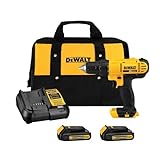
If this is mainly for dowels, look at a compact 12V cordless drill with a 3/8-inch chuck. It is usually the sensible balance of size, control, and cost. A basic drill is fine; a brushless motor or premium battery system is not a requirement for a few small holes.
If you want one tool for furniture assembly, general repairs, and occasional larger drilling, a compact 18V cordless drill is the more flexible buy. Compare the bare-tool weight and grip as well as the listed torque. A lighter drill is easier to hold square to a small dowel.
Skip the impact driver for this task unless it is the only tool available. Its hammering rotational action and abrupt response make it harder to start a tiny bit precisely; it can also snap small bits. A hammer drill should be used with hammer mode switched off in wood.
Bits and setup matter as much as the drill
Use a sharp brad-point bit for clean, accurately located holes in wood. Its center spur helps keep the bit from skating. For very small diameters, a sharp high-speed-steel twist bit also works, but it needs a clear starting mark and a steady hand. Match the bit diameter to the fastener or dowel pin, and check the actual fit on scrap before drilling the finished piece.
Mark the center with a sharp pencil or an awl, then clamp the dowel so it cannot roll. If the hole must be centered on the end grain, a small drill guide or a dowel-center jig is more reliable than judging the angle by eye. A bench vise with soft jaws works well; do not hold a short dowel in your fingers while drilling.
For repeatable depth, wrap tape around the bit as a visual marker or use a stop collar. Tape can shift, so it is a rough guide rather than a precise stop. Drill a few millimeters at a time and withdraw the bit to clear chips, especially in a deeper hole. Packed chips create heat and can make the bit bind.
How to drill without splitting or wandering
Set the drill to low gear and start at a slow, steady speed. Keep the drill aligned with the dowel’s centerline, applying light pressure rather than forcing the bit. Let the cutting edges do the work. Excess pressure can bend a small bit, pull the drill off line, or split a thin section of hardwood.
For a through-hole, place a scrap backer tightly against the exit side. This supports the fibers and reduces breakout as the bit emerges. If the hole is close to the dowel’s edge, use lighter pressure and consider drilling a pilot hole about half the final diameter. Hardwood still splits when there is too little material around a hole; a pilot hole cannot fix a design that leaves a very thin wall.
Common problems have simple clues. A wandering entrance usually means the bit is dull, the surface was not marked securely, or the drill started too fast. Burning suggests a dull bit, too much pressure, or chips trapped in a deep hole. A sudden grab can twist the dowel or your wrist, which is why clamping matters even for a small bit.
When a cheaper drill is fine
For occasional holes under 1/4 inch, an inexpensive cordless drill is adequate if its trigger runs smoothly at low speed and its chuck holds the bit without visible wobble. You do not need a high-torque model to drill a few shallow holes in hardwood. Spend first on sharp bits, a way to clamp the dowel, and a simple drill guide if alignment is critical. Those upgrades often improve the result more than buying a heavier drill.