What's inside
- Top 3 Picks
- Quick Comparison
- How We Chose
- 1. iSpring RCC7AK-BN – Best for Alkaline, Mineral-Balanced RO Water
- 2. DREO Reverse Osmosis Water Filter Countertop – Best Countertop RO Without Installation
- 3. Waterdrop G3P600 Tankless RO – Best for High-Demand Kitchens
- 4. Purewell 3-Stage Gravity Filter – Best No-Power, Off-Grid Filtration
- 5. Ninja HydraSense WF1001WH1 – Best Smart Countertop Convenience
- 6. Bluevua RO100ROPOT – Best Countertop RO with Pot-Style Dispensing
- 7. Waterdrop 10UA Under Sink Water Filter – Best Budget Under-Sink System
- 8. Express Water Whole House Water Filter System – Best for Whole-Home Protection
- 9. Sawyer Products SP128 Mini – Best Portable and Emergency Filtration
- Top 3 Picks
- Quick Comparison
- How We Chose
- 1. iSpring RCC7AK-BN – Best for Alkaline, Mineral-Balanced RO Water
- 2. DREO Reverse Osmosis Water Filter Countertop – Best Countertop RO Without Installation
- 3. Waterdrop G3P600 Tankless RO – Best for High-Demand Kitchens
- 4. Purewell 3-Stage Gravity Filter – Best No-Power, Off-Grid Filtration
- 5. Ninja HydraSense WF1001WH1 – Best Smart Countertop Convenience
- 6. Bluevua RO100ROPOT – Best Countertop RO with Pot-Style Dispensing
- 7. Waterdrop 10UA Under Sink Water Filter – Best Budget Under-Sink System
- 8. Express Water Whole House Water Filter System – Best for Whole-Home Protection
- 9. Sawyer Products SP128 Mini – Best Portable and Emergency Filtration
As an Amazon Associate I earn from qualifying purchases. This post may contain affiliate links at no extra cost to you.
The best water filtration system overall for most households is the iSpring RCC7AK-BN — a 75 GPD, six-stage reverse osmosis system with alkaline remineralization that installs under the sink and removes the widest range of dissolved contaminants at a mid-range price. It suits anyone who wants drinking water that tastes clean and slightly mineral-balanced rather than flat, and who has cabinet space plus a cold-water supply line to tap. If you rent, move often, or simply have no appetite for plumbing, the DREO Countertop RO delivers comparable dissolved-solids removal with zero installation, while the Waterdrop G3P600 is the pick for busy kitchens that want tankless 600 GPD output and a slim under-sink footprint. On a tight budget, the Waterdrop 10UA handles chlorine, taste and odor for about a year per cartridge. For whole-home protection, the Express Water three-stage system treats every tap at once. The rest of this guide breaks down contaminant removal, flow rate, filter life, installation and replacement cost across twelve systems so you can match one to your water, your space and your tolerance for maintenance.
What we cover
- Top 3 Picks
- Quick Comparison
- How We Chose
- 1. iSpring RCC7AK-BN – Best for Alkaline, Mineral-Balanced RO Water
- 2. DREO Reverse Osmosis Water Filter Countertop – Best Countertop RO Without Installation
- 3. Waterdrop G3P600 Tankless RO – Best for High-Demand Kitchens
- 4. Purewell 3-Stage Gravity Filter – Best No-Power, Off-Grid Filtration
- 5. Ninja HydraSense WF1001WH1 – Best Smart Countertop Convenience
- 6. Bluevua RO100ROPOT – Best Countertop RO with Pot-Style Dispensing
- 7. Waterdrop 10UA Under Sink Water Filter – Best Budget Under-Sink System
- 8. Express Water Whole House Water Filter System – Best for Whole-Home Protection
- 9. Sawyer Products SP128 Mini – Best Portable and Emergency Filtration
Our Top Picks
 DREO Reverse Osmosis Water Filter Countertop5L15.67 x 6.73 x 13.35 inches10.78 poundsCheck on Amazon
 Waterdrop G3P600 Tankless Reverse Osmosis Water Filter System600 GPD18.06 x 5.68 x 17.76 inches31 poundsCheck on Amazon
 Purewell 3-Stage 0.01μm Ultra-Filtration Gravity Water Filter SystemLarge8.9 x 8.9 x 20 inches8.5 PoundsCheck on Amazon
 Ninja HydraSense™ Intelligent Water Filtration System14.37 x 5.07 x 13.78 inches6.6 PoundsCheck on Amazon
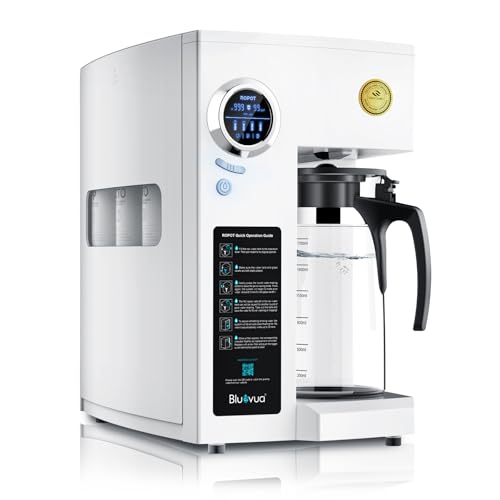 Bluevua RO100ROPOT Countertop Reverse Osmosis Water Filter SystemROPOT-UV10.9 x 15.4 x 14.3 Inches17.8 PoundsCheck on Amazon

Top 3 Picks
Best Overall: iSpring RCC7AK-BN
The six-stage design pairs a standard reverse osmosis train with a remineralization stage, so you get the broad dissolved-solids rejection RO is known for without the flat, slightly acidic taste that turns some people off plain RO water. The 75 GPD rating and included storage tank mean it keeps up with a family’s drinking and cooking needs without running dry mid-glass. It is the most balanced combination of contaminant coverage, capacity and price tier in this list.
Best Budget: Waterdrop 10UA
A single-cartridge under-sink system certified to NSF/ANSI 42, with a cartridge the listing rates for about a year of service. It will not lower your TDS reading and it will not touch dissolved heavy metals, but for the most common municipal complaint — chlorine taste and odor — it does the job at the lowest ownership cost here. Ideal for renters-friendly, low-complexity installs.
Best Premium: Waterdrop G3P600
Tankless, 600 GPD, and slim enough to reclaim the cabinet floor space that a storage tank eats. The higher daily rating matters if you fill large pots, run a refrigerator ice maker, or have several people drawing water at once. It costs more up front and its filter cartridges sit in a higher price bracket, but it removes the two biggest annoyances of traditional RO: slow recovery and bulky tank hardware.
Quick Comparison
| Product | Best for | Key specs | Price tier |
|---|---|---|---|
| iSpring RCC7AK-BN | Mineral-balanced RO for family kitchens | 6-stage RO, 75 GPD, alkaline remineralization, storage tank, brushed nickel faucet | Mid-range |
| DREO Countertop RO | Renters who want RO without plumbing | Countertop RO, 3:1 pure-to-drain, TDS readout, filter-life display | Mid-range |
| Waterdrop G3P600 | High-demand kitchens, no tank | Tankless under-sink RO, 600 GPD, slim cabinet footprint | Premium |
| Purewell 3-Stage Gravity Filter | No-power, off-grid, or emergency filtration | Gravity ultrafiltration, 0.01 μm, NSF/ANSI 42 & 372, 304 stainless housing | Budget |
| Ninja HydraSense WF1001WH1 | Smart countertop convenience | Countertop intelligent filtration, electronic filter monitoring, no plumbing | Premium |
| Bluevua RO100ROPOT | Countertop RO with pot-style dispensing | Countertop RO, no installation, pot/carafe dispensing, plug-in operation | Premium |
| Waterdrop 10UA | Lowest-cost under-sink chlorine removal | Under-sink filtration, NSF/ANSI 42, cartridge rated ~1 year | Budget |
| Express Water Whole House 3-Stage | Treating every tap in the house | 3-stage sediment + carbon, main-line install, whole-home capacity | Premium |
| Sawyer SP128 Mini | Travel, camping, emergency kits | Hollow-fiber 0.1 μm absolute, roughly 2 oz, rated up to 100,000 gallons | Budget |
| Waterdrop TSA | Budget under-sink with deeper media stack | 8-layer under-sink cartridge, NSF/ANSI 42 | Budget |
| APEC ROES-50 | Simple, proven 5-stage RO | 5-stage RO, 50 GPD, storage tank, dedicated faucet | Mid-range |
| iSpring RCC7-BN | Value 5-stage RO with more daily capacity | 5-stage RO, 75 GPD, NSF certified, brushed nickel faucet | Mid-range |
How We Chose
This roundup is built from published manufacturer specifications, certification listings and the structural realities of each filtration category, not from laboratory work or field testing. The selection criteria were deliberately narrow. First, category fit: a system only makes the list if it genuinely solves a distinct problem — whole-home sediment and chlorine control, under-sink dissolved-solids rejection, countertop convenience with no plumbing, gravity filtration with no electricity, or portable emergency treatment. Duplicating the same job twice wastes the reader’s time.
Second, documented performance claims. We favored systems whose listings name a certification standard (NSF/ANSI 42 for taste and odor, NSF/ANSI 372 for lead-free plumbing materials) or a quantified capability such as a gallon-per-day rating, a micron pore size, or a stated filter lifespan. Vague marketing language about “pure” water was treated as a negative signal.
Third, ownership cost trajectory rather than sticker price alone. A cheap head unit with expensive proprietary cartridges can cost more over five years than a mid-range system with widely available replacements. We looked at how many consumable stages each system uses, how often they are typically changed, and whether replacements are commodity items or brand-locked.
Fourth, installation friction and upgrade path — whether a unit needs a dedicated faucet hole, a drain saddle, a main-line cut, an electrical outlet, or nothing at all, and whether it can later be expanded with a remineralization stage or a larger tank. Price tiers (budget, mid-range, premium) reflect general market positioning rather than current listings, since retail prices move constantly.
1. iSpring RCC7AK-BN – Best for Alkaline, Mineral-Balanced RO Water
As an Amazon Associate we earn from qualifying purchases at no extra cost to you.

This is the system to pick if you have tried standard reverse osmosis water and found it thin or flat-tasting. The RCC7AK-BN takes the conventional under-sink RO layout and adds a final alkaline remineralization stage, which reintroduces a controlled blend of minerals after the membrane has stripped nearly everything out. The result is water with a rounder mouthfeel and a pH that reads higher than plain RO output. It suits a household of three to five people who drink a lot of water, cook with it, and want a dedicated drinking faucet that matches a brushed nickel kitchen setup.
The stage order follows the standard six-stage RO architecture: a sediment prefilter to catch particulates, granular and carbon block stages to reduce chlorine and its byproducts, the RO membrane itself as the workhorse for dissolved solids, a post-carbon polishing stage for taste, and the alkaline cartridge at the end. Only the membrane does the heavy lifting on dissolved contaminants; the carbon stages protect the membrane from chlorine degradation, which is the single most common reason RO membranes fail early.
- Filtration class: six-stage reverse osmosis with alkaline remineralization
- Rated output: 75 gallons per day
- Certification: NSF certified components per the listing
- Faucet: brushed nickel, included
- Storage: pressurized tank included (usable draw is lower than tank volume because of backpressure)
- Installation: under-sink, cold-water supply, drain connection, dedicated faucet hole
- Consumables: staged — prefilters changed most often, membrane and alkaline cartridge far less often
- Price tier: mid-range
The strongest argument for this unit is the tank. Tankless RO systems are sleek, but they depend on line pressure and electricity to make water on demand. A tank stores several gallons of finished water in advance, so you can draw a full pitcher or a stockpot without waiting through a slow trickle, and you still have water during a short power interruption. The 75 GPD rating is a reasonable middle ground — enough for a family, not so oversized that you are paying for capacity you never use.
Where it gives ground is footprint. The tank and the multi-stage bracket occupy a meaningful share of a base cabinet, and if your sink has no spare faucet hole you will be drilling one or giving up the soap dispenser. The alkaline stage is also an extra consumable that a five-stage system does not carry, and the six-stage stack means more individual cartridges to track at replacement time.
Pros
- Remineralization removes the flat taste that discourages people from drinking RO water
- 75 GPD plus a storage tank handles simultaneous draws better than a small tankless unit
- Brushed nickel faucet blends with most modern kitchen hardware
- Standard cartridge sizes keep replacements relatively inexpensive and easy to source
- Membrane is protected by two upstream carbon stages, extending its service life
Cons
- Tank and bracket consume significant under-sink storage
- Six stages means more cartridges to buy and track than a five-stage design
- Requires a faucet hole and a drain connection — not renter-friendly
- Lower daily output than premium tankless models
- Alkaline cartridge adds recurring cost with no effect on contaminant removal
Compared with the nearest alternative: the iSpring RCC7-BN is the same family of system without the alkaline stage — five stages instead of six, same 75 GPD class, same brushed nickel finish, and slightly lower ongoing cost because you are not buying a remineralization cartridge. If you like the taste of plain RO water, save the difference. If you have tried RO and disliked it, the RCC7AK-BN is the version worth the extra stage. Against the Waterdrop G3P600, this unit trades cabinet space and a slower recovery rate for a lower purchase price and the ability to dispense during a power outage.
2. DREO Reverse Osmosis Water Filter Countertop – Best Countertop RO Without Installation

The DREO countertop RO is aimed squarely at the person who wants reverse osmosis quality but cannot or will not touch the plumbing. There is no drain saddle, no faucet hole, no supply-line tee — you set it on the counter, plug it in, and it makes RO water into whatever container you place under the spout. For renters, apartment dwellers, dorm residents in suite-style housing, and anyone whose lease forbids modifications, that is the entire value proposition.
Two features separate it from the older generation of countertop RO units. First, the 3:1 pure-to-drain ratio, which is a genuinely efficient figure for reverse osmosis — traditional under-sink RO systems commonly run 1:1 to 2:1, meaning they send as much or more water down the drain as they deliver to your glass. A 3:1 ratio means three gallons of drinking water for every gallon of concentrate, which matters if you are on a metered water supply or simply dislike waste. Second, the on-board TDS readout and filter-life indicator turn two invisible variables into visible numbers.
- Filtration class: countertop reverse osmosis
- Efficiency: 3:1 pure-to-drain ratio per the listing
- Monitoring: built-in TDS display and filter-life indicator
- Installation: none — countertop placement and a standard outlet
- Footprint: occupies permanent counter space, typically comparable to a large coffee maker
- Water source: refilled from the tap rather than plumbed, so capacity is limited by the reservoir
- Price tier: mid-range
The TDS readout deserves a note, because it is both the most useful and the most misunderstood feature on any countertop RO. TDS stands for total dissolved solids — the combined concentration of minerals, salts and metals in the water. A functioning RO membrane typically reduces TDS by a large margin, so watching the number fall after installation confirms the membrane is working. But low TDS is not the same as safe water, and high TDS is not automatically dangerous; the reading tells you about dissolved content, not about bacteria, and it will not flag every contaminant. Used as a performance indicator for the membrane, it is excellent. Used as a safety verdict, it is not.
The main trade-off is counter real estate and batch capacity. Because the unit pulls from a reservoir you refill rather than a plumbed line, you cannot fill an endless stream of containers the way you can with an under-sink tank system, and you will refill the reservoir regularly in a busy household. The 3:1 ratio helps here too — less of your refilled water is lost as concentrate.
Pros
- Zero installation — no plumbing, no drilling, no landlord conversation
- 3:1 pure-to-drain ratio is efficient for RO and reduces water waste
- TDS display makes membrane performance visible at a glance
- Filter-life indicator removes the guesswork from replacement timing
- Moves with you when you change apartments
Cons
- Permanent counter footprint in kitchens that are often short on space
- Reservoir-based operation means manual refills rather than continuous supply
- Produces water in batches, so large-volume filling is slower than a tank system
- Requires a nearby electrical outlet
- Higher purchase price than a basic under-sink carbon filter
Compared with the nearest alternative: the Bluevua RO100ROPOT occupies the same countertop-RO niche and dispenses into a pot-style vessel rather than a reservoir-and-spout arrangement, which changes how you fill and serve water but not the underlying technology. Choose the DREO if you want the TDS readout and the 3:1 efficiency figure front and center; choose the Bluevua if the pot-based dispensing format suits how you actually use water. Both give up the continuous supply of an under-sink system. If counter space is the deciding factor, the Waterdrop G3P600 reclaims the counter entirely by hiding under the sink — but only if you can plumb it.
3. Waterdrop G3P600 Tankless RO – Best for High-Demand Kitchens

Tankless reverse osmosis solves the two complaints that push people away from traditional under-sink RO: slow recovery and the bulky storage tank. The G3P600 is rated at 600 gallons per day, an order of magnitude above the 50-75 GPD class that dominates this list, and it delivers that water on demand without a tank eating the floor of your cabinet. If you fill stockpots, run an ice maker, or live in a household where three people draw water at the same moment, this is the tier where that stops being a problem.
The 600 GPD figure translates to roughly 0.4 gallons per minute of continuous production, which is still not a torrent — no RO system is — but it is fast enough that you rarely notice you are waiting. More importantly, there is no tank to drain and refill, so the first glass is as fast as the tenth. Traditional tank systems slow noticeably as the tank empties, which is exactly when you are most likely to be filling something large.
- Filtration class: tankless under-sink reverse osmosis
- Rated output: 600 gallons per day
- Footprint: slim, no storage tank, frees cabinet floor space
- Installation: under-sink, cold-water supply, drain connection, dedicated faucet, electrical outlet
- Monitoring: typically includes filter-life indicators on the faucet or unit
- Consumables: proprietary cartridge sets, generally in a higher price bracket than commodity RO filters
- Price tier: premium
Tankless designs do have a dependency worth understanding before you buy. Traditional RO uses line pressure to push water through the membrane and stores finished water in a pressurized tank, which means you can draw water during a power outage. A tankless system uses a pump to hit its rated output, so when the electricity goes out, so does your water. For most municipal customers that is a minor inconvenience. For anyone in an area with frequent outages, or anyone who treats their filtration system as part of an emergency plan, a tank system is the more resilient choice.
The other consideration is cartridge economics. Premium tankless units tend to use proprietary, integrated filter cartridges that cost more per change than the commodity 10-inch cartridges used by mid-range systems. Over a five-year horizon that gap can approach the difference in purchase price, so it is worth checking replacement pricing before you commit. In exchange, cartridge changes on tankless units are usually a twist-and-click affair with no tools and no risk of cross-threading a housing.
Pros
- 600 GPD output eliminates the slow-recovery complaint entirely
- No tank means meaningfully more usable cabinet storage
- Consistent flow rate from the first glass to the last
- Modern, compact under-sink presentation with tool-free cartridge changes
- Handles concurrent draws from faucet and refrigerator line
Cons
- Highest purchase tier among the under-sink systems here
- Proprietary cartridges cost more per replacement than commodity filters
- Requires an electrical outlet under the sink
- No stored water during a power outage
- Overkill for one or two people with modest daily consumption
Compared with the nearest alternative: the APEC ROES-50 is the philosophical opposite — a 50 GPD, five-stage, tank-equipped system that has been a default recommendation for years. The APEC costs less up front and uses standard cartridges, but it produces water at a fraction of the rate and takes up cabinet floor space. The iSpring RCC7AK-BN sits between them: 75 GPD with a tank and a remineralization stage. If you rarely fill more than a glass or a kettle, the extra capacity of the G3P600 is hard to justify. If your kitchen runs hot — big family, frequent cooking, ice maker — the tankless design earns its premium.
4. Purewell 3-Stage Gravity Filter – Best No-Power, Off-Grid Filtration

Gravity filtration is the oldest and most robust approach in this list, and the Purewell three-stage unit is a good example of why it still matters. There is no pump, no electricity, no plumbing and no drain line. You fill the upper chamber, gravity pulls water through a 0.01-micron ultrafiltration element and two carbon-based stages, and filtered water collects below. If the power is out, if you are off-grid, if you are filtering water at a cabin or during a boil-water advisory, this is the category that keeps working when everything else in this roundup does not.
The 0.01-micron (10 nanometre) pore size is the number that matters most here. For context, ultrafiltration membranes in this range are designed to reject particulates, sediment, and microorganisms larger than the pore size, including common bacteria and protozoan cysts, while allowing dissolved minerals to pass through. That is a fundamentally different mechanism from reverse osmosis, which removes dissolved solids by forcing water through a semi-permeable membrane under pressure. Gravity ultrafiltration keeps the minerals and does not lower your TDS reading; RO strips both.
- Filtration class: three-stage gravity-fed ultrafiltration
- Pore size: 0.01 micron
- Certification: NSF/ANSI 42 and NSF/ANSI 372 per the listing
- Housing material: 304 stainless steel
- Power required: none
- Installation: none — countertop or tabletop placement
- Capacity: gravity systems in this class typically hold one to three gallons, refilled by hand
- Price tier: budget
The NSF/ANSI 372 certification is the detail worth pausing on. It certifies that the wetted components meet lead-free requirements for plumbing materials — a standard that many inexpensive gravity filters never bother to obtain. Combined with the 304 stainless housing, which resists corrosion and does not impart taste, it signals a unit built to be filled and refilled for years rather than one assembled from the cheapest available plastic.
The obvious limitation is throughput. Gravity does the work, so the flow rate is a trickle compared to a plumbed system, and you are limited to whatever volume the upper chamber holds per fill. For a household that drinks several gallons a day, that means constant refilling. It is also not a substitute for reverse osmosis if your concern is dissolved contaminants such as heavy metals, nitrates or high TDS — ultrafiltration does not address those. And like any gravity filter, the upper chamber and the spigot need periodic cleaning, which is the maintenance step owners most often skip.
Pros
- Works with no electricity, plumbing or water pressure
- 0.01-micron ultrafiltration rejects particulates and microorganisms by size
- NSF/ANSI 42 and 372 certifications plus 304 stainless housing
- Retains dissolved minerals rather than stripping them
- Lowest ongoing cost structure of any plumbed-equivalent option
Cons
- Slow gravity flow and limited per-fill capacity
- Does not remove dissolved contaminants the way reverse osmosis does
- Manual refilling required multiple times per day in a busy household
- Chambers and spigot need regular hand cleaning
- Not a whole-home solution and not intended for pressurized supply
Compared with the nearest alternative: the Sawyer SP128 Mini is the other non-powered option here, and the two serve different jobs. The Sawyer is a personal, pocket-sized hollow-fiber filter rated for roughly 100,000 gallons, built for backpacking and emergency kits, and it filters directly from a stream or bottle. The Purewell is a stationary countertop appliance for a kitchen or cabin with a reliable (if untreated) water source. If you need water while moving, take the Sawyer. If you need a permanent supply at a fixed location without utilities, take the Purewell. Neither one replaces an under-sink RO system for dissolved-solids removal.
5. Ninja HydraSense WF1001WH1 – Best Smart Countertop Convenience

Ninja’s entry into water filtration is positioned as an intelligent system, and the word “intelligent” is doing real work in this category. Countertop filtration appliances have historically been passive — you fill a reservoir and gravity or a small pump does the rest, with no feedback about whether the filter is still doing anything useful. The HydraSense adds electronics to that equation: filter-life monitoring, dispense control, and a user interface that tells you the state of the system instead of leaving you to guess.
That matters more than it sounds. The single most common failure mode in household water filtration is not a broken filter — it is a filter left in service long past its rated life, because nothing on the appliance indicated it needed changing. A cartridge that has exhausted its carbon media still passes water, still looks fine, and still produces a clear glass. Without monitoring, the only signal is taste, and taste perception is unreliable. An appliance that counts litres or days and prompts you is genuinely solving a real problem.
- Filtration class: countertop intelligent filtration appliance
- Monitoring: electronic filter-life tracking and status indication
- Installation: none — countertop placement, standard outlet
- Operation: on-demand dispensing into a glass, bottle or carafe
- Footprint: occupies permanent counter space; plan for roughly the area of a large blender
- Consumables: brand-specific replacement cartridges
- Price tier: premium
Where this unit competes is on the experience rather than the raw specification sheet. It is not a reverse osmosis system, so it should not be compared to the G3P600 or the RO100ROPOT on dissolved-solids removal — a carbon-based countertop appliance addresses taste, odour and chlorine, not TDS. What it offers instead is a polished, appliance-grade interaction: no reservoir to haul to the sink if it dispenses from a plumbed or refillable supply, no guesswork about cartridge status, and a footprint designed to look intentional on a counter rather than like laboratory equipment.
The trade-offs are the usual ones for premium countertop appliances. You are paying a premium for electronics and design, the replacement cartridges are brand-specific, and the unit depends on electricity. If your goal is the lowest cost per gallon of genuinely clean-tasting water, a basic under-sink carbon system will beat it. If your goal is a system that you will actually keep maintained because it tells you when to maintain it, the monitoring is the feature you are buying.
Pros
- Electronic filter-life monitoring removes the guesswork from cartridge changes
- No plumbing, no drilling, no drain connection
- Appliance-grade design that fits a modern kitchen visually
- On-demand dispensing without hauling a heavy reservoir
- Simple enough that the whole household can use it without instruction
Cons
- Premium tier pricing for a carbon-class filtration system
- Does not reduce dissolved solids the way reverse osmosis does
- Brand-specific cartridges limit where you can buy replacements
- Requires an electrical outlet and permanent counter space
- Electronics add failure points that a passive gravity filter does not have
Compared with the nearest alternative: the Bluevua RO100ROPOT is the other premium countertop appliance in this list, and the difference is fundamental. The Bluevua uses reverse osmosis and will lower your TDS reading; the Ninja HydraSense uses carbon-class filtration and will not. If dissolved contaminants are your concern, the Bluevua is the correct choice. If your water is municipally treated and the complaint is chlorine taste plus maintenance forgetfulness, the HydraSense’s monitoring and dispensing experience is the more pleasant daily product. Neither requires installation, so the decision comes down to what you need removed.
6. Bluevua RO100ROPOT – Best Countertop RO with Pot-Style Dispensing

The RO100ROPOT is a countertop reverse osmosis system built around a pot-style dispensing vessel rather than a reservoir with a spout. That design choice shapes everything about how you use it: you make water into a container you then carry, pour from, or refrigerate, instead of drawing glass by glass from a fixed nozzle. For households that keep a pitcher of cold water in the fridge, it maps neatly onto existing habits.
Underneath the format, this is real reverse osmosis. Water is forced through a semi-permeable membrane that rejects the large majority of dissolved solids, which is the mechanism that separates RO from every carbon and ultrafiltration product in this roundup. If your water has high TDS, an off taste that carbon has not fixed, or you simply want the most thorough dissolved-contaminant reduction available in a no-installation format, countertop RO is the category to be in, and this is one of the two premium options here.
- Filtration class: countertop reverse osmosis
- Installation: none — plug in and operate from the counter
- Dispensing: pot/carafe-style vessel rather than a fixed spout
- Water source: manual refill from the tap; no plumbing connection
- Monitoring: typically includes filter-life indication
- Consumables: multi-stage cartridge set, brand-specific
- Price tier: premium
Countertop RO occupies a specific and useful niche. It gives you membrane-level filtration without the three things that stop people from installing under-sink RO: drilling a faucet hole, cutting into the supply line, and finding space for a tank. In a rental, in a small apartment, in an office kitchen, or in a home with quartz or solid-surface counters you are unwilling to drill, it is the only route to RO water short of buying it bottled.
The honest limitations are throughput and refilling. Countertop RO units produce water in batches and depend on a reservoir you fill by hand, so a household that goes through several gallons a day will be making trips to the sink with a container. The pot-style format partly offsets this, since you can produce a full pot and refrigerate it rather than drawing individual glasses, but it is still a manual process. Counter space and an outlet are non-negotiable, and the multi-stage cartridge set is a recurring cost in the premium bracket.
Pros
- Genuine reverse osmosis without any installation or drilling
- Pot-style dispensing suits refrigerator storage and pouring
- Moves with you between homes
- Reduces dissolved solids in a way carbon filters cannot
- No drain line, no faucet hole, no landlord negotiation
Cons
- Premium tier purchase price
- Manual refilling and batch production limit daily throughput
- Permanent counter footprint plus a nearby outlet
- Brand-specific cartridges at a higher replacement cost
- Slower for filling large volumes than a plumbed tank system
Compared with the nearest alternative: the DREO Countertop RO is the direct rival, and both solve the no-installation problem with membrane filtration. The DREO emphasises efficiency and instrumentation — a 3:1 pure-to-drain ratio and a TDS readout — while the Bluevua emphasises the dispensing format. If you want to watch your water quality numbers and minimise waste, the DREO is the stronger spec sheet. If you want to fill a pot and put it in the fridge, the Bluevua is the more natural fit. Against the Waterdrop G3P600, both countertop units give up capacity and speed in exchange for not touching the plumbing.
7. Waterdrop 10UA Under Sink Water Filter – Best Budget Under-Sink System

The 10UA is the simplest plumbed option in this roundup: an under-sink filtration system certified to NSF/ANSI 42, with a cartridge the listing rates for roughly a year of service. There is no membrane, no tank, no pump and no drain line. It installs on the cold-water supply and delivers filtered water to a tap. For the most common municipal water complaint — chlorine taste and odour — that is sufficient, and it does the job at the lowest ownership cost of any plumbed system here.
Understanding what NSF/ANSI 42 covers is important, because it is easy to assume a certification means more than it does. Standard 42 addresses aesthetic effects: chlorine, chloramine, taste and odour. It is not the standard for health-related contaminant reduction, which is NSF/ANSI 53, nor the standard for reverse osmosis systems, which is NSF/ANSI 58. A system certified to 42 is telling you it reliably improves how water tastes and smells. That is a real and worthwhile claim, and it is also a bounded one.
- Filtration class: under-sink carbon filtration (no membrane)
- Certification: NSF/ANSI 42
- Cartridge life: approximately one year per the listing
- Installation: under-sink, cold-water supply line
- Drain line: not required
- Storage tank: none
- Effect on TDS: negligible — carbon filtration does not remove dissolved solids
- Price tier: budget
The one-year cartridge claim is the headline number, and it is worth thinking about what drives it. Cartridge life is governed by the volume of water passed through the media and the concentration of what it is removing. A one-year rating assumes typical household usage; a large family, or water with heavy chlorine demand, will exhaust the media sooner. Chlorine is consumed by the carbon as it passes, so the cartridge has a finite capacity rather than a calendar expiry. Taste is the practical signal, but it appears late — by the time water tastes chlorinated again, the media has been saturated for some time.
Because there is no membrane or tank, installation is about as simple as plumbed filtration gets: a supply-line connection, a mounting bracket, and a feed to the faucet. There is no drain saddle to drill and no electrical outlet required, which removes two of the three obstacles that make under-sink RO intimidating. That simplicity, combined with the lowest replacement cost in this roundup, makes it the rational default for anyone whose water is already municipally treated and simply tastes like a swimming pool.
Pros
- Lowest purchase and replacement cost of any plumbed system here
- NSF/ANSI 42 certified for chlorine, taste and odour
- No drain line and no electrical outlet needed
- Compact — no tank competing for cabinet space
- Simple enough for a confident DIYer to install in an afternoon
Cons
- Does not reduce dissolved solids, heavy metals or TDS
- Single-stage carbon media offers less depth than multi-stage designs
- Cartridge life depends on usage and chlorine load, not the calendar
- Still requires under-sink plumbing and a dedicated tap
- Not appropriate for well water with biological or dissolved contaminants
Compared with the nearest alternative: the Waterdrop TSA is the same brand’s eight-layer under-sink cartridge system, also NSF/ANSI 42 certified, and it is the natural upgrade. The TSA stacks more media layers into the cartridge, which generally means more contact time and broader reduction of the contaminants carbon can address. The 10UA wins on cost and simplicity; the TSA wins on filtration depth for a modest increase in ongoing expense. If you are comparing against RO, remember that neither one touches dissolved solids — for that you need the APEC ROES-50 or an iSpring system.
8. Express Water Whole House Water Filter System – Best for Whole-Home Protection

Every other product in this roundup treats water at a single point — one tap, one pitcher, one bottle. The Express Water three-stage whole-house system treats everything: showers, laundry, dishwasher, water heater, ice maker, garden spigots. It installs on the main line where water enters the house, and every fixture downstream benefits. That is a categorically different proposition from a drinking-water filter, and it solves a different set of problems.
The value of whole-house treatment is easiest to see in what it protects rather than what it removes. Sediment and particulates are the leading cause of premature failure in water-using appliances — they clog aerators, coat heating elements, abrade valve seats and shorten the life of washing machines and water heaters. Chlorine, meanwhile, is aggressive toward rubber seals and gaskets throughout a plumbing system, and it is the reason some people notice dry skin and dull laundry. A three-stage sediment-and-carbon system addresses both, which is why the category is popular in homes on municipal supply with older galvanised or mixed plumbing.
- Filtration class: three-stage whole-house sediment and carbon treatment
- Installation point: main water line, upstream of all fixtures
- Stages: sediment prefilter plus carbon stages, in a series of housings
- Flow capacity: sized by housing and cartridge diameter; larger units pass more water at lower pressure loss
- Power required: none
- Consumables: sediment cartridges changed more often than carbon cartridges
- Price tier: premium
Two engineering realities govern whether a whole-house system performs well, and both are about pressure. First, every filter housing in the water path costs you pressure. A three-stage system with clogged sediment cartridges can drop household pressure noticeably, which shows up as weak shower flow or a slow-filling washing machine. Second, cartridge sizing must match household demand. A system sized for a one-bathroom home will throttle a four-bathroom house with simultaneous showers, irrigation and laundry. When sizing, count bathrooms and major appliances, not people.
Installation is also the most demanding of any product here. It requires shutting off the main supply, cutting into the incoming line, and soldering or fitting connections — work that typically falls to a plumber rather than a homeowner. Plan for a bypass valve so you can service cartridges without losing water to the whole house, and expect the housings to need a mounting point on a wall or a sturdy bracket.
Critically, a whole-house system is not a substitute for a drinking-water filter. It reduces sediment, chlorine and taste issues across the home, but it does not perform reverse osmosis and is not designed to remove dissolved contaminants to drinking-water standards at every tap. The standard arrangement is a whole-house system on the main line plus a point-of-use filter at the kitchen sink.
Pros
- Protects every fixture and appliance, not just the kitchen tap
- Reduces chlorine exposure in showers and laundry
- Sediment removal extends the life of water heaters and washing machines
- No electricity required
- Reduces the load on any downstream drinking-water filter
Cons
- Most involved installation in this roundup — usually a plumber’s job
- Filter housings reduce household water pressure
- Requires main-line access and ideally a bypass valve
- Does not replace point-of-use RO for dissolved contaminants
- Premium tier, and cartridge changes are bulky and heavy
Compared with the nearest alternative: the closest thing to a competitor in this list is the Purewell gravity filter, and they are opposites. The Purewell treats a single countertop chamber with no utilities at all; the Express Water treats an entire building and requires main-line plumbing. If your complaint is that showers smell of chlorine and appliances keep failing, only the whole-house route solves it. If your complaint is that drinking water tastes off, a point-of-use system like the Waterdrop 10UA or an under-sink RO is the cheaper and more appropriate answer.
9. Sawyer Products SP128 Mini – Best Portable and Emergency Filtration

The Sawyer Mini is the outlier in this roundup and one of the most useful products in it. It is a hollow-fibre filter the size of a small flashlight, weighing roughly two ounces, rated for up to 100,000 gallons of service. It requires no power, no chemicals, no cartridges and no maintenance beyond occasional backflushing. It is designed to be carried, not installed, and that is precisely why it belongs in this list.
The specification that matters is the pore size