What's inside
- Top 3 Picks
- Quick Comparison
- How We Chose
- 1. Westinghouse 12500 Watt Dual Fuel Home Backup Portable Generator – Best for Most Home Backup Panels
- 2. Westinghouse 14500 Peak Watt Tri-Fuel Home Backup Portable Generator – Best for Homes With Natural Gas
- 3. Westinghouse 6500 Watt Dual Fuel Home Backup Portable Generator – Best Budget Home Backup
- 4. Westinghouse 13500 Peak Watt Dual Fuel Home Backup Portable Generator – Best Mid-Range Step Up
- 5. Westinghouse 8200 Peak Watt Tri-Fuel Inverter Generator – Best Inverter for Backup Plus Electronics
- 6. Westinghouse 28000 Peak Watt Tri-Fuel Home Backup Portable Generator – Best for Whole-Home and Off-Grid Power
- 7. Westinghouse 4650 Peak Watt Portable Generator – Best Budget RV and Tailgate Generator
- 8. Westinghouse 18000 Peak Watt Tri-Fuel Home Backup Portable Generator – Best for Large Homes on Propane or Natural Gas
- 9. Westinghouse 12000 Peak Watt Tri-Fuel Inverter Generator – Best Premium Inverter for Clean-Power Backup
- Top 3 Picks
- Quick Comparison
- How We Chose
- 1. Westinghouse 12500 Watt Dual Fuel Home Backup Portable Generator – Best for Most Home Backup Panels
- 2. Westinghouse 14500 Peak Watt Tri-Fuel Home Backup Portable Generator – Best for Homes With Natural Gas
- 3. Westinghouse 6500 Watt Dual Fuel Home Backup Portable Generator – Best Budget Home Backup
- 4. Westinghouse 13500 Peak Watt Dual Fuel Home Backup Portable Generator – Best Mid-Range Step Up
- 5. Westinghouse 8200 Peak Watt Tri-Fuel Inverter Generator – Best Inverter for Backup Plus Electronics
- 6. Westinghouse 28000 Peak Watt Tri-Fuel Home Backup Portable Generator – Best for Whole-Home and Off-Grid Power
- 7. Westinghouse 4650 Peak Watt Portable Generator – Best Budget RV and Tailgate Generator
- 8. Westinghouse 18000 Peak Watt Tri-Fuel Home Backup Portable Generator – Best for Large Homes on Propane or Natural Gas
- 9. Westinghouse 12000 Peak Watt Tri-Fuel Inverter Generator – Best Premium Inverter for Clean-Power Backup
As an Amazon Associate I earn from qualifying purchases. This post may contain affiliate links at no extra cost to you.
The best Westinghouse generator for most home backup setups is the Westinghouse 12500 Watt Dual Fuel Home Backup Portable Generator. It sits in the sweet spot where the wattage is high enough to carry a 30-amp transfer-switch circuit with a furnace blower, a well or sump pump, the refrigerator, and a few rooms of lights and electronics, yet the unit is still a wheeled portable you can move into place and feed from a propane tank or a gas can. If your panel work is already done and you want the widest load coverage without jumping into whole-home territory, that is the pick. Drop to the 6500 Watt Dual Fuel if your plan is a single essentials circuit and you would rather spend less and store something smaller, and step up to the 18000 Peak Watt Tri-Fuel if you are backing up a large home with a well pump and central air, and you want the option of running on natural gas so you never refuel during an outage.
What we cover
- Top 3 Picks
- Quick Comparison
- How We Chose
- 1. Westinghouse 12500 Watt Dual Fuel Home Backup Portable Generator – Best for Most Home Backup Panels
- 2. Westinghouse 14500 Peak Watt Tri-Fuel Home Backup Portable Generator – Best for Homes With Natural Gas
- 3. Westinghouse 6500 Watt Dual Fuel Home Backup Portable Generator – Best Budget Home Backup
- 4. Westinghouse 13500 Peak Watt Dual Fuel Home Backup Portable Generator – Best Mid-Range Step Up
- 5. Westinghouse 8200 Peak Watt Tri-Fuel Inverter Generator – Best Inverter for Backup Plus Electronics
- 6. Westinghouse 28000 Peak Watt Tri-Fuel Home Backup Portable Generator – Best for Whole-Home and Off-Grid Power
- 7. Westinghouse 4650 Peak Watt Portable Generator – Best Budget RV and Tailgate Generator
- 8. Westinghouse 18000 Peak Watt Tri-Fuel Home Backup Portable Generator – Best for Large Homes on Propane or Natural Gas
- 9. Westinghouse 12000 Peak Watt Tri-Fuel Inverter Generator – Best Premium Inverter for Clean-Power Backup
Our Top Picks
 Westinghouse 12500 Watt Dual Fuel Home Backup PortableWGen9500DF27.2 x 26.1 x 26.5 inchesCheck on Amazon
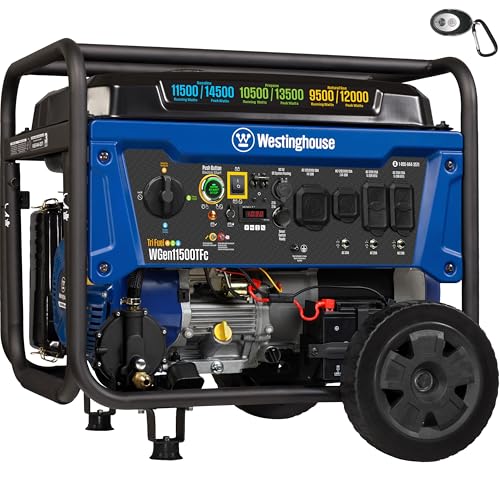 Westinghouse 14500 Peak Watt Tri-Fuel Home Backup Portable26.5" x 27.2" x 26.1"27.2 x 26.1 x 26.5 inches230 PoundsCheck on Amazon
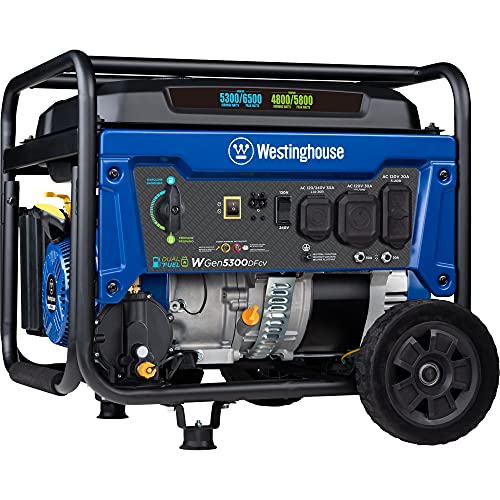 Westinghouse 6500 Watt Dual Fuel Home Backup Portable21 x 18 x 19.09 inches135.6 PoundsCheck on Amazon
 Westinghouse 13500 Peak Watt Dual Fuel Home Backup27.2 x 26.1 x 26.5 inches230 PoundsCheck on Amazon
 Westinghouse 8200 Peak Watt Tri-Fuel Portable Inverter Generator27 x 20.9 x 21.7 Inches134.5 poundsCheck on Amazon
 Westinghouse 28000 Peak Watt Tri-Fuel Home Backup Portable38 x 35 x 40.4 inches557 poundsCheck on Amazon
Top 3 Picks
Best Overall: Westinghouse 12500 Watt Dual Fuel Home Backup Portable Generator
This is the model that matches the most common real-world backup plan: one 30-amp inlet, one interlock or transfer switch, and a list of loads that adds up to somewhere between 5,000 and 9,000 running watts. Dual fuel means you can keep gasoline on hand for maximum output and switch to propane for long outages and indefinite storage life. Remote electric start and a wheel kit round out a package that is genuinely usable at 2 a.m. in bad weather.
Best Budget: Westinghouse 6500 Watt Dual Fuel Home Backup Portable Generator
For readers who need to cover a furnace, a refrigerator, a few lights, and the internet router, this is the sensible floor. It is transfer-switch ready with a 30-amp outlet, it runs on gasoline or propane, and it is small enough that one person can move it and store it in a garage corner. You give up the high-wattage headroom for well pumps and central air, but you keep the fuel flexibility and the hookup path.
Best Premium: Westinghouse 18000 Peak Watt Tri-Fuel Home Backup Portable Generator
When the backup plan includes a 200-amp service panel, a deep well, a septic pump, and a heat pump or central air, the wattage math stops working on a 12,500-peak machine. This tri-fuel unit adds natural gas to the fuel list, which means an outage measured in days no longer depends on how many propane cylinders you stocked. It is heavy, it is not a carry-up-the-stairs machine, and it belongs on a pad with a permanent fuel connection.
Quick Comparison
Every product below is a Westinghouse portable generator currently sold for home backup, RV, or job-site use. Peak wattage figures come from the model names; running wattage on Westinghouse’s home-backup units typically lands at roughly 75 to 82 percent of peak, and propane usually costs you about 10 percent of output versus gasoline, with natural gas costing more. Weights and noise are given as class-typical ranges because manufacturers revise specs between production runs — confirm the current label before you buy.
| Product | Best for | Key specs | Price tier |
|---|---|---|---|
| Westinghouse 12500 Watt Dual Fuel Home Backup | Most home backup panels; essentials plus a well pump | 12,500 peak W; gasoline or propane; remote electric start; transfer-switch ready; 120/240V twist-lock; ~250–300 lb class | Mid-range |
| Westinghouse 14500 Peak Watt Tri-Fuel Home Backup | Homes with a natural gas meter; long outages | 14,500 peak W; gasoline, propane, or natural gas; remote electric start; transfer-switch ready; ~300–350 lb class | Premium |
| Westinghouse 6500 Watt Dual Fuel Home Backup | Budget essentials circuit; RV owners who also want backup | 6,500 peak W; gasoline or propane; 30A outlet; RV ready; transfer-switch ready; ~150–190 lb class | Budget |
| Westinghouse 13500 Peak Watt Dual Fuel Home Backup | Mid-range step up for larger loads on propane | 13,500 peak W; gasoline or propane; remote electric start; transfer-switch ready; ~280–330 lb class | Mid-range |
| Westinghouse 8200 Peak Watt Tri-Fuel Inverter | Backup plus sensitive electronics; quieter neighborhoods | 8,200 peak W; gasoline, propane, or natural gas; inverter clean power; remote electric start; transfer-switch ready; ~200–250 lb class | Mid-range |
| Westinghouse 28000 Peak Watt Tri-Fuel Home Backup | Whole-home and off-grid power | 28,000 peak W; gasoline, propane, or natural gas; remote electric start; transfer-switch ready; 400+ lb class, wheeled and not hand-carried | Premium |
| Westinghouse 4650 Peak Watt Portable | Budget RV, tailgate, and small job-site power | 4,650 peak W; gasoline; RV-ready 30A outlet; CO sensor; ~100–130 lb class | Budget |
| Westinghouse 18000 Peak Watt Tri-Fuel Home Backup | Large homes on propane or natural gas | 18,000 peak W; gasoline, propane, or natural gas; remote electric start; transfer-switch ready; ~350–420 lb class | Premium |
| Westinghouse 12000 Peak Watt Tri-Fuel Inverter | Premium clean-power backup for electronics-heavy homes | 12,000 peak W; gasoline, propane, or natural gas; inverter; remote start; transfer-switch ready; ~300–360 lb class | Premium |
| Westinghouse 6600 Watt Dual Fuel Home Backup | Budget dual fuel with transfer-switch prep | 6,600 peak W; gasoline or propane; remote electric start; transfer-switch ready; ~160–200 lb class | Budget |
| Westinghouse 4000 Peak Watt Super Quiet Dual Fuel Inverter | Quiet budget inverter; camping and small essentials | 4,000 peak W; gasoline or propane; inverter; super-quiet class (~52–58 dBA at quarter load); remote electric start; ~100–120 lb class | Budget |
| Westinghouse 5000 Peak Watt Super Quiet Inverter | Mid-range quiet inverter for RV and light backup | 5,000 peak W; gasoline; inverter; remote electric start with auto choke; super-quiet class; ~100–130 lb class | Mid-range |
How We Chose
This list is built from published manufacturer specifications, model names, and the category norms that decide whether a generator actually works in a backup role. We weighed four things. First, load coverage: peak and running wattage, plus whether the unit is realistically sized for a 30-amp or 50-amp transfer-switch circuit, since a 30-amp 240-volt circuit tops out at 7,200 watts and a 50-amp circuit at 12,000. Second, fuel flexibility and runtime: dual-fuel and tri-fuel machines trade a small output penalty for the ability to run for days on a fuel source you can refill or that never runs out. Third, the practical details that decide whether you will actually use the thing — starting method, outlet types, wheel kit, weight class, and noise class, which matters more in a suburb than on a rural acre. Fourth, the upgrade path: whether a given model can later be wired to a transfer switch or inlet box, and how much headroom it leaves before you have to buy again. We did not test, benchmark, or own these generators; everything here is a reading of the specifications and the way these classes of machine behave in the field.
1. Westinghouse 12500 Watt Dual Fuel Home Backup Portable Generator – Best for Most Home Backup Panels
As an Amazon Associate we earn from qualifying purchases at no extra cost to you.

This is the default recommendation for a reason. It is the smallest machine in Westinghouse’s home-backup line that still gives you enough running wattage to carry a realistic essentials list — furnace blower, refrigerator, freezer, sump pump, well pump, internet, and a few rooms of lighting — through a multi-day outage without tripping the breaker every time the compressor kicks on. It suits a homeowner who has an electrician-installed 30-amp inlet and interlock, or a transfer switch, and who wants one machine that can do backup duty in winter and run a travel trailer or a job site in summer.
Key specs
- Peak wattage: 12,500 watts on gasoline, per the nameplate
- Running wattage: roughly the 9,500-watt class on gasoline, with a typical propane derate of about 10 percent
- Fuel: gasoline or propane (dual fuel), so you can store propane indefinitely and burn gasoline for maximum output
- Starting: remote electric start with a key fob, plus push-button start on the control panel and a recoil backup
- Transfer-switch ready: 120/240-volt twist-lock outlet sized for a 30-amp inlet, with household 120-volt duplex outlets alongside it
- CO shutdown protection is a standard feature across Westinghouse’s current portable line — confirm it on the specific listing you buy from
- Mobility: wheel kit and fold-down handle on a unit in the 250-to-300-pound class, so it rolls rather than carries
Strengths
The wattage headroom is the whole point. A 30-amp 240-volt circuit can pass 7,200 watts, and this generator can deliver more than that continuously on gasoline while absorbing motor starting surges that briefly pull two to three times running watts. That margin is what keeps a well pump from stalling the furnace or knocking the refrigerator offline when both cycle at once. Because it is dual fuel, you also get a plan B: run gasoline for the first day while you assess the outage, then switch to propane cylinders if the roads are closed and the gas stations are dark. Propane does not go stale, so cylinders you filled two years ago still work.
The starting setup is friendlier than the spec sheet suggests. Remote electric start means you are not pulling a rope in freezing rain, and the control panel layout on Westinghouse’s home-backup units — outlet bank, breaker switches, fuel valve, choke, and hour meter in one place — is simple enough to operate under stress. The CO shutdown sensor is the feature that matters most for anyone who has ever been tempted to run a generator in a garage, and the automatic shutoff removes some of the risk from that mistake. It is not a substitute for placing the unit outdoors, well away from windows and vents, but it is a meaningful backstop.
Pros
- Enough running wattage for a genuine essentials circuit, not just lights and a phone charger
- Dual fuel gives you both maximum output and indefinite fuel storage
- Remote electric start plus recoil backup means it starts in bad weather
- Transfer-switch ready out of the box with a 120/240-volt twist-lock outlet
- Wheel kit and handle make a 250-to-300-pound machine a one-person move on flat ground
Cons
- Heavy enough that stairs, gravel, and mud are real problems — plan a permanent pad
- Conventional (non-inverter) output, so total harmonic distortion is higher than a pure sine inverter
- Louder than an inverter unit; expect conventional-generator noise in the high 60s to low 70s dBA at load
- Will not carry central air conditioning or a large heat pump alongside the rest of the house
How it compares
Against the 13500 Peak Watt Dual Fuel, this model gives up roughly a thousand peak watts and a little running headroom, but it usually costs less and it is easier to move. If your load list already includes a 1.5-ton air conditioner or a big deep-well pump, the 13,500-peak machine is the better buy; if your list is a furnace, a fridge, a pump, and lights, you will never notice the difference. Against the 6500 Watt Dual Fuel, this is the more capable machine by a wide margin and the one that will not need replacing when your backup plan grows.
2. Westinghouse 14500 Peak Watt Tri-Fuel Home Backup Portable Generator – Best for Homes With Natural Gas

This is the model for a house that already has a natural gas meter and a gas line near where the generator will sit. Tri-fuel means gasoline, propane, or natural gas, and the natural gas option changes the character of an outage: as long as the gas utility keeps pressure, the generator runs without you refilling anything. It suits a homeowner with a larger essentials list — a deep well, a septic pump, a furnace, a couple of freezers — who is willing to accept a heavier machine and a slightly lower output on gaseous fuel in exchange for not thinking about fuel at all.
Key specs
- Peak wattage: 14,500 watts, per the nameplate
- Running wattage: roughly the 11,500-watt class on gasoline
- Fuel: gasoline, propane, or natural gas (tri-fuel), with hose and regulator hardware for gaseous fuels
- Starting: remote electric start with key fob, push-button start, and recoil backup
- Transfer-switch ready: 120/240-volt twist-lock outlet for a 30-amp inlet, with household outlets for corded loads
- Mobility: wheel kit and fold-down handle on a machine in the 300-to-350-pound class
Strengths
The natural gas capability is the headline, but it comes with a number you have to plan around. Natural gas is the least energy-dense of the three fuels, so a tri-fuel generator typically produces noticeably less than its gasoline rating when plumbed to a gas line — often in the range of a 20 to 30 percent reduction. That is still a lot of power on a 14,500-peak machine, but it means you should size your load list against the natural gas figure, not the gasoline figure, if natural gas is your primary plan. Propane sits between the two, usually around a 10 percent reduction from gasoline, and it stores indefinitely in cylinders.
Beyond fuel, this unit is built for the role. The running wattage class is high enough to carry a 50-amp transfer switch partially loaded — remember that a 50-amp 240-volt circuit can pass 12,000 watts, and this machine’s gasoline running figure is right at that ceiling — which gives you room for a heat pump or central air cycling alongside the essentials, provided you manage what runs simultaneously. Remote start matters more on a machine this size, because the alternative is hauling on a recoil rope attached to a 300-plus-pound generator in the cold.
Pros
- Three fuel options, including a natural gas hookup that never needs refilling
- Running wattage in the 11,500-watt class on gasoline is enough for a partially loaded 50-amp circuit
- Remote electric start and recoil backup
- Transfer-switch ready with a 120/240-volt twist-lock outlet
- Propane option gives you indefinite fuel storage as a fallback if gas pressure fails
Cons
- Natural gas output is meaningfully lower than the gasoline rating — plan your loads against the gaseous-fuel number
- Heavy, in the 300-to-350-pound class, and needs a level pad
- Conventional output rather than inverter-clean power
- Costs more than the dual-fuel 12500 without a dramatic jump in gasoline output
How it compares
The nearest alternative is the 18000 Peak Watt Tri-Fuel, which adds a substantial step in wattage and lets you think about a fully loaded 50-amp circuit rather than a partially loaded one. The trade is weight, price, and physical footprint — the 18,000-peak machine wants a permanent pad and probably a second person to reposition. If you have natural gas and a modest load list, the 14,500-peak model is the more proportionate buy; if you are trying to carry central air plus a well plus the rest of a large house, the bigger unit is the honest answer.
3. Westinghouse 6500 Watt Dual Fuel Home Backup Portable Generator – Best Budget Home Backup

This is the machine for the reader whose backup plan is one circuit and a short list. It suits a homeowner who wants a furnace, a refrigerator, a sump pump, the router, and some lights to keep running, and who would rather spend the difference on a proper inlet and interlock installation than on wattage they will never use. It also suits an RV owner who wants one generator that does double duty at the campground and at the house.
Key specs
- Wattage: 6,500 watts, per the nameplate
- Running wattage: roughly the 5,300-to-5,500-watt class on gasoline
- Fuel: gasoline or propane (dual fuel)
- Transfer-switch ready: 30-amp outlet for a standard 120/240-volt inlet
- RV ready: 30-amp outlet matches the shore power connection on most travel trailers
- Mobility: one of the smaller home-backup machines, in the 150-to-190-pound class, with a wheel kit
Strengths
The value here is fit rather than power. A 30-amp inlet and interlock is the cheapest safe way to connect a portable generator to a house panel, and this generator is sized to match it almost exactly — the circuit passes 7,200 watts at 240 volts, and the machine’s peak rating sits just under that, which means you can run the circuit hard without constantly worrying about the inlet breaker. For a furnace blower, a modern refrigerator, a sump pump, and a few rooms of LED lighting and electronics, the running wattage class is genuinely adequate, provided you do not try to add a well pump, an electric water heater, or central air.
Dual fuel matters more at this size than at the top of the range, because a smaller machine burns less fuel per hour and therefore runs longer on a given propane cylinder. A 20-pound propane cylinder will not run this generator all night at load, but a pair of them, rotated, will get you through a cold night with the furnace and fridge running, and propane stores indefinitely, which is not true of gasoline. The RV-ready 30-amp outlet means the same machine powers a travel trailer, which is a genuine second use rather than a marketing line.
Pros
- Lowest entry point into a real transfer-switch-ready home backup setup
- 30-amp outlet matches both a standard inlet and an RV shore power connection
- Dual fuel with indefinite propane storage
- Light enough, at roughly 150 to 190 pounds, for one person to move with the wheel kit
- Small enough to store on a garage shelf rather than a dedicated pad
Cons
- No headroom for a well pump, electric water heater, or central air conditioning
- Conventional output rather than inverter-clean power
- Still audible at load — this is not a quiet machine
- Lacks the remote electric start of the larger models, so starting means being at the unit
How it compares
The obvious alternative is the 6600 Watt Dual Fuel, which is nearly identical in wattage but adds remote electric start and transfer-switch readiness with a slightly different feature set. If you can find the 6,600-watt version at a similar tier, the remote start is worth having. Against the 12500 Watt Dual Fuel, this machine is roughly half the output — the difference between “essentials” and “essentials plus a well pump and a bigger furnace load.” Buy this one if you know your list, and buy the 12,500 if you suspect it will grow.
4. Westinghouse 13500 Peak Watt Dual Fuel Home Backup Portable Generator – Best Mid-Range Step Up

This model exists for the reader who looked at the 12500 and asked whether a little more headroom would let them keep the air conditioner on. It suits a homeowner with a 30-amp inlet who wants to run a larger furnace, a deeper well pump, and a small central air unit in rotation rather than all at once, and who prefers propane as the primary fuel because of how it stores.
Key specs
- Peak wattage: 13,500 watts, per the nameplate
- Running wattage: roughly the 10,500-to-11,000-watt class on gasoline
- Fuel: gasoline or propane (dual fuel), with a propane hose and regulator included
- Starting: remote electric start with key fob, push-button start, recoil backup
- Transfer-switch ready: 120/240-volt twist-lock outlet for a 30-amp inlet, plus household outlets
- Mobility: wheel kit and fold-down handle, in the 280-to-330-pound class
Strengths
The extra running wattage over the 12500 class is what lets you consider a small central air conditioner or a heat pump in a managed rotation. Motor starting is the constraint that trips people up: an air conditioner compressor can pull two to three times its running wattage for a second or two at startup, so a unit with more running capacity also has more surge capacity to absorb that spike without dragging the voltage down and knocking the furnace control board offline. If your outage plan includes cooling, this is the point in the Westinghouse range where that becomes realistic rather than wishful.
Dual fuel at this wattage is a practical choice rather than a compromise. Propane delivers roughly 90 percent of gasoline output, which still leaves a large number of watts, and it removes the fuel-storage problem entirely — no stabilizer, no rotation schedule, no ethanol degrading in a carburetor. For a machine that might sit unused for eleven months and then be asked to run for three days straight, that reliability is worth more than the last few hundred watts.
Pros
- More running headroom than the 12500 class, enough to consider a small central air unit in rotation
- Remote electric start and recoil backup
- Dual fuel with indefinite propane storage
- Transfer-switch ready with a 120/240-volt twist-lock outlet
- Wheel kit keeps a 300-pound-class machine movable on flat ground
Cons
- Meaningfully heavier and larger than the 12500 class with only a modest wattage gain
- Still conventional output, not inverter-clean
- Conventional-generator noise levels at load
- Not enough to carry a whole-house load list; you will still manage circuits
How it compares
Against the 12500 Watt Dual Fuel, this is a straight upgrade in output and a straight downgrade in portability. If you will not be moving the generator — it lives on a pad next to the house, connected to a permanent inlet — the extra watts are free capability and the weight is irrelevant. Against the 14500 Peak Watt Tri-Fuel, it lacks the natural gas option, which is the deciding factor for anyone with a gas meter near the install location.
5. Westinghouse 8200 Peak Watt Tri-Fuel Inverter Generator – Best Inverter for Backup Plus Electronics

This is the model for the reader who wants backup power that will not damage or confuse sensitive electronics, and who lives somewhere quiet enough that noise matters. It suits a homeowner with a modest essentials list — furnace, refrigerator, internet, a few rooms of lights, a home office — who wants pure sine wave output, tri-fuel flexibility, and a machine that can sit on a patio without generating complaints.
Key specs
- Peak wattage: 8,200 watts, per the nameplate
- Running wattage: roughly the 6,500-to-6,800-watt class on gasoline
- Fuel: gasoline, propane, or natural gas (tri-fuel)
- Inverter output: clean, low-distortion power suitable for electronics, variable-speed engine for lower noise and better fuel economy at part load
- Starting: remote electric start
- Transfer-switch ready: 120/240-volt twist-lock outlet, with household outlets for corded loads
- Mobility: wheel kit and handle, in the 200-to-250-pound class
Strengths
Inverter generators produce power electronically rather than directly from the alternator, which holds total harmonic distortion low enough that modern electronics, variable-speed furnace controls, and heat pump boards behave normally. That matters in a way that is easy to underestimate: a conventional generator with dirty output can cause a furnace control board to throw faults, a UPS to chatter, or a laptop power supply to run hot. Inverter output removes that class of problem. The variable-speed engine is the second benefit — at part load, the engine throttles down, which cuts noise and fuel consumption substantially compared with a fixed-speed machine running the same small load.
Tri-fuel at this wattage is unusual and useful. Natural gas gives you an outage plan that does not depend on stored fuel, propane gives you indefinite storage, and gasoline gives you maximum output. The trade is the same as everywhere else: expect around a 10 percent output reduction on propane and a larger one on natural gas, so size your load list against the fuel you will actually use. For an essentials circuit with electronics in the mix, the gasoline running figure is comfortable; on natural gas, you will want to be more selective about what runs simultaneously.
Pros
- Inverter output protects electronics and modern appliance control boards
- Tri-fuel: gasoline, propane, and natural gas
- Variable-speed engine means quieter operation and better fuel economy at light load
- Remote electric start and transfer-switch readiness in one package
- Noticeably quieter than a conventional generator of similar output
Cons
- Lower running wattage than conventional machines in the same price tier
- Inverter electronics add a failure point that a simple alternator does not have
- Still heavy enough at 200-plus pounds to need a wheel kit and a level surface
- Natural gas output is lower still; heavy loads may need gasoline or propane
How it compares
Against the 12500 Watt Dual Fuel, this machine gives up a large amount of raw wattage and gains clean power, lower noise, and a third fuel. The choice is about what you are protecting: if the load list is a well pump and a furnace, the 12500 wins on capability; if it is a home office, a modern furnace, and a network rack, the inverter is the safer machine. Against the 12000 Peak Watt Tri-Fuel Inverter, this is the smaller, lighter, cheaper version of the same idea — the 12,000-peak unit is the one to buy if you want inverter power and still need to carry a well pump.
6. Westinghouse 28000 Peak Watt Tri-Fuel Home Backup Portable Generator – Best for Whole-Home and Off-Grid Power

This is the top of the Westinghouse portable range, and it belongs to a different category of buyer: someone who wants a 200-amp service panel to stay largely live, or who is running an off-grid property where the generator is the primary power source rather than an emergency backup. It suits rural homeowners with a well, a septic system, electric heat or a large heat pump, and outbuildings, and it suits anyone who has concluded that managing circuits during an outage is not acceptable.
Key specs
- Peak wattage: 28,000 watts, per the nameplate
- Fuel: gasoline, propane, or natural gas (tri-fuel)
- Starting: remote electric start
- Transfer-switch ready: high-amperage 120/240-volt outlet intended for a transfer switch or inlet sized for the load
- Mobility: wheeled, in the 400-pound-and-up class — this is a roll-into-place machine, not a carry
- Intended use: whole-home backup, off-grid primary power, or large agricultural and light commercial loads
Strengths
The wattage is the point. At this level you are no longer deciding which circuits to feed; you are deciding whether to run the air conditioning and the well pump at the same time, and the answer is usually yes. That changes the experience of an outage from a managed emergency into something closer to normal life, which is exactly what a household with young children, medical equipment, or a home business needs. Tri-fuel matters even more here, because a machine that draws this much fuel will empty a propane cylinder quickly — natural gas is the only fuel source that realistically supports a multi-day run at this load level without a delivery or a refill run.
The practical reality of a 28,000-peak machine is that it wants infrastructure: a concrete or gravel pad, a permanent fuel connection, a properly sized inlet or transfer switch, and probably a battery maintainer for the electric start. Budget for that work alongside the generator. Once it is installed, though, it is the closest thing to whole-home power you can get without a permanently installed standby unit, and it can be moved if you relocate.
Pros
- Enough wattage for whole-home backup including large motor loads
- Tri-fuel, with natural gas support for long outages without refueling
- Remote electric start on a machine you would never want to rope-start
- Also serves as a primary power source for off-grid properties
- Transfer-switch ready for a high-amperage connection
Cons
- Very heavy and expensive to install properly — pad, fuel line, and inlet work add up
- Thirsty at load; propane cylinders will not last long
- Loud, and impractical in a dense neighborhood
- Far more machine than a typical suburban essentials backup plan requires
How it compares
The nearest alternative is the 18000 Peak Watt Tri-Fuel, which covers a large home with a well and central air if you are willing to manage what runs at once, at lower cost and lower weight. The 28,000-peak machine is for the buyer who has already decided that circuit management is not acceptable, or who needs the capacity for a genuine off-grid or agricultural load. If you are choosing between the two on price alone, the 18,000-peak model is usually the better value; if you are choosing on capability, this one settles the argument.
7. Westinghouse 4650 Peak Watt Portable Generator – Best Budget RV and Tailgate Generator
This is the smallest and simplest machine on the list, and it suits a different reader: the RV owner, the tailgater, the job-site user, and the homeowner who wants to run a refrigerator, a freezer, a few lamps, and a phone charger during a short outage without spending much. It is gasoline only, which keeps the price and the complexity down, and it carries a CO sensor with automatic shutdown, which is the safety feature that matters most in this category.
Key specs
- Peak wattage: 4,650 watts, per the nameplate
- Running wattage: roughly the 3,700-watt class
- Fuel: gasoline only
- RV ready: 30-amp outlet for travel trailer shore power
- CO sensor with automatic shutdown
- Mobility: portable class, roughly 100 to 130 pounds, with a wheel kit and handle
Strengths
For its size, the running wattage is enough to run a 13,500 BTU RV air conditioner plus a few small loads, which is the classic use case for this class of machine. At home, it covers a refrigerator, a freezer, a sump pump, and lighting without complaint, and it will run a furnace blower if you are not also trying to run a well pump. Gasoline-only is a simplification rather than a limitation for most buyers at this tier — you are not planning a week-long outage around it, you are covering a few hours or a day and running a trailer on weekends.
The CO sensor deserves a mention because this is the machine most likely to be used in a semi-enclosed space, like under an RV awning or beside a garage door. Carbon monoxide shutdown does not make indoor use safe — no generator is safe indoors, in a garage, or in any attached structure — but it is a real layer of protection for the times when placement is imperfect. Follow the manual’s clearance guidance and keep the exhaust pointed away from any opening.
Pros
- Lowest-cost way into a Westinghouse generator with a real 30-amp RV outlet
- Light and genuinely portable compared with the home-backup models
- CO sensor with automatic shutdown
- Enough running wattage for a travel trailer air conditioner plus small loads
- Simple, gasoline-only fuel system is easy to maintain
Cons
- No propane or natural gas option
- Not enough output for a well pump, electric heat, or central air
- Conventional output rather than inverter-clean power
- Gasoline storage means stabilizer and rotation, or drained fuel and a fresh can on hand
How it compares
The nearest alternative is the 6500 Watt Dual Fuel, which costs more but roughly doubles the usable home-backup capability and adds propane. If your primary use is a travel trailer with occasional home backup, the 4650 is the proportionate buy. If the home backup matters as much as the RV use, spend up — the 6500 is the machine that will still be adequate in five years. The 4000 Peak Watt Super Quiet Dual Fuel Inverter is the other nearby option, and it is quieter with cleaner output, but it costs more for similar wattage.
8. Westinghouse 18000 Peak Watt Tri-Fuel Home Backup Portable Generator – Best for Large Homes on Propane or Natural Gas

This is the sweet spot in Westinghouse’s large-format range. It suits a homeowner with a big load list — a deep well pump, a septic pump, a furnace or heat pump, a large refrigerator and freezer, and a home office — who wants the option of running on natural gas for the duration of a long outage but does not need to keep an entire 200-amp panel live. It is also the sensible choice for a rural property that loses power regularly and wants a machine that can be started remotely from inside the house.
Key specs
- Peak wattage: 18,000 watts, per the nameplate
- Fuel: gasoline, propane, or natural gas (tri-fuel)
- Starting: remote electric start
- Transfer-switch ready: 120/240-volt high-amperage outlet for a transfer switch or inlet
- Mobility: wheeled, in the 350-to-420-pound class
- Intended use: large-home backup, well and septic systems, managed central air
Strengths
The value here is that you can realistically run a 50-amp transfer switch circuit at or near its 12,000-watt ceiling on gasoline, and still have a meaningful amount of power available on propane. That is the difference between “the essentials stay on” and “the house mostly works” — a 50-amp circuit can carry a heat pump or a central air unit alongside a well pump, a furnace, and refrigeration, provided you stagger the big motor starts. In practice that means leaving the air conditioner off while the well pump runs, which is a manageable rule for a household to follow.
Tri-fuel is more than a checkbox at this size. A machine drawing this much power will consume a 20-pound propane cylinder in a matter of hours at load, so propane is best treated as a short-term bridge. Natural gas is the fuel that makes a multi-day outage survivable without a refill run, and gasoline is the fuel that gives you the maximum wattage figure on the label. Owning all three means you can match the fuel to the outage: gasoline for the first day, natural gas for the long haul if the line holds, propane as the fallback if it does not.
Pros
- Enough output to load a 50-amp circuit close to its limit on gasoline
- Tri-fuel with natural gas support for extended outages
- Remote electric start
- Covers well pumps, septic pumps, and managed central air
- Transfer-switch ready for a high-amperage connection
Cons
- Heavy and awkward — plan a permanent pad and a second person for repositioning
- Propane consumption is high at load; cylinders are a short-term solution
- Conventional output rather than inverter-clean
- Substantially more expensive than the 12500 and 13500 classes
How it compares
Against the 14500 Peak Watt Tri-Fuel, this is the upgrade you make when you want to stop managing the load list so carefully. Against the 28000 Peak Watt Tri-Fuel, it is the more proportionate machine for a large but not enormous house — the 28,000-peak unit is for buyers who want to stop managing circuits entirely, or who are powering an off-grid property. For most large homes with a well and central air, this is the point where the wattage stops being the limiting factor.
9. Westinghouse 12000 Peak Watt Tri-Fuel Inverter Generator – Best Premium Inverter for Clean-Power Backup

This is the machine for the buyer who wants inverter-grade power quality and enough wattage to run a real load list. It suits a homeowner with modern appliances, a variable-speed furnace or heat pump, a home office or server rack, and a well pump — someone who has read enough about total harmonic distortion to care, and who wants tri-fuel flexibility on top of it.