What's inside
As an Amazon Associate I earn from qualifying purchases. This post may contain affiliate links at no extra cost to you.
What we cover
Our Top Picks


Best Rotary Cheese Grater for Home Kitchen
The best rotary cheese grater for a home kitchen is a stainless-drum model with a dependable suction base, a wide feed chute, and a handle that turns smoothly under light pressure; for most households, the OXO Good Grips Rotary Grater is the best all-round choice, while the Zyliss Classic Rotary Cheese Grater is the better pick when interchangeable drums and a compact, traditional design matter more.
Rotary graters are most useful when you regularly prepare hard cheese, chocolate, nuts, or vegetables but do not want to operate a box grater over a bowl. The important differences are not limited to the number of drums. Drum material affects sharpness and rust resistance, the handle determines how much effort is needed, and the base decides whether the grater stays put when the food becomes difficult to turn.
As an Amazon Associate we earn from qualifying purchases at no extra cost to you.

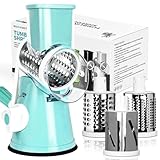


Quick comparison
| Model or type | Drum material | Typical drum options | Feed-chute capacity | Approximate size | Best suited to |
|---|---|---|---|---|---|
| OXO Good Grips Rotary Grater | Stainless steel | Fine, medium, coarse | About 45–55 mm wide; one small cheese block at a time | About 19 × 12 × 10 cm; roughly 450–550 g | Frequent everyday use and easy handling |
| Zyliss Classic Rotary Cheese Grater | Stainless steel | Fine, coarse, and slicing-style drums, depending on set | About 45–50 mm wide | About 20 × 10 × 8 cm; roughly 350–500 g | Compact storage and versatile drum selection |
| Basic clamp-style rotary grater | Chromed steel or stainless steel | Usually one medium drum | About 35–45 mm wide | About 18 × 8 × 8 cm; roughly 250–400 g | Occasional use and the lowest purchase cost |
| Large lever-style rotary grater | Stainless steel | Two or three drums | About 55–65 mm wide | About 23 × 14 × 12 cm; roughly 600–800 g | Large quantities and users who want extra leverage |
Dimensions and weights vary between production versions and regional packaging. Treat the figures as useful buying ranges rather than laboratory measurements. A wider chute is more convenient, but it does not automatically mean the grater is faster: the drum still has to engage the cheese evenly, and an overfilled chute can make the handle harder to turn.
Head-to-head: OXO versus Zyliss
OXO Good Grips Rotary Grater
The OXO is the strongest choice for a busy home kitchen because its design emphasizes control. Its broad handle is comfortable during repeated rotations, and the suction-style base is intended to anchor the grater to a smooth worktop. The three-drum arrangement covers the common jobs: fine grating for hard cheese or zest, medium grating for pasta toppings, and coarse grating for softer cheese or vegetables.
Its main advantage is reduced hand strain rather than maximum capacity. The chute accepts a useful piece of cheese, but it is still a household grater, not a high-volume food-service machine. Cut a large block into pieces that fit loosely rather than forcing it down. This keeps the drum turning smoothly and reduces pressure on the retaining plate.
Choose the OXO when more than one person uses the kitchen, when you grate several times a week, or when a comfortable handle is more important than the smallest possible storage footprint.
Zyliss Classic Rotary Cheese Grater
The Zyliss Classic is a practical alternative with a familiar rotary layout and interchangeable stainless-steel drums. It is particularly appealing if you want one tool for fine cheese, coarse cheese, and slicing-style work without buying several separate graters.
The handle is effective, although its more traditional shape may feel less cushioned during a long preparation session. Its compact body is easy to store in a drawer, but the narrower profile means you may need to cut cheese into smaller pieces. That is a minor inconvenience for a household making one or two servings of pasta, but it becomes noticeable when preparing a large dish.
Choose the Zyliss when drum versatility and compact storage are your priorities, especially if you grate intermittently rather than every day.
What matters most in daily use
Drum material and cutting performance
Stainless-steel drums are the safest general recommendation. They resist corrosion from salty or moist foods and usually retain a sharper cutting edge than inexpensive painted or thinly chromed drums. Look for a drum that feels rigid when pressed at the center. If it flexes, cheese can smear against the housing instead of passing cleanly through the holes.
Fine drums work well with Parmesan-style cheeses, hard chocolate, and small amounts of zest. Medium drums are the most useful for everyday pasta and gratins. Coarse drums are faster for cheddar, mozzarella, and vegetables, but softer ingredients can clog if they are warm.
Handle effort
A good rotary grater should not require forceful cranking. Excessive effort usually comes from one of four problems: the cheese is too soft, the chute is overfilled, the drum is not seated correctly, or the retaining plate is pressing too tightly.
For the easiest rotation, chill soft cheese for 15–20 minutes, cut it into pieces shorter than the chute, and apply gentle downward pressure. A large handle helps because it gives your fingers more leverage, but a smooth gear connection matters just as much. A grater that turns easily while empty but binds under load has limited practical value.
Feed-chute capacity
Most home rotary graters accept a cheese piece approximately 45–55 mm wide. In practical terms, that is enough for a small handful of cheese, not an entire supermarket block. A 200-gram block may require four or five loads depending on its shape.
That is not necessarily a weakness. Smaller loads keep the pressure plate aligned and make it easier to switch between cheeses. If you routinely grate 500 grams or more, choose a model with a wider chute and a robust suction base, or consider a food processor with a grating disc instead.
Suction stability
A suction base works best on a clean, smooth, nonporous surface such as polished stone, glass, or a smooth laminate worktop. It performs poorly on textured wood, grout lines, dusty surfaces, or countertops with crumbs underneath.
Before attaching it, wipe both the counter and the suction pad. Press the base down firmly, engage the locking lever if provided, and test it with a light sideways push. If it slides, reposition it rather than compensating with more hand pressure. A small silicone or rubber pad can improve grip on some surfaces, but check that it does not interfere with the manufacturer’s locking mechanism.
Decision matrix for different kitchens
| Your situation | Best choice | Why |
|---|---|---|
| Grating several times per week | OXO-style three-drum model | Comfortable handle, stable base, and useful drum range |
| Small kitchen or limited drawer space | Zyliss-style compact model | Short body and removable drums store efficiently |
| Lowest-cost occasional use | Basic single-drum model | Fewer parts and lower market price, with less versatility |
| Large family meals | Wide-chute lever model | Fewer reloads and more leverage, but more storage space required |
| Textured or uneven worktop | Clamp-style model | Mechanical clamping is more reliable than suction on rough surfaces |
Cleanup and long-term ownership
Cleanup is where a rotary grater can either justify its purchase or become an unwanted drawer item. Remove the drum immediately after use, rinse away dairy residue before it dries, and use a soft brush from the outside of the drum toward the inside. Do not push a finger along the cutting surface; even a small drum can cut skin.
Dishwasher safety varies by model and by component. Stainless-steel drums may tolerate the dishwasher, while plastic housings, suction seals, and handle assemblies can last longer with hand washing. Follow the care instructions for the exact model. Dry the drum fully before storage, especially around the folded cutting edges and axle opening.
The parts most likely to wear are the suction seal, plastic retaining plate, drum axle, and handle connection. A grater that begins to slip may not have a dull drum; the suction pad may simply be dirty, warped, or permanently compressed. Replacement drums are valuable because they can extend the life of the housing, but confirm availability before buying an unfamiliar model.
Common mistakes to avoid
- Do not fill the chute above the pressure plate; overloaded food increases handle effort and can jam the drum.
- Do not grate warm, oily cheese immediately from a hot dish; it is more likely to smear and clog.
- Do not use a suction base on a wet or heavily textured surface.
- Do not store a damp drum inside the housing, where trapped moisture can cause odors and staining.
- Do not assume every drum is interchangeable; axle shape and locking tabs differ between brands.
Final recommendation
For most homes, the OXO Good Grips Rotary Grater is the best rotary cheese grater for home kitchen use because it balances a comfortable handle, stable suction, useful drum sizes, and manageable cleanup. Select the Zyliss Classic if you value compact storage and a traditional interchangeable-drum design. If you only grate cheese a few times a year, a basic single-drum model is sufficient; if you prepare large quantities, prioritize chute width and mechanical stability over the lowest price.