What's inside
As an Amazon Associate I earn from qualifying purchases. This post may contain affiliate links at no extra cost to you.
What we cover
What the names mean
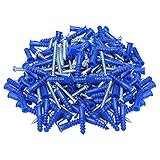
Both anchors are meant for hollow drywall, but they install differently. A plastic expansion anchor has a slotted plastic body. A screw pushes into it and spreads the plastic against the sides of the pilot hole. A self-drilling drywall anchor has a pointed, usually threaded body that cuts into drywall as you turn it; its internal opening takes a screw.
Neither type turns drywall into a stud. Their grip comes from gypsum board, which can crumble or tear around a fastener. Choose based on the load, the wall, and how often the item will be pulled or bumped—not just the weight printed on the box.
As an Amazon Associate we earn from qualifying purchases at no extra cost to you.


Quick comparison
| Feature | Plastic expansion anchor | Self-drilling drywall anchor |
|---|---|---|
| Installation | Drill a pilot hole, insert anchor, drive screw | Turn anchor directly into drywall, then drive screw |
| Best fit | Light, mostly static items and firm, intact drywall | Light-to-moderate items needing a simpler install |
| Main failure risk | Anchor spins or pulls out if the hole is too large | Anchor strips the drywall if overdriven or overloaded |
| Removal | Often easier to remove, though the anchor may stay in the wall | May leave a larger damaged hole or need to be cut flush |
| Tool needs | Drill and correctly sized bit, or a suitable hand tool | Screwdriver or drill/driver with a light touch |
When plastic expansion anchors work
Plastic anchors are a reasonable, inexpensive choice for light-duty hardware: a small picture hook, a lightweight wall sign, or a cable clip that will not be tugged. They are widely available in assorted plastic drywall anchor kits, and a basic kit is often all you need for occasional household jobs.
They do require a pilot hole. Check the package for the specified bit diameter; a hole even slightly too large can let the anchor rotate when you tighten the screw. Drill straight, keep the hole shallow enough for the anchor body, and push the anchor in until its flange sits against the wall. Then tighten the screw until the item is held snug. Stop if the anchor spins. More torque will usually enlarge the hole rather than improve the grip.
The trade-off is that the screw expands the anchor inside the hole, but the anchor still relies on a small area of drywall. It can hold a light, static load well when installed correctly, yet perform poorly under repeated pulling, vibration, or a load that sticks far out from the wall. A shelf bracket or coat hook can place leverage on the fastener that a simple weight rating does not capture.
When self-drilling anchors work
Self-drilling anchors save a step: most versions cut their own opening, so there is no pilot hole to measure. Their broad threads engage more of the board than a short plastic expansion anchor. That can make them a practical choice for curtain hardware, small bathroom accessories, and similar light-to-moderate fixtures, provided the anchor is rated for the job and the drywall is sound. Look for self-drilling drywall anchors with a stated load rating and the matching screws.
Install one with a screwdriver or a drill/driver set to low speed and low clutch torque. Keep it perpendicular to the wall. Stop when its head is flush; driving it too far can break the paper face or strip the gypsum around the threads. If the anchor turns without advancing, or the drywall face tears, remove it and choose another location or fastening method. Do not reuse a stripped hole.
Their convenience has limits. The larger threaded body may leave a larger repair than a small plastic anchor, and a protruding head can interfere with a fixture that must sit flat. Some metal self-drilling anchors are stronger than common plastic versions, but the drywall remains the weak point. A higher anchor rating does not make a fragile wall suitable for a heavy or safety-critical load.
Choose by load and wall condition
For a light object with little outward pull, either type can be fine. Pick plastic expansion anchors if you already have the right bit and want a simple, cheap fixing. Pick self-drilling anchors when avoiding a pilot hole is useful or when the fixture’s instructions call for that style. Follow the package rating, and treat it as a limit for the stated installation—not a promise that every wall and loading direction will perform the same.
For heavy mirrors, shelves carrying books, grab bars, wall-mounted TVs, or anything people could lean on, find a stud or use a fastening system designed for hollow walls and the expected load. A stud finder can help, but confirm the location before drilling. For hollow-wall applications without a usable stud, a toggle-style anchor may be more appropriate; compare hollow-wall toggle anchors and follow the fixture maker’s instructions.
Also check the wall before choosing. Avoid crumbling, damp, patched, or damaged drywall. If you hit wood, metal, plumbing, or wiring while drilling, stop and reassess rather than forcing an anchor into the obstruction. Keep fasteners away from the board edge, where drywall is more likely to break out, and space multiple anchors so they do not weaken the same area.
A few checks that prevent failures
Use a drill bit matched to the anchor, not a larger bit that happens to be handy. With plastic anchors, clear loose dust and make sure the body fits snugly. With self-drilling anchors, start square and let the threads cut; pushing hard or using high speed can tear the face paper. Drive screws only until the fixture is secure. A screw that keeps turning without tightening is a warning, not a cue to apply more force.
Before hanging anything valuable, test the installed fixing gently by hand. If it moves, creaks, or pulls the wall surface, take it down and change the location or anchor type. For an item with several mounting points, use the specified number and spacing; do not assume that adding anchors automatically multiplies the safe load, since uneven alignment can leave one fastener carrying most of it.