What's inside
As an Amazon Associate I earn from qualifying purchases. This post may contain affiliate links at no extra cost to you.
An impact driver’s bit holder is a small part with a big effect on how smoothly a job goes. A loose holder can let a bit wobble or fall out; an awkward one can slow every screw change. The right choice depends on the bits you use, how often you change them, and whether you need reach or flexibility more than compactness.
As an Amazon Associate we earn from qualifying purchases at no extra cost to you.


What we cover
Choose by the job
For ordinary fastening with standard 1-inch insert bits, a short magnetic holder is inexpensive and usually adequate. If bits regularly stick in screw heads, fall out overhead, or need frequent swapping, a locking quick-release holder is worth considering. Long holders help reach recessed fasteners, while flexible extensions are for access around obstacles—not for adding strength.
Check that a holder is impact-rated and has a 1/4-inch hex shank compatible with your impact driver. Many holders and bits use this standard, but a drill’s three-jaw chuck can also accept them. Avoid using a plain, non-impact-rated extension for repeated impact-driver work; its shaft or retention parts may wear or break under repeated blows.
Holder types compared
| Type | Best use | Main trade-off | Retention |
|---|---|---|---|
| Short magnetic holder | Everyday screws and quick bit changes | Can attract metal chips; bit can pull out with a screw | Magnet only |
| Locking quick-release holder | Frequent changes, overhead work, or bits that must stay put | More parts to clean; can be longer and cost more | Magnet plus mechanical sleeve or detent |
| Long magnetic holder | Recessed screws and limited-access areas | Extra length can increase wobble and reduce control | Usually magnet only |
| Flexible extension | Fasteners around light obstructions | Less direct control; not suited to high-torque driving | Varies by design |
What secure retention really means
A magnet holds the bit against the holder, but it does not necessarily lock it in place. That is often fine for short screws driven horizontally. It becomes less reliable when working above shoulder height, when a bit is worn, or when the screw’s recess grips the bit tightly enough to pull it out as you withdraw the driver.
A locking holder uses a sliding collar, detent, or similar mechanism to retain the bit. Pull the collar back to insert or remove a bit, then confirm it has returned to its resting position. A lock helps keep the bit in the holder, but it cannot compensate for a damaged bit shank or a holder packed with debris. If a bit still slips, inspect both parts and try a fresh bit before applying more force.
Magnetic holders can also pick up steel filings, especially during metalworking. Wipe the tip and the bit shank when you see debris; accumulated chips can interfere with seating and leave a bit slightly off-center. A visibly bent bit or holder should be replaced rather than used for precision work.
What to buy
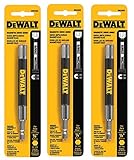
For a basic home kit, a short, impact-rated magnetic holder is usually enough. It costs less, adds little length, and works well with common Phillips, square, and Torx insert bits. A basic impact-rated magnetic bit holder is a sensible choice if you mostly drive screws into framing, furniture, or wall anchors and do not need a positive lock.
If you swap bits often or work on ladders and overhead, choose a locking holder with a sleeve you can operate with one hand. Check that it accepts standard 1-inch insert bits; some designs are intended for longer power bits instead. Look for a collar that slides smoothly without excessive play. A locking quick-release impact bit holder is a practical upgrade when dropped bits or repeated changes are slowing the job.
Buy a long holder only when the extra reach solves a real access problem. A longer shaft can make it easier to reach a screw set behind a bracket, but it also gives the bit more opportunity to wobble. For screws requiring careful alignment, bring the driver close to the fastener instead of relying on extra reach where possible.
For occasional awkward angles, a flexible bit extension can help reach around a light obstruction. It is not a substitute for a right-angle attachment or a straight setup when driving tight, high-torque fasteners. Stop if the extension twists sharply, vibrates, or struggles to turn the screw.
Use the holder without damaging it
Seat the 1/4-inch hex shank fully in the driver’s collet before use, then tug lightly to check that it is engaged. Insert the bit until it bottoms out in the holder. On a locking model, release the collar and make sure it returns; on a magnetic model, check that the bit sits straight rather than at an angle. Keep the driver aligned with the screw and use a suitable bit size to reduce cam-out and wear.
Use a drill or low-speed setting for delicate work where available, and reserve impact mode for fasteners that can tolerate it. Small screws, soft woods, plastic fittings, and some drywall anchors can strip or crack under impact. For wall anchors, follow the anchor maker’s pilot-hole size and driving instructions. A secure holder keeps the bit in place; it does not prevent overtightening.
When to replace a holder
Replace it if the bit repeatedly falls out, the collar sticks after cleaning, the shank visibly wobbles, or the holder shows cracks or deformation. Some play is normal, but pronounced runout makes starting screws harder and can damage recesses. Before replacing a holder, test it with a new, undamaged bit: worn or undersized bit shanks can imitate a failed retention mechanism.
For most users, the best value is one short magnetic holder for general work and one locking holder if secure retention matters. Pay extra for the locking mechanism when it solves a repeated problem; otherwise, the cheaper magnetic option is usually the more straightforward tool.