What's inside
As an Amazon Associate I earn from qualifying purchases. This post may contain affiliate links at no extra cost to you.
What we cover
Why stair landings are difficult
A concrete stair landing is a cramped place to drill. You may be working above or beside a stairwell, with limited room to brace yourself and little space for the drill to run straight. The hole might also be close to an edge, where a wandering bit or a cracked corner can ruin the anchor location.
For a few holes for a handrail bracket or gate, a good cordless hammer drill is usually enough. The usual job is a hole roughly 1/4 to 1/2 inch in diameter and 2 to 3 inches deep, depending on the anchor. For frequent drilling, larger holes, or hard aggregate, a rotary hammer is a better tool: its hammering mechanism delivers stronger impacts with less effort from the user.
As an Amazon Associate we earn from qualifying purchases at no extra cost to you.
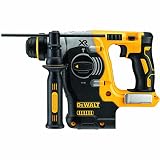


Before buying, check the anchor maker’s required hole diameter and depth. Drilling too shallow leaves dust at the bottom and prevents the anchor from seating; drilling too wide can make it spin or pull out. Keep a vacuum or blow-out bulb handy, and use eye and hearing protection. Concrete dust contains respirable silica, so don’t dry-sweep it.
What to buy for the job
For occasional anchor holes, look for a 18V or 20V-class cordless hammer drill with a side handle, a clutch, and a two-speed gearbox. Battery voltage labels are not a reliable way to compare drilling power across brands. A brushless motor can improve runtime and reduce wear, but it is not essential for a short installation.
A hammer drill uses a toothed mechanism that rapidly pulses the bit. It works well with standard round-shank masonry bits, but the impacts are relatively light. A rotary hammer uses a more forceful piston mechanism and commonly accepts SDS-Plus bits. If you will drill more than a handful of holes, drill repeatedly into hard concrete, or need holes larger than about 1/2 inch, consider a cordless SDS-Plus rotary hammer instead.
| Tool type | Best fit | Main trade-off |
|---|---|---|
| Cordless hammer drill | Occasional small anchor holes; general drilling and driving | Slower and more tiring in hard concrete |
| Cordless rotary hammer | Repeated holes, larger diameters, tough concrete | Bulkier, costlier, and less suited to delicate screwdriving |
| Standard drill/driver | Wood, metal, and fasteners | No hammer action; a poor choice for drilling concrete |
Features that matter more than peak numbers
A side handle is important on a stair landing. It gives you a second point of control if the bit binds in aggregate. Use it, especially for holes above 3/8 inch. A depth stop is useful for consistent anchor holes, but a strip of tape on the bit works for occasional jobs. A bright work light helps in stairwells, though it does not replace good lighting from a separate lamp.
Weight and length matter in a tight space. A large high-capacity battery can add useful runtime but make the drill harder to hold overhead or at an awkward angle. A compact drill with a 2.0Ah or 4.0Ah battery is often a sensible balance for a few holes. If you already own a compatible battery platform, buying a bare tool may save money.
For a typical landing installation, compare cordless hammer drills with a side handle from the battery system you own. Don’t choose on advertised torque alone: torque figures describe twisting force, not how quickly a drill will bore through concrete.
Drilling without damaging the landing
Mark the hole and check the concrete edge distance recommended by the anchor manufacturer. As a practical precaution, avoid drilling close to an edge or corner unless the anchor is specifically rated for that location. Concrete can split or spall, particularly when an expanding wedge anchor is installed too near an edge. For edge-sensitive or cracked concrete, choose an anchor approved for the conditions and follow its instructions.
Use a sharp carbide-tipped masonry bit of the exact specified diameter. Start with hammer action off and low speed if the tip keeps skating; once it has a shallow seat, switch to hammer mode. Keep the drill square to the surface, use firm pressure, and let the tool work. Excessive force can overheat the bit and make it harder to control. Pull the bit out periodically to clear dust, especially in deeper holes.
If progress stops, don’t keep leaning harder. The bit may be dull, the drill may be overheating, or it may have hit a hard stone. Let the tool cool, clear dust, and check the bit. A hammer drill can still stall or twist sharply when a bit catches, another reason to hold the side handle. If you hit reinforcing steel, stop rather than cutting through it; relocate the hole or consult a qualified contractor if the reinforcement cannot be avoided.
Bits, anchors, and when to spend more
For light-duty fixtures, a correctly sized masonry screw may avoid the expansion forces of a sleeve or wedge anchor, but it still needs the specified hole and embedment. For a handrail, use hardware suitable for the expected loads; a loose rail is a serious fall hazard. Follow the anchor’s instructions for minimum embedment, edge spacing, hole cleaning, and installation torque. Vacuuming the hole is often more effective than simply blowing dust toward the stairwell.
For three or four small holes in ordinary concrete, renting or borrowing a rotary hammer can be cheaper than buying one, and a hammer drill is acceptable if you already own it and can work patiently. For regular concrete work, a cordless rotary hammer kit is worth considering. Use SDS-Plus bits for SDS-Plus tools; they are not interchangeable with the round-shank masonry bits held by a standard hammer drill.