What's inside
As an Amazon Associate I earn from qualifying purchases. This post may contain affiliate links at no extra cost to you.
For a few anchors in brick, a standard cordless drill can be enough—but only if the brick is soft, the hole is small, and your drill bit is suited to masonry. For repeated holes, hard brick, or larger anchors, a hammer drill is faster and less likely to leave you with a polished hole that will not hold a plug.
As an Amazon Associate we earn from qualifying purchases at no extra cost to you.


What we cover
Choose by brick and anchor
Start with the anchor maker’s required hole diameter and depth. A common plastic expansion plug calls for a hole matched to its listed diameter, often around 6–10 mm (¼–⅜ in), while larger masonry anchors may require bigger holes and more drilling effort. The packaging is the authority: an oversized or shallow hole can keep an anchor from gripping, no matter which drill you use.
Brick varies. Older, softer brick is often easier to drill than dense, hard-fired brick. Mortar can be softer still, but it is not automatically the best place to fasten: mortar joints may be weak, deteriorated, or too narrow for the anchor. Unless the anchor instructions or load plan say otherwise, drill into the brick itself, away from edges and joints.
Hammer drill vs standard drill
| Tool | Best fit | What to expect |
|---|---|---|
| Standard drill | A few small holes in soft brick | Works with a sharp masonry bit and patience; slow in hard brick, with more pressure and heat. |
| Hammer drill | Several holes, harder brick, or larger anchors | Rotates while pulsing the bit forward, usually cutting masonry faster with less pushing. |
| Rotary hammer | Frequent drilling or larger, deep holes | Uses a stronger hammering action; often unnecessary for a couple of small wall anchors. |
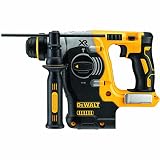
A hammer drill is not the same as an impact driver. An impact driver delivers rotational impacts for driving screws; it is not the right substitute for a hammer drill when drilling brick. If you are buying a tool mainly for masonry holes, compare cordless hammer drills. For occasional work on soft brick, a basic cordless drill/driver may be the more sensible purchase.
When a standard drill is enough
Use a standard drill when you are making only one or two small holes, the brick is not especially hard, and you have a sharp masonry bit. Set the drill to its normal drilling mode, not a screw-driving clutch setting. Start slowly to keep the bit from skating, then maintain steady pressure. Expect the job to take longer than it would with hammer action.
The main failure mode is friction without useful cutting. The bit may spin, heat up, and leave a shallow, smooth-sided hole. More pressure is not always the answer: it can overheat the bit, strain a small cordless drill, or cause the bit to wander. If progress stalls after a short test, stop and switch to a hammer drill rather than leaning harder.
When a hammer drill pays off
Hammer action is useful when you need several holes, are working in dense brick, or need a hole larger than a small plug requires. It breaks up the masonry as the bit rotates, so the cutting edges can clear material more quickly. For a single 6 mm hole in soft brick, the time saved may not justify buying a tool. For a row of holes or a hard wall, it can turn a frustrating job into a predictable one.
Use a dedicated masonry bit, not a wood or metal bit. A tungsten-carbide tip is typical for brick. Match the bit diameter to the anchor specification, and use hammer mode only for masonry. If your drill has selectable modes, begin without hammer action to establish the hole, then engage it if needed. Hammering can chip fragile brick faces, especially near an edge or with a blunt bit.
Drill the hole cleanly
Check for wires and pipes before drilling, and wear eye protection; masonry dust and chips can fly. Mark the hole, hold the drill square to the wall, and start at low speed. Drill to the anchor’s specified depth. A strip of tape on the bit is a simple depth marker, but do not rely on it if the hole must be especially precise.
Back the bit out periodically to clear dust, particularly in a deep hole. Do not let the bit bind or sit spinning in the hole: that generates heat and can enlarge the opening. Vacuum or brush out the finished hole as the anchor instructions recommend. Dust left inside can prevent a plug from seating fully and reduce its grip.
Seat and check the anchor
Push the anchor into the clean hole. It should fit snugly; if it drops in loosely, the hole may be oversized, the brick may have crumbled, or the anchor may be wrong for the material. Do not try to rescue a poor hole by forcing in a larger plug unless its specified hole size and load rating suit the job. Move to sound brick and drill a new, correctly sized hole.
Drive the screw without overtightening. A plastic plug expands as the screw enters; excessive torque can spin the plug or strip the brick around it. For heavy, overhead, or safety-critical loads, use an anchor rated for the substrate and load rather than assuming an ordinary plastic plug is adequate. A standard drill is fine for light-duty installation in soft brick, but the right bit, clean hole, and correctly matched anchor matter more than extra power.