Our Top Picks
 Makita XFD10Z 18V LXT Lithium-Ion Cordless Driver-Drill1/2"8.6 x 3.7 x 8.9 Inches2.93 poundsCheck on Amazon
 Makita CT225SYX 18V LXT® Lithium-Ion Compact Cordless 2-Pc.No Size12.99 x 9.25 x 9.88 InchesCheck on Amazon
 Makita FD09R1 12V max CXT® Lithium-Ion Cordless 3/8"No Size4.37 x 14.49 x 11.93 inches6.75 PoundsCheck on Amazon
 Makita XFD131 18V LXT® Lithium-Ion Brushless Cordless 1/2"One Size10.16 x 15.08 x 6.06 inches7.25 poundsCheck on Amazon
 Makita XPH12Z 18V LXT Lithium-Ion Compact Brushless Cordless7.8"L x 3.6"W x 9.5"H3.6 x 7.8 x 9.5 inches3.09 poundsCheck on Amazon
 Makita XPH16Z 18V LXT® Lithium-Ion Compact Brushless Cordless18 volts6.9 x 3.47 x 6.9 inchesCheck on Amazon
What's inside
- What Makita gets right
- The buying criteria, in order of weight
- Reading a Makita model number
- What separates a good pick from a bad one at each price band
- The drills in this guide, side by side
- Which one suits you, and who should skip it
- One More Pick From the Top List: XPH16Z
- Three more drills worth a look
- Two More Makita Drills for Heavy Work: XFD14Z and GPH01Z
- More Makita LXT Drills for Different Jobs: XFD12Z, XFD13 and XDT14Z
- What Independent Makita Drill Reviews Found
- How We Chose the Drills in This Makita Cordless Drill Review
- Perks of Buying a Makita LXT Drill
- Where Makita loses
- LXT or XGT for a drill?
- Makita CT225SYX vs TD173D vs DF333D: What Each One Is
- Makita vs DeWalt, in one paragraph
- Batteries and chargers: the half of the kit people skip
- Drill, hammer drill or impact driver?
- Warranty and service
- Mistakes that cost people money
- FAQ
- More Makita Drill Questions
- Related Guides
As an Amazon Associate I earn from qualifying purchases. This post may contain affiliate links at no extra cost to you.
If you hand a Makita LXT brushless drill to somebody who has only used budget tools, the first thing they say is how smooth it feels. That is not marketing fluff — Makita puts real engineering into vibration, balance and motor control, and you feel it in your forearm after a long day.
Pros come back for a duller reason than brand loyalty. A drill you hold for six hours is an ergonomics problem before it is a power problem: nobody runs out of torque on normal work with a modern brushless 18V drill, they run out of wrist. The hard part is buying one. The range is enormous, the kits vary wildly in what is actually in the box, and Makita rarely discounts anything, so a bad choice means premium money for a tool that is worse than the cheaper thing beside it on the shelf.
As an Amazon Associate we earn from qualifying purchases at no extra cost to you. Prices and availability change often, so check the current listing before you buy.


Here is what the LXT drill range looks like once you strip out the model-number confusion.
| Type | What it is | Best for |
|---|---|---|
| Compact brushless drill/driver | Light, short, everyday | Homeowners, cabinet work |
| Brushless hammer drill | Adds masonry mode | General building |
| Sub-compact (CXT 12V) | Very light, small | Electrical, overhead, finish |
| XGT 40V drill | Separate platform | Heavy sustained drilling |
Two of those rows cover almost everybody. The compact brushless drill/driver is the default answer; the hammer drill is the answer if masonry turns up in your work more than once or twice a year. The other two are specialist tools that get bought for the wrong reasons.

Updated October 2026 — Makita LXT drill review in one line: the Makita XFD131 18V LXT brushless driver-drill kit is the best Makita drill for most people, with 440 in-lbs of torque, a 2-speed gearbox (0-500/0-1,900 RPM) and a 3.0Ah pack in the box. Add a hammer mode only if you drill brick or block often.
Quick picks by need:
- Best overall: Makita XFD131 — compact brushless 18V LXT kit · 440 in-lbs · 1/2″ chuck
- Best hammer drill on 18V: Makita XPH14Z — 1,250 in-lbs · hammer mode · tool only
- Best lightweight: Makita FD09R1 — 12V max CXT · 3/8″ chuck · for overhead and cabinet work
- Best kit with big batteries: Makita XT269T — drill plus impact driver · 5.0Ah packs
- Most powerful: Makita GPH01Z — 40V max XGT hammer driver-drill · 1,250 in-lbs · 0-2,600 RPM
What we cover
- What Makita gets right
- The buying criteria, in order of weight
- Reading a Makita model number
- What separates a good pick from a bad one at each price band
- The drills in this guide, side by side
- Which one suits you, and who should skip it
- One More Pick From the Top List: XPH16Z
- Three more drills worth a look
- Two More Makita Drills for Heavy Work: XFD14Z and GPH01Z
- More Makita LXT Drills for Different Jobs: XFD12Z, XFD13 and XDT14Z
- What Independent Makita Drill Reviews Found
- How We Chose the Drills in This Makita Cordless Drill Review
- Perks of Buying a Makita LXT Drill
- Where Makita loses
- LXT or XGT for a drill?
- Makita CT225SYX vs TD173D vs DF333D: What Each One Is
- Makita vs DeWalt, in one paragraph
- Batteries and chargers: the half of the kit people skip
- Drill, hammer drill or impact driver?
- Warranty and service
- Mistakes that cost people money
- FAQ
- More Makita Drill Questions
- Related Guides
What Makita gets right
Ergonomics. Grip circumference, balance point and trigger feel are consistently better than average. Overhead work is where this shows up most. A drill whose mass sits behind the chuck instead of hanging off the front of your hand is the difference between finishing a ceiling run and shaking your arm out every ten fixings. The trigger matters too: the useful part of the travel is the first third, and that is where you either start a screw cleanly or cam out.
Vibration and noise. Noticeably lower than most rivals. In an occupied house that matters more than you would think. Less vibration also means a bit that wanders less starting a hole, and a clutch you can feel loading up before it lets go.
Battery gauge and charger. Makita’s rapid chargers are fast and the packs have decent protection electronics. The charger is the part buyers ignore and then resent: two packs plus a rapid charger means you never stop, while a slow charger turns a two-battery kit into a one-battery kit with an intermission.
Range depth. LXT covers well over 250 tools, so one battery genuinely can run a whole shop. In five years that will matter more than any number printed on the box, because the drill is rarely the last Makita thing you buy.
The buying criteria, in order of weight
Most guides hand you a feature list and leave you to guess which features decide anything. This is how the criteria are weighted here, from most to least important.
- The battery platform you are joining. This outranks everything else combined. Already own LXT packs? Buy LXT and stop reading comparisons. Own another brand? The real question is whether Makita’s feel justifies a second charger and a second set of packs.
- What is in the kit. Two decent packs, a rapid charger and a case is a working kit; one small pack and a slow charger is a demonstration. Identical tools sit in very different kits, and that is where most of the price gap hides.
- Brushless over brushed. More runtime per charge, more usable power for the same weight, less to wear out. Paying near-brushless money for a brushed motor is the commonest way to overpay here.
- Length and weight against chuck capacity. A short drill gets between studs and inside cabinets; a bigger one takes a 1/2″ chuck and holds large bits without slipping. Decide which of those problems you actually have.
- Hammer function. Worth it only if brick, block or concrete are regular. Otherwise it is length, weight and money spent on a mode you forget exists.
The order is the point. Different platforms? That decides it and nothing else gets a vote. Same platform? Kit contents decide it. Specs only break ties between tools that will both do the job.
Reading a Makita model number
Half the confusion in the Makita range disappears once you can read the model code. It tells you the platform, the tool type and whether a battery is in the box, which is exactly the information that decides value.
- XFD is an 18V LXT driver-drill: drilling and screw driving, no hammer mode.
- XPH is an 18V LXT hammer driver-drill: the same job plus a percussion setting for brick and block.
- XDT is an 18V LXT impact driver, the usual partner in a two-tool kit.
- FD codes such as FD09 are 12V max CXT driver-drills, the slide-pack sub-compact line.
- G codes such as GFD and GPH are 40V max XGT tools, a separate battery platform.
- XT, CT and CX at the start of a code usually mark a combo kit rather than a single tool.
- Z at the end means tool only: no battery, no charger. ZB is the black-finish version of a bare tool, as on the XFD15ZB.
Kit suffixes vary, and trying to memorise them is a waste of effort. The reliable shortcut is the battery size printed in brackets in the listing title, such as 1.5Ah, 3.0Ah or 5.0Ah, plus the “kit includes” line. Higher numbers within one family are usually newer generations, but newer is not automatically better for your work — an older compact brushless drill with two big packs will out-work a newer one sold with a single small pack.
What separates a good pick from a bad one at each price band
The bottom shelf
The pattern is a brushed motor, one small pack, a slow charger, sometimes a bag instead of a case. You get the badge and almost none of the reasons to want it, and a mid-tier brushless kit from a cheaper brand will out-work it. If your budget only reaches here, buy a better spec from a lesser brand rather than a worse spec from this one.
The middle
Where the honest kits live: compact brushless drill/driver, two decent packs, rapid charger, case. Good and bad picks at this level are separated by the packs and the charger, not the tool. Two large packs is something you can work out of all day; two small ones at nearly the same money is the same drill with less runway.
The top
Here you pay for percussion, larger packs, big combo kits or a different platform. Fair if the feature maps to work you do weekly. Not fair when you buy a four-tool combo to get the two tools you need, because the bundle is usually subsidised with smaller batteries. Buy the drill kit you want, then add bare tools onto packs you already own.
The drills in this guide, side by side
Torque figures are the manufacturer’s maximums and are only roughly comparable between tools. Use the table to rule tools in or out, then let kit contents decide.
| Model | Platform | Motor | Chuck | Hammer mode | Max torque | Sold as |
|---|---|---|---|---|---|---|
| Makita XFD10Z | 18V LXT | Brushed | 1/2″ | No | 480 in-lbs | Tool only |
| Makita XFD131 | 18V LXT | Brushless | 1/2″ | No | 440 in-lbs | Kit, 3.0Ah |
| Makita XFD15ZB | 18V LXT sub-compact | Brushless | 1/2″ | No | 350 in-lbs | Tool only |
| Makita XPH12Z | 18V LXT compact | Brushless | 1/2″ | Yes | 530 in-lbs | Tool only |
| Makita XPH16Z | 18V LXT compact | Brushless | 1/2″ | Yes | 970 in-lbs | Tool only |
| Makita XPH14Z | 18V LXT | Brushless | 1/2″ | Yes | 1,250 in-lbs | Tool only |
| Makita FD09R1 | 12V max CXT | Brushed | 3/8″ | No | 250 in-lbs | Kit, 2.0Ah |
| Makita CT225SYX | 18V LXT | Brushed | Drill + impact driver | No | 480 in-lbs (drill) | 2-tool kit, 2 x 1.5Ah |
| Makita XT269T | 18V LXT | Brushless | Hammer drill + impact driver | Yes (drill) | 530 in-lbs (drill) | 2-tool kit, 2 x 5.0Ah |
Two things stand out. First, the brushed XFD10Z quotes more torque than the brushless XFD131, which is a good reminder that the torque number is not the reason to buy brushless; runtime, heat and how the motor holds speed under load are. Second, the sub-compact XFD15ZB gives up some torque for a shorter, lighter body, which is the right trade for overhead and cabinet work and the wrong one for big augers.
The 12V FD09R1 is the outlier: smaller chuck, lower torque, separate batteries. That is fine for a second drill but it does not share packs with anything else in the table.
Which one suits you, and who should skip it
Makita LXT brushless drill kits
The standard recommendation. Get the kit with two 5Ah packs if you can find it — the small-battery kits undersell the tool.
Suits almost everyone: homeowners doing real projects, joiners, cabinet fitters, anyone drilling wood, plasterboard, metal and screws. Skip it if your walls are masonry and you are constantly plugging fixings into brick — buy the hammer version and avoid owning two drills.
Makita LXT hammer drill
Adds percussion for brick and block. Same smooth motor, slightly more weight.
Suits general builders, renovators and anyone in an older masonry house. You carry a little extra length and weight all day for a job you do occasionally, which is a fair trade if occasionally means weekly. Skip it for furniture and cabinet work, where the longer nose is a nuisance — and do not treat it as a substitute for a rotary hammer if you drill big holes in concrete repeatedly.
Makita CXT 12V sub-compact
For electricians, installers and anyone working above shoulder height all day. Surprisingly capable for the size.
Suits electricians, AV and alarm installers and kitchen fitters; the weight saving is felt by lunchtime, not on paper. Skip it as your only drill. It is an excellent second drill and a compromised first one, because sooner or later you meet a hole it cannot finish — usually a big auger or hole saw in a joist.
One More Pick From the Top List: XPH16Z
Makita XPH16Z Compact Brushless Hammer Driver-Drill — Best Step-Up Hammer Drill in a Compact Body
Makita lists the XPH16Z at 970 in-lbs of torque, 0-550 and 0-1,800 RPM, up to 27,000 blows per minute in hammer mode, a 1/2″ chuck and a brushless motor. The body is about 6-7/8 inches long and 4.9 lb with a battery, and it is sold tool only, so you need LXT packs and a charger.
It sits between the lighter XPH12Z and the heavier XPH14Z. Pick it if masonry turns up now and then and you still want a drill you can hold overhead. Skip it if you rarely touch brick; a driver-drill without hammer mode does the everyday job for less.
Three more drills worth a look
The picks above cover most buyers. These three fill the gaps: a heavy-duty LXT hammer drill, a kit that comes with the big batteries this guide keeps recommending, and the obvious cross-shop if you are not yet committed to Makita.
Makita XPH14Z Hammer Driver-Drill — Best for Heavy Drilling on LXT

The XPH14Z is the drill to buy when the compact models start to struggle. It is a full-size 18V LXT brushless hammer driver-drill with a 1/2″ chuck, rated at up to 1,250 in-lbs of torque, which puts large spade bits, self-feed bits, long augers and hole saws through joists comfortably within reach. The hammer mode handles brick and block for anchors and fixings.
The cost is size and weight. It is noticeably heavier than the compact XPH12Z and XPH16Z (about 6 lb with a battery against roughly 4 to 5 lb), so it is a poor choice for cabinet work, overhead fixing or anything inside a tight bay. It suits framers, plumbers, electricians drilling a lot of large holes, and renovators who want one LXT drill that never runs out of muscle.
- Pro: Highest torque rating in this guide
- Pro: Hammer mode for masonry fixings
- Pro: Runs on the same LXT packs as everything else
- Con: Noticeably heavier than the compact models
- Con: Tool only, so packs and charger are extra
Makita XT269T Brushless Combo Kit — Best Kit With Big Batteries

Earlier we said the small-battery kits undersell the tool and that two 5.0Ah packs are what you want. The XT269T is that advice in a box: an 18V LXT brushless two-tool kit pairing the XPH12Z hammer driver-drill with an XDT13Z impact driver, supplied with two 5.0Ah batteries and a rapid charger. Check the listing for the exact models, charger and case included, as kit contents are what you are really paying for.
It suits homeowners starting serious renovation work and tradespeople setting up on LXT for the first time, because the impact driver takes over long screws and lag bolts while the drill stays on holes and clutch-controlled driving.
- Pro: Brushless drill and impact driver together
- Pro: Large 5.0Ah packs for full-day runtime
- Pro: Strong starting point for building out the LXT platform
- Con: Higher entry price than a single-tool kit
- Con: 5.0Ah packs add weight for overhead work
Milwaukee M18 FUEL 2903-20 Drill/Driver — Best Cross-Shop Alternative

If you are choosing a platform from scratch, Milwaukee’s M18 FUEL drill/driver is the tool most often weighed against a premium Makita. The 2903-20 is a brushless 1/2″ drill/driver sold as a bare tool, aimed squarely at trade users who want maximum performance from an 18V platform. Milwaukee’s appeal is a deep catalogue, especially for plumbing and electrical specialist tools, and plenty of jobsite support.
The battery-platform rule still applies. If you already own M18 packs, this is the sensible drill and Makita is not worth a second charger. If you own neither, compare the feel in the hand, the kit deals available at the time, and which specialist tools you will want in two years.
- Pro: Flagship brushless performance on M18
- Pro: Huge range of trade-specific tools on the same packs
- Pro: Natural pick for existing M18 owners
- Con: Tool only; batteries and charger are extra
- Con: Starting a second platform if you already own LXT
Two More Makita Drills for Heavy Work: XFD14Z and GPH01Z
Both of these appear in competitor guides and fill a gap in the line-up above: a full-power LXT drill without the hammer mode, and the XGT 40V hammer drill for people who drill big holes all day.
Makita XFD14Z 18V LXT Brushless Driver-Drill — Best high-torque LXT drill without hammer mode

- Max torque: 1,250 in-lbs
- Speed: 2-speed, 0-550 / 0-2,100 RPM
- Length: 7 in, 14% shorter than the model it replaced
- Weight: 5.7 lb with an 18V battery
- Chuck: all-metal 1/2″ self-ratcheting; XPT dust and water resistance; LED light
- Sold as: tool only
The XFD14Z is the XPH14Z without the percussion mode. That makes it the better pick for framers, deck builders and anyone running self-feed bits and large hole saws through lumber who never drills masonry. Dropping the hammer mechanism does not shrink the tool much, but it removes the clutch-collar position you can set by accident and the extra wear parts that come with percussion. At 7 inches long it is short for a drill in this torque class.
Pros:
- Same 1,250 in-lbs rating as the XPH14Z hammer drill
- Short head for a drill in this torque class
- Metal ratcheting chuck holds big bits under load
Cons:
- Heavy for overhead and cabinet work at 5.7 lb
- Tool only; needs 5.0Ah packs to make sense
Skip it if… you drill brick or block even once a month; the XPH14Z adds the hammer mode and usually sells for the same or less.
Makita GPH01Z 40V max XGT Hammer Driver-Drill — Best for sustained heavy drilling

- Max torque: 1,250 in-lbs
- Speed: 0-650 / 0-2,600 RPM; 0-9,750 / 0-39,000 BPM
- Capacity: 3″ wood, 13/16″ masonry, 13/16″ steel; 6″ hole saw in wood
- Clutch: electronic, 41 settings in low and 21 in high
- Weight: 6 lb with battery; length 7-1/8 in
- Safety: AFT kickback control cuts the motor if the bit binds
The GPH01Z quotes the same peak torque as the XPH14Z, so the case for it is not the headline number. It is speed and sustained output: Makita rates it up to 35% faster drilling than its 18V XPH07, and the 40V packs hold that output longer before the motor backs off. The AFT kickback cut-off matters more on a drill this strong, because a bound auger can twist a wrist. Makita has since added the GPH03, rated at up to 1,590 in-lbs, for people who want even more.
Pros:
- Faster under heavy load than the 18V hammer drills
- Kickback cut-off and an electronic clutch with fine control
- XPT dust and water resistance for site work
Cons:
- Separate 40V battery platform; LXT packs do not fit without an adapter
- Heaviest drill here at 6 lb with battery
Skip it if… you already own LXT packs and do not drill large holes daily; the XPH14Z covers most of the same work.
More Makita LXT Drills for Different Jobs: XFD12Z, XFD13 and XDT14Z
These three fill gaps in the line-up above: a compact driver-drill with more torque, the bare-tool version of the kit pick, and a brushless impact driver to pair with any of them.
Makita XFD12Z 18V LXT Brushless Driver-Drill – Best Compact Drill With More Torque

The XFD12Z sits between the everyday XFD13 and the full-size XFD14Z. It is a compact brushless 1/2″ driver-drill that gives up very little length for a useful jump in torque, so it suits tradespeople who want one drill for cabinets, framing screws and the occasional large bit. It is sold as a bare tool, which makes it a good add-on once you already own LXT packs.
- Max torque: 530 in-lbs
- Speed: 2-speed, 0-500 / 0-2,000 RPM
- Length: 6-3/4 in; weight 3.9 lb with battery
- Chuck: 1/2″; brushless motor
- Extras: dual LED lights, XPT dust and water resistance, Star Protection electronics
Pros: strong for a compact body; weather-resistant build; works with every LXT pack. Cons: tool only, so a battery and charger are extra; costs more than the XFD13. Skip it if you want a complete kit out of the box and do not need the extra torque.
Makita XFD13 18V LXT Brushless Driver-Drill, Bare Tool – Best Bare Tool for Existing LXT Owners

This is the same drill that ships in the XFD131 kit, sold on its own. If you already have LXT batteries and a charger, it is the cheapest way to add a brushless driver-drill and the one most buyers should compare against the XFD10Z before spending more. It stays short and light enough for overhead work.
- Max torque: 440 in-lbs
- Speed: 2-speed, 0-500 / 0-1,900 RPM
- Length: 6-5/8 in; weight 3.8 lb with battery
- Chuck: 1/2″; brushless motor
- Sold as: tool only (no battery, charger or bag)
Pros: brushless efficiency at a bare-tool price; light for its class; easy to find a matching kit later. Cons: no battery in the box; less torque than the XFD12Z. Skip it if you do not own LXT packs yet, because the XFD131 kit costs less than buying a pack and charger separately.
Makita XDT14Z 18V LXT Brushless Impact Driver – Best Impact Driver to Pair With an LXT Drill
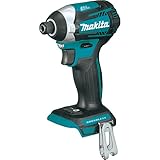
Every drill in this guide pairs well with an impact driver for long screws and lag bolts. The XDT14Z is a brushless 3-speed impact driver with a Quick-Shift mode that adjusts speed and torque as the fastener seats, which helps on decking and cabinet screws where overdriving is a risk. It uses the same LXT packs as the drills.
- Max torque: 1,550 in-lbs
- Speed: 3-speed, 0-1,100 / 0-2,100 / 0-3,600 RPM
- Length: 4-5/8 in; weight 3.3 lb with battery
- Collet: 1/4″ hex; brushless motor
- Extras: Quick-Shift mode, tightening mode, XPT dust and water resistance, dual LED lights
Pros: strong torque in a short body; precision modes reduce stripped screws; shares LXT packs. Cons: tool only; not a drill replacement because it has no clutch. Skip it if you rarely drive long fasteners and a drill-driver already covers your screws.
What Independent Makita Drill Reviews Found
We did not run our own drilling trials for this Makita cordless drill review, so it is worth knowing what outlets with timed and lab-style trials reported. Their findings broadly support the picks above.
- Makita XFD131: Reviewed.com named it its top cordless drill overall, and in its timed drilling trials it was fastest or tied for fastest. Reviewed.com last updated that guide in December 2024, so newer rivals may not have been in the field.
- Makita XPH12 kit: HGTV reported that the kit’s battery drilled 122 holes at 1-1/4 inches before running flat, more than double the DeWalt 20V in the same trial.
- Makita FD07R1 (12V brushless): Consumer Reports picked it as a compact choice, noting it weighs just over 2 lb yet scored well for power against some 18V and 20V drills. It is the brushless sibling of the FD09R1 in this guide.
- Makita GFD02 (40V compact XGT): Consumer Reports rated it above average for power and speed but heavy at about 4.2 lb.
The common thread: Makita’s compact LXT drills earn their reputation on balance and speed rather than peak torque, and the XGT tools are where the extra power lives.
How We Chose the Drills in This Makita Cordless Drill Review
This guide is research-based. We compared Makita’s published specifications (torque, speed, length, weight with battery, chuck type), the actual contents of each kit, and findings from independent reviewers with timed or lab-style trials. Drills were weighted by the criteria set out earlier: platform first, then kit contents, then brushless motor, then size against chuck capacity, then hammer mode. Torque figures are maker ratings, not our measurements.
Perks of Buying a Makita LXT Drill
The main perks of buying a Makita LXT drill are a shared 18V battery platform, a brushless motor option, built-in protection electronics, and a three-year limited warranty.
- One battery for the whole system: every LXT pack fits every LXT tool, and the range runs past 250 tools, so a drill is a cheap way into saws, impact drivers, lights and outdoor tools.
- Longer runtime from brushless motors: Makita rates its brushless tools at up to 50% more runtime per charge than brushed motors, which matters most on long days with a single pack.
- Protection electronics: Star Protection computer controls guard the tool and pack against overload, over-discharge and overheating, and models with XPT add dust and water resistance for site work.
- Compact bodies: the XFD13 is 6-5/8 inches long and the XFD12Z is 6-3/4 inches, so both fit between studs and inside cabinets.
- Warranty: Makita has long offered a three-year limited warranty on LXT tools in the US; check the current terms for your purchase.
These perks only pay off if you stay on LXT. Buying a Makita drill as your only Makita tool, with no spare packs, wastes most of them.
Where Makita loses
- ✘ Rarely discounted — you pay close to list price
- ✘ XGT batteries do not fit LXT tools, which splits the platform
- ✘ Fewer big-box promotions than DeWalt in the US
- ✘ Some kits ship with 3Ah packs at premium prices
All of that is avoidable. Buy kits rather than bare tools until you have a stack of packs, time the purchase to the seasonal promotion windows, and read the pack capacity in the listing before the headline spec of the drill. That one line usually decides whether a kit is good value.
LXT or XGT for a drill?
LXT. Every time. XGT’s advantage is sustained high current for big tools — a drill never gets near that ceiling. Buying XGT for a drill means paying more and starting a second battery collection for no gain. XGT earns its money on tools that pull hard for minutes and cook themselves on 18V: large rotary hammers, big saws, outdoor equipment. A drill works in bursts of a few seconds with pauses between, which is the easiest life a pack ever gets. Run XGT for the heavy stuff if you need it, but keep the drill on LXT so your light, compact tools all feed from one pile of batteries.
Makita CT225SYX vs TD173D vs DF333D: What Each One Is
These are three different tools, not three versions of one drill: the CT225SYX is a US 18V LXT two-tool combo kit, while the TD173D and DF333D are impact driver and drill-driver models sold mainly outside the US.
| Model | Type | Platform | Listed torque | Where it is sold |
|---|---|---|---|---|
| Makita CT225SYX | 2-tool kit: XFD10Z drill + XDT11Z impact driver | 18V LXT | 480 in-lbs (drill), 1,460 in-lbs (impact) | US |
| Makita TD173D | Impact driver | 18V LXT | 180 N-m (about 1,600 in-lbs) | Mainly Japan and other non-US markets |
| Makita DF333D | Drill-driver | 12V max CXT | 30 N-m (about 265 in-lbs) | Non-US markets |
For a US buyer, the CT225SYX is the only one of the three you can buy as a ready kit: two brushed tools, two 1.5Ah packs, a charger and a bag. Its packs are small, so it suits light household jobs. If you want brushless tools and larger packs, the XT269T kit above is the better step up.
The US counterparts of the other two are the brushless XDT14Z impact driver covered above for the TD173D, and the 12V CXT drills such as the FD09R1 in this guide for the DF333D. Torque figures come from the maker and regional listings, so check the page for your country before comparing.
Makita vs DeWalt, in one paragraph
DeWalt gives you a wider tool catalogue and much better deals. Makita gives you a tool that is more pleasant to use for hours. If you are buying on price, DeWalt. If the drill is in your hand all day, Makita is worth the premium.
Batteries and chargers: the half of the kit people skip
Every LXT slide-style 18V pack fits every LXT tool, regardless of when it was made, and that compatibility is the reason the platform is worth joining. The 12V max CXT packs are a separate system, and 40V max XGT packs do not fit LXT tools, so keep those lines separate in your head when you compare kits.
Pick pack size by the job, not by the box. Compact packs in the 1.5Ah to 3.0Ah range keep a drill light and well balanced for overhead work and cabinet installs. 5.0Ah packs add runtime and a little heft, and they balance nicely on hammer drills and bigger tools. A sensible setup for most people is one compact pack for light work and one 5.0Ah pack for long sessions.
Check for a fuel gauge. Many current LXT packs show remaining charge with a row of lights, but some small packs bundled in budget kits do not. A gauge saves you from starting a job on a nearly flat pack.
Rapid charger or nothing. Makita’s rapid chargers turn packs around fast enough that two batteries cover continuous work. A standard charger takes noticeably longer, which is the “one-battery kit with an intermission” problem described earlier.
Protection electronics. Makita’s Star Protection system lets the tool and pack communicate to guard against overloading, over-discharging and overheating. Look for the star marking on packs, especially if you buy spares separately.
Avoid unbranded clone packs. Cheap look-alike batteries are common for every major platform. They may lack the same protection circuitry and can void warranty coverage. Buy genuine packs, ideally when a promotion bundles them with a tool.
Drill, hammer drill or impact driver?
A driver-drill (XFD, FD) drills holes and drives screws with a clutch, so it can stop at a set torque and avoid stripping or overdriving small screws. It is the right first tool for almost everyone.
A hammer driver-drill (XPH) does all of that plus a percussion mode for brick, block and occasional concrete. Turn the hammer off and it behaves like a slightly longer, heavier drill.
An impact driver (XDT) uses rotational blows through a 1/4″ hex collet to drive long screws, lag bolts and structural fasteners with less wrist strain. It is not a drill replacement — it usually has no clutch and holds hex-shank bits only — but for decking, framing and repeated long screws it is faster and kinder to your arms. That is why two-tool kits pair a drill with an impact driver.
If you drill large holes in concrete repeatedly, none of these is the right tool; that is rotary hammer territory, as noted above.
Warranty and service
Makita has long offered a three-year limited warranty on LXT tools, batteries and chargers in the U.S. Terms can change and may differ for reconditioned tools or third-party sellers, so check the current policy and keep your receipt. Buying from an authorized dealer makes claims simpler, and it is one more reason to avoid suspiciously cheap listings for packs and tools.
Mistakes that cost people money
- Buying the bare tool with no packs. Adding a battery and charger separately usually costs more than the kit would have, and you wait for a delivery before you can use the drill.
- Chasing the biggest torque figure. Past a certain point you cannot brace against it anyway. Runtime, balance and clutch control are what you notice at the end of a day.
- Buying hammer function “just in case”. The just-in-case job happens twice; the extra weight happens every day.
- Starting a second platform by accident. A cheap tool on a different battery system stops being cheap the moment it needs its own charger and packs.
FAQ
Is Makita 18V weaker than DeWalt 20V? No. Same battery architecture, different marketing labels — one brand quotes nominal voltage, the other quotes peak.
Are Makita batteries expensive? Mid-range. Cheaper than Milwaukee, roughly level with DeWalt. Buy capacity when a promotion appears; a spare large pack changes how the tool feels to own more than any accessory will.
Which Makita drill for a beginner? A compact LXT brushless drill/driver kit. Skip the hammer function unless you have masonry walls, and put the saving into a second pack or a decent bit set.
Kit or bare tool? Kit, until you own two healthy packs and a rapid charger. After that, bare tools are the cheapest way to expand, and that is the whole reason to pick a deep platform in the first place.
Check Makita drill prices →What is the difference between Makita XFD and XPH drills? XFD models are driver-drills for wood, metal and screws. XPH models add a hammer mode for brick and block. If masonry is rare in your work, the XFD is lighter, shorter and cheaper for the same everyday performance.
Does a Makita drill come with a battery? Only the kits. Any model ending in Z is tool only, with no battery or charger. Kits list the battery size in the title, such as the 3.0Ah pack in the XFD131 kit.
Do Makita 12V CXT batteries fit 18V LXT tools? No. CXT and LXT are separate platforms with different packs and chargers, and XGT 40V packs are separate again. Choose one main platform and buy outside it only for a specific reason, such as a very light second drill.
How much torque do I actually need? For furniture, cabinets, pilot holes and general screw driving, the 350 to 500 in-lbs class covered by the compact drills is plenty. Large augers, self-feed bits and big hole saws through framing lumber are where a high-torque model like the XPH14Z earns its weight.
Is the XFD10Z brushless? No, it uses a brushed motor. It is still a capable drill and a sensible bare tool if you already own LXT packs and want a low-cost spare, but for a main drill the brushless XFD131 kit is the better long-term buy.
Is a sub-compact drill like the XFD15ZB powerful enough? For most household work, cabinetry and overhead installs, yes. It trades some torque for a shorter, lighter body. Pair it with a bigger drill or a hammer drill if you regularly bore large holes.
More Makita Drill Questions
Which Makita LXT drill is best for a homeowner?
The Makita XFD131 kit is the best fit for most homeowners because it includes a brushless drill, one 3.0Ah battery, a charger and a bag. Add a second pack if you work for more than an hour at a time.
What is the difference between the Makita XFD12Z and XFD13?
The XFD12Z is the stronger drill, with 530 in-lbs and 0-2,000 RPM against the XFD13’s 440 in-lbs and 0-1,900 RPM. Both are compact brushless 1/2″ drills, but the XFD12Z adds XPT dust and water resistance.
Is the Makita CT225SYX brushless?
No. The CT225SYX combo kit pairs a brushed XFD10Z drill with a brushed XDT11Z impact driver, plus two 1.5Ah batteries and a charger. Step up to the XT269T for brushless tools and 5.0Ah packs.
Is the Makita XFD131 still worth buying in 2026?
Yes, the Makita XFD131 is still worth buying in 2026 as an everyday driver-drill kit. Its 440 in-lbs and 0-1,900 RPM cover furniture, cabinets, plasterboard and pilot holes, and the kit includes a 3.0Ah pack. Buy the XFD14Z or XPH14Z instead only if you bore large holes in framing lumber often.
When does a Makita XGT 40V drill make sense over LXT?
A Makita XGT 40V drill makes sense only if you already run XGT tools or drill large holes for long stretches every day. For mixed work, an LXT drill shares packs with far more tools, so the GPH01Z is a specialist pick rather than a default.