What's inside
- Rotary Hammer Buying Guide: Picking the Right Impact Energy for Your Job
- Match impact energy to the job
- Choose by situation, not by the biggest number
- One-inch holes: check the whole setup
- Corded or cordless? Estimate runtime before buying
- Ownership details that affect the choice
- Quick buying decision
- Related Guides
- Rotary Hammer Buying Guide: Picking the Right Impact Energy for Your Job
- Match impact energy to the job
- Choose by situation, not by the biggest number
- One-inch holes: check the whole setup
- Corded or cordless? Estimate runtime before buying
- Ownership details that affect the choice
- Quick buying decision
- Related Guides
As an Amazon Associate I earn from qualifying purchases. This post may contain affiliate links at no extra cost to you.
What we cover
- Rotary Hammer Buying Guide: Picking the Right Impact Energy for Your Job
- Match impact energy to the job
- Choose by situation, not by the biggest number
- One-inch holes: check the whole setup
- Corded or cordless? Estimate runtime before buying
- Ownership details that affect the choice
- Quick buying decision
- Related Guides
Rotary Hammer Buying Guide: Picking the Right Impact Energy for Your Job
For Tapcon screws and occasional small holes, choose a light rotary hammer around 1–2 joules; for routine half-inch anchors and one-inch holes, look around 2–4 joules; for frequent large holes or light chiseling, consider 4–6 joules or more, provided the tool’s weight and bit capacity suit the work.
Impact energy is a useful starting point, not a guarantee of speed. Bit quality, concrete hardness, hole depth, tool weight, and how comfortably you can control the machine all affect the result. Use the ranges below to narrow your choice, then check the manufacturer’s stated drilling capacity and duty guidance.
As an Amazon Associate we earn from qualifying purchases at no extra cost to you.
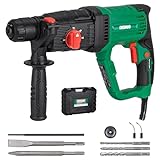


Match impact energy to the job
| Typical work | Useful impact-energy range | Common tool class | What to watch for |
|---|---|---|---|
| Tapcon-style concrete screws; small holes, usually about 3/16–1/4 in. | About 1–2 J | Compact SDS-Plus | Frequent drilling or thick, hard concrete may favor more capacity. |
| Half-inch anchors; repeated holes around 3/8–5/8 in. | About 2–4 J | Mid-size SDS-Plus | Check the exact bit diameter and recommended drilling range. |
| Occasional one-inch holes in concrete | About 3–5 J | Powerful SDS-Plus or compact SDS-Max | For repeated deep holes, SDS-Max generally offers more headroom. |
| Light chiseling: tile removal, small channels, loose mortar | About 2–5 J | SDS-Plus with hammer-only mode | Tool balance and vibration control matter as much as peak energy. |
| Frequent large holes or sustained demolition | About 5 J and up | SDS-Max | Expect more weight, larger bits, and higher fatigue in overhead work. |
These are practical selection bands, not standardized thresholds. Manufacturers may measure or publish impact energy differently, so compare tools within the same brand or test standard where possible. A tool’s maximum drilling diameter is also not its ideal everyday diameter: routinely working at the maximum can be slow and hard on both the tool and operator.
Choose by situation, not by the biggest number
- Occasional homeowner, a few small holes a year: A compact SDS-Plus tool around 1–2 J is usually easier to store and control than a heavier model. If the holes are shallow and infrequent, a hammer drill may be enough; it is not the same tool as a rotary hammer and is generally less effective in concrete.
- Regular anchor installation: For multiple half-inch holes, a 2–4 J SDS-Plus rotary hammer is a sensible middle ground. Look for variable speed, a depth stop, and a clutch that helps limit reaction if a bit binds.
- One-inch holes are occasional: A higher-output SDS-Plus model may handle them if its manual supports that diameter. If the work involves many deep holes, a larger SDS-Max tool can maintain a more comfortable margin, though it costs more and is harder to use in tight or overhead spaces.
- Light chiseling is part of the job: Confirm the tool has a hammer-only mode and accepts suitable chisels. For tile removal or short channels, controllable power is more useful than maximum impact energy; a heavy demolition hammer is excessive for delicate work.
- Frequent heavy work: Choose for the workload and bit system first. SDS-Max bits and tools are intended for larger, demanding applications, but their extra weight can be a disadvantage when drilling small anchor holes all day.
One-inch holes: check the whole setup
A one-inch hole can mean very different things: a shallow anchor hole, a deep pass through reinforced concrete, or a series of holes for services. Check the tool’s stated capacity for solid masonry and the bit type you plan to use. Long bits increase binding risk, while rebar can stop or damage a standard masonry bit. Do not force the tool or assume that higher joules make it appropriate for cutting reinforcement.
For a single occasional hole, renting a suitable SDS-Max tool may be more practical than buying one. For repeated work, compare the larger tool’s extra capacity with its carrying weight, compatible bit costs, and the fatigue of handling it across a full shift.
Corded or cordless? Estimate runtime before buying
Corded rotary hammers provide continuous power without battery changes and are a strong fit for long sessions near an outlet. Their drawbacks are managing the cable, needing a suitable power source, and the extra care required around wet areas and trip hazards. Use an appropriately rated extension cord if the manufacturer permits one.
Cordless models are convenient for ladders, remote sites, and short jobs. Their practical output and runtime depend on the specific tool, battery capacity, concrete, bit diameter, depth, and how continuously you drill. A larger battery can add weight, and one battery rarely represents a full day of repeated drilling.
A simple planning estimate is:
Estimated holes per charge = usable drilling minutes per charge ÷ average minutes of trigger time per hole.
For example, if your own work pattern gives you 12 minutes of actual drilling per charge and each hole takes 20 seconds of trigger time, that is roughly 36 holes before allowing for pauses, battery variation, and difficult spots. Treat this as a planning method, not a promise: check manufacturer runtime information and, for production work, budget for a spare battery or a charger nearby.
Ownership details that affect the choice
- Bits are consumables: Blunt, low-quality, or unsuitable bits drill slowly and make the tool work harder. Match the shank system—commonly SDS-Plus or SDS-Max—and use a bit suited to the material and hole size.
- Keep the shank clean: Dust and grit on the bit shank can accelerate chuck wear. Wipe it before insertion and use the lubricant specified by the tool manufacturer; don’t grease the flutes unless the instructions call for it.
- Manage dust: Concrete dust is abrasive and hazardous to breathe. Use an appropriate dust-extraction setup and respiratory protection for the conditions and applicable safety guidance. Clear dust from the tool’s vents as directed, with the tool disconnected or its battery removed.
- Expect wear over time: Bits wear first in many drilling setups, but chuck components, brushes on applicable models, seals, and vibration-control parts may also need service. Check parts availability and service support if the tool will earn its keep on frequent jobs.
- Don’t force a jammed bit: A stuck bit can twist the tool suddenly. Keep a firm two-handed grip, use the auxiliary handle, and follow the manual’s guidance for clearing jams. Let the hammer mechanism do the work instead of leaning heavily on the tool.
Quick buying decision
Choose a compact 1–2 J SDS-Plus rotary hammer for occasional Tapcon-size holes; move to roughly 2–4 J for recurring half-inch anchors; and consider 3–5 J or more when one-inch drilling or light chiseling is regular rather than occasional. Pick corded for long sessions with reliable power nearby, cordless for mobility and shorter bursts, and SDS-Max when large, demanding work justifies its greater size. Before buying, verify the manufacturer’s drilling capacities, tool weight, battery platform or cord requirements, and the cost of the bits and accessories you’ll actually use.