Key takeaways
- The first time you drill a perfectly perpendicular hole at a repeatable depth, you understand why shops have one.
What's inside
As an Amazon Associate I earn from qualifying purchases. This post may contain affiliate links at no extra cost to you.
A handheld drill makes holes that are approximately straight. A drill press makes holes that are exactly perpendicular, exactly deep and exactly where you put them — repeatedly. For joinery, metalwork and any batch of identical parts, that difference is the whole point.
Nobody buys one because of a single hole. They buy one because of the fourth shelf pin that came out three degrees off and left the shelf rocking, or the wide Forstner bit that grabbed and tore the workpiece out of their hands, or a run of twelve identical parts where the twelfth has to match the first. A handheld drill can do any one of those jobs badly and still get away with it. It cannot do them the same way twenty times in a row.
As an Amazon Associate we earn from qualifying purchases at no extra cost to you. Product prices and availability are accurate as of the date shown and are subject to change.

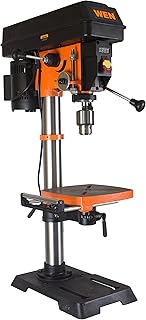

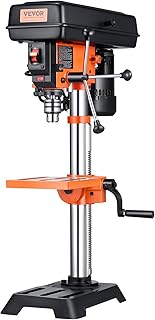
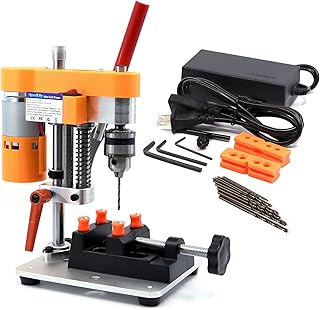


So the useful way to read a drill press buying guide is to work out which of those problems you are buying your way out of, because they are not solved by the same specs. Perpendicular holes are nearly free — every press gives you that. Repeatability comes from the table, a fence and a depth stop you can trust. Clean holes come from low runout and the right speed. Raw capacity comes from swing and quill travel. Hardly anyone needs all four maxed out, and paying for the wrong one is how people end up with a big machine that still frustrates them.
The Specs That Actually Decide It
This is the part of the listing that matters. Most of the rest is marketing.
| Spec | What it means | What to look for | |
|---|---|---|---|
| Swing | 2× throat distance | 12″ | + for general shop use |
| Quill travel | Max depth per plunge | 3″ | + is comfortable |
| Runout | Wobble at the chuck | Under 0.005″ | is good |
| Speed range | RPM options | Slow speeds matter for metal and large bits | |
| Table | Size and tilt | Bigger and flatter is better |
What no spec sheet tells you is how to weigh those against each other. For a wood-first shop I rank them runout, speed range, table, quill travel, swing. Runout comes first because it is the only one you cannot fix later: you can build a better table and bolt on a fence in an afternoon, but you cannot make a wobbling spindle run true. Speed range comes next, because it decides whether big bits and metal are pleasant or a smoking mess. Swing comes last — most furniture parts use a fraction of the throat depth people argue about, and a wide panel can be drilled from both edges.
Two numbers get overrated. Motor horsepower is one; almost nothing in a wood shop is limited by motor output before it is limited by speed. The number of speeds on a step-pulley machine is the other. Five well-spaced speeds that reach genuinely low rpm beat sixteen that all live in the fast half of the range.
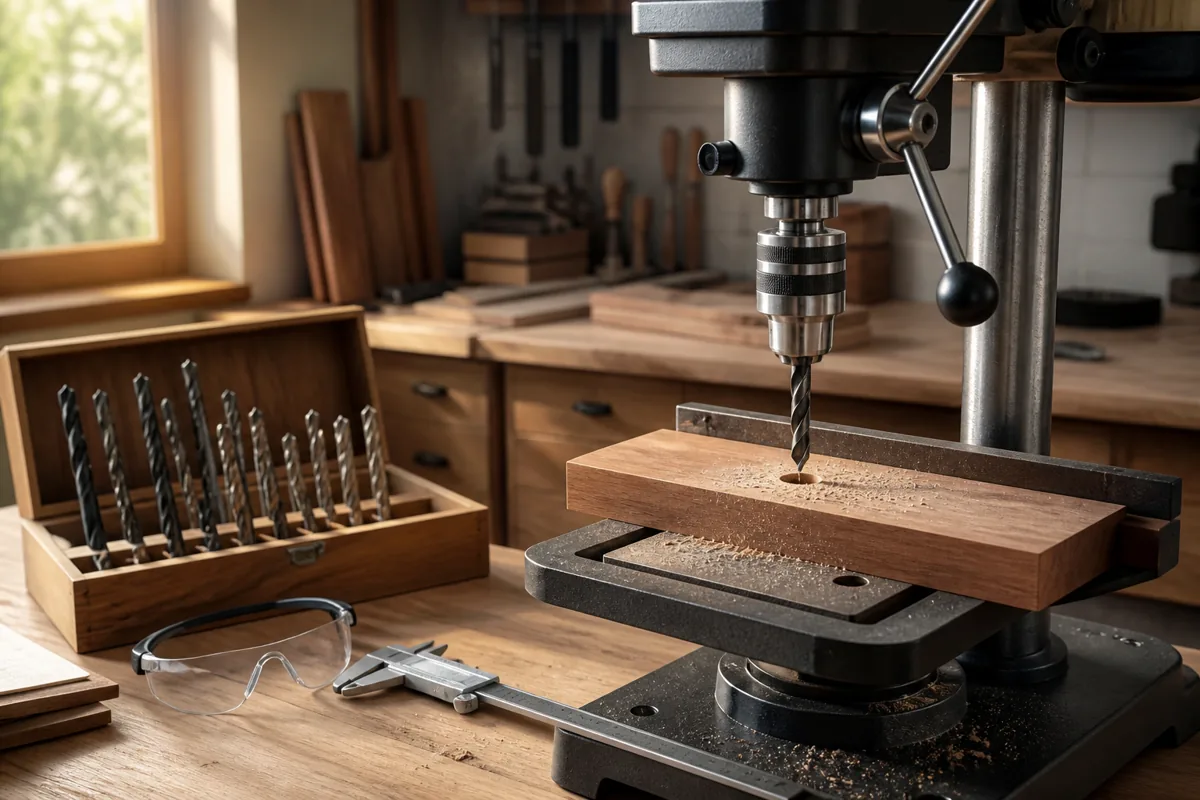
Benchtop or floor standing?
Benchtop presses cover most woodworking — they cost less, take a bench corner, and handle typical furniture parts. Floor-standing models give you height for long workpieces and usually better quill travel and rigidity.
For a garage shop, a solid benchtop press on a dedicated stand is usually the better use of space and money.
The catch with a benchtop machine is that the bench becomes part of the tool. Set a light press on a flexing worktop and you will feel the whole assembly move as you plunge, which shows up as ragged hole walls and a bit that wanders on entry. Bolt it down. A dedicated stand also lets you set the height so the table sits where your hands actually work, which matters more across an afternoon than any figure on the box.
Buy benchtop if your work is furniture parts, dowel and shelf-pin holes, small brackets and the occasional bit of hardware fitting. Buy floor standing if you drill steel regularly, handle parts taller than a bench machine will accept, or want the extra quill travel for deep boring and large Forstner work.
Benchtop drill presses
12–13 inch swing, multiple speeds, a table that tilts. Check runout on arrival — it is the spec cheap presses fail.
Floor standing drill presses
More capacity and rigidity. Worth it if you drill metal regularly or work with tall pieces.
Who should skip a press for now: if you drill a dozen holes a year in softwood, a drill guide or a self-centering doweling jig holds a bit square for a fraction of the money and none of the floor space. A press earns its footprint through repetition.
Speed matters more than power
Large bits and metal both need low speeds. A press that only goes down to 600 rpm will burn Forstner bits and work-harden steel. Look for a range starting around 200–300 rpm, or a variable-speed model.
The rule underneath that is simple: the bigger the bit and the harder the material, the slower it should turn. A small twist bit in pine is happy fast. A wide Forstner in hard maple wants the lowest speed the machine has, a slow feed, and regular retraction to clear chips. Steel wants slow plus cutting fluid — run it fast and you glaze the cutting edge, polish the hole and harden the material so the next attempt cannot bite at all.
Step pulleys are fine; a belt change takes under a minute once you have done it twice. Variable speed earns its premium if you swap bit sizes constantly, because the belt change you can skip is the one you will actually make. What I would not accept at any price is a lowest speed sitting well above the low hundreds.
What You Get as You Spend More
At the entry end you are buying geometry, not refinement: a thin table, a chuck that may or may not run true, a depth stop made of a threaded rod and two nuts, a quill return spring with the manners of a screen door. These machines still do good work if the spindle runs true, and that is the lottery. Check runout the day it arrives, while sending it back is still easy.
The middle band is where most home shops belong — heavier cast iron with real slots, less side play in the quill, a usable depth stop, a decent factory chuck, and a speed range that genuinely reaches low rpm. A bad unit here is a defect rather than a coin flip. Above that you pay for rigidity and control: castings that damp vibration, better quill bearings, a table that cranks up and down and stays square, sometimes a tapered spindle that takes better tooling. Worth it for frequent metal or production runs, overkill for shelf pins.
Mistakes That Cost People Most
- Chasing swing. A large press wedged in a corner you cannot walk around is worse than a 12″ one at your elbow.
- Not testing runout inside the return window. Chuck a long, known-straight bit, run it slow and watch the tip: a tiny circle is normal, a visible orbit is not.
- Working straight onto the bare cast table. It dulls bits and blows out the exit face.
- Trusting the depth stop for a batch without proving it on scrap first.
- Holding small parts by hand because clamping feels slow. It is slow. It also keeps the part from becoming a projectile.
Accessories that make it genuinely useful
A press out of the crate is about two thirds of a tool. This is the list that closes the gap, and it belongs in the purchase budget rather than the someday pile.
- ✔ An auxiliary wooden table with a replaceable insert and a fence
- ✔ A drill press vise for metal — never hold metal by hand
- ✔ Forstner bits, which are made for this machine
- ✔ A depth stop you can actually set precisely
- ✔ Good lighting on the spindle
Get the auxiliary table right and everything else follows: a flat plywood or MDF top fixed to the cast table, a replaceable insert under the bit, a fence to register parts against, and a stop block for repeat spacing. That combination is what turns a hole-maker into a machine that produces identical parts.
Drill press vises and tables
A vise for metal and a wooden auxiliary table with a fence for wood. Both transform how usable the machine is.
Safety
A press is calm right up until it is not. It has far more torque than a handheld drill and no sense of what is in the way, so these rules are short and absolute.
- ✘ Never hold metal workpieces by hand — a bit that grabs turns the part into a spinning blade
- ✘ No gloves near the spindle, ever
- ✘ Tie back hair and remove loose sleeves
- ✘ Clamp the workpiece for anything over small diameters
- ✘ Remove the chuck key before starting — every time
FAQ
Do I need one for woodworking? Not to start, but once you make repeated joinery or need perpendicular holes, nothing else does the job as well.
Is used worth it? Old cast-iron presses are excellent value if the quill and bearings are sound. Check runout before buying. Belts, springs and chucks are cheap to replace; a scored quill or a sloppy spindle bore is not.
What is runout and why care? Wobble at the chuck. High runout means oversized, ragged holes and broken small bits.
Does it really need bolting down? Yes. Bolted to a bench or stand, a press cuts cleaner and cannot walk when a big bit grabs. Clamps are a temporary answer, not the answer.
Buy for the problem you actually have: a true spindle, low speeds and a table you can build on will out-work a bigger machine with none of those things.
Compare drill presses →