What's inside
- Best plumber’s hole saw kit choices by situation
- Head-to-head comparison: what the main kit types actually offer
- Diameter matters more than piece count
- Bi-metal versus carbide: which teeth should plumbers buy?
- Arbor compatibility can make or break the purchase
- Decision matrix for choosing your kit
- How to make a cleaner, longer-lasting cut
- Ownership costs and common failure points
- Final buying recommendation
- Related Guides
- Best plumber’s hole saw kit choices by situation
- Head-to-head comparison: what the main kit types actually offer
- Diameter matters more than piece count
- Bi-metal versus carbide: which teeth should plumbers buy?
- Arbor compatibility can make or break the purchase
- Decision matrix for choosing your kit
- How to make a cleaner, longer-lasting cut
- Ownership costs and common failure points
- Final buying recommendation
- Related Guides
As an Amazon Associate I earn from qualifying purchases. This post may contain affiliate links at no extra cost to you.
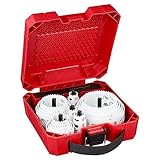
The best plumber’s hole saw kit for most installation work is a bi-metal set with 3/4-inch to 2-1/2-inch saws, a quick-change arbor, a pilot drill that can be replaced, and at least 1-5/8 inches of cutting depth; choose a carbide-grit or carbide-tipped kit instead when you regularly cut abrasive cement board, tile, or cast materials.
Plumbers usually need hole saws for two different jobs: creating clearance through wood, drywall, and plastic panels, or cutting through tougher sheet materials and occasionally metal pipe surrounds. No single kit is ideal for all of them. The useful comparison is not the number of pieces on the case, but whether its diameters match your fittings, whether the arbor fits your drill, and whether the teeth survive the material you cut most often.
As an Amazon Associate we earn from qualifying purchases at no extra cost to you.



What we cover
- Best plumber’s hole saw kit choices by situation
- Head-to-head comparison: what the main kit types actually offer
- Diameter matters more than piece count
- Bi-metal versus carbide: which teeth should plumbers buy?
- Arbor compatibility can make or break the purchase
- Decision matrix for choosing your kit
- How to make a cleaner, longer-lasting cut
- Ownership costs and common failure points
- Final buying recommendation
- Related Guides
Best plumber’s hole saw kit choices by situation
- Best all-purpose choice: a bi-metal hole saw kit covering approximately 3/4, 7/8, 1-1/8, 1-1/4, 1-1/2, 1-3/4, 2, 2-1/4, and 2-1/2 inches. This range handles many supply-line, drain, cable, and valve-clearance cuts through wood, drywall, plastic, and thin sheet metal.
- Best for frequent metal work: a professional bi-metal kit from Milwaukee Hole Dozer, Lenox, or Bosch with variable-pitch teeth and replaceable pilot bits. These cut more smoothly in sheet steel than inexpensive uniform-tooth sets.
- Best for abrasive panels: a carbide-grit or carbide-tipped kit. It is slower and less forgiving than bi-metal, but better suited to cement board, fiberglass-reinforced panels, tile, and some composite materials.
- Best compact option: a six- to nine-piece kit containing only the diameters used for your normal service work. It takes less room in a van and avoids paying for large saws that rarely leave the toolbox.
- Best budget option: a basic bi-metal set with fewer saws, provided the arbor is rigid, the pilot drill is replaceable, and replacement cups are readily available.
Head-to-head comparison: what the main kit types actually offer
| Kit type | Common diameter range | Typical cutting depth | Tooth or edge material | Best materials | Typical market range |
|---|---|---|---|---|---|
| Compact bi-metal plumbing set | 3/4 to 2-1/2 in. | 1-1/2 to 1-5/8 in. | High-speed-steel teeth on alloy backing | Wood, drywall, PVC, ABS, thin steel | $35-$90 |
| Professional bi-metal set | 3/4 to 4-1/2 in. | 1-5/8 to 2 in. | Variable-pitch HSS teeth | Wood, plastics, stainless and mild sheet steel | $80-$220 |
| Carbide-grit panel set | 1-1/4 to 3 in. | 1-1/2 to 2 in. | Carbide grit bonded to the rim | Cement board, fiberglass, tile, abrasive composites | $50-$160 |
| Carbide-tipped specialty set | 1 to 4 in. | 1-5/8 to 2 in. | Individual carbide teeth or inserts | Thicker panels, nonferrous metal, demanding mixed work | $100-$300 |
These are useful buying ranges rather than universal specifications. Individual Milwaukee Hole Dozer, Lenox, Bosch, and other kits differ by configuration, and some packages omit the arbor or include only one arbor for several cup sizes. Check the current case label before ordering.
Diameter matters more than piece count
A hole saw should provide clearance, not merely match the nominal pipe diameter. For a pipe passing through a wood stud or cabinet panel, allow room for movement, insulation, a sleeve, or an adjustable fitting. As a practical starting point, a hole roughly 1/4 inch larger than the outside diameter of a rigid pipe gives useful installation tolerance, while flexible tubing may need a smaller opening if it must be supported tightly.
| Typical task | Useful hole-saw size | Why this size is common |
|---|---|---|
| Small water line or tubing clearance | 3/4 to 1-1/8 in. | Leaves room around compact tubing and connectors |
| 1/2-inch nominal pipe passage | 1 to 1-1/4 in. | Allows clearance around the pipe rather than cutting an exact-fit hole |
| Valve, supply stop, or larger fitting | 1-1/2 to 2-1/2 in. | Accommodates the fitting body and installation access |
| Drain or waste-pipe clearance | 2-1/2 to 4-1/2 in. | Provides space for larger pipe, couplings, or sleeves |
Measure the actual outside diameter of the part that must pass through the opening. Nominal pipe sizes do not equal outside diameter, and fittings are often much wider than the pipe itself.
Bi-metal versus carbide: which teeth should plumbers buy?
Bi-metal teeth
Bi-metal is the safest default for mixed plumbing work. The rim combines a flexible alloy body with hardened high-speed-steel teeth, so it tolerates occasional contact with nails and handles wood, plastic, drywall, and thin metal. Variable-pitch teeth reduce vibration and help clear chips. The limitations are heat and tooth wear: forcing the saw through steel, cutting dry, or using high speed can quickly dull the rim.
Carbide-grit rims
Carbide-grit hole saws are effective on abrasive panels where ordinary teeth lose their edge. They are useful for cement board, fiberglass, laminates, and some tile. Their edge is more like a cutting surface than a row of sharp teeth, so cuts can be slower and dustier. They are a poor first choice for clean wood cuts and can chip brittle tile if the drill is pushed sideways.
Carbide-tipped teeth
Carbide-tipped saws suit demanding material-specific work, including some thicker nonferrous metal and hard panels. They can last longer than standard bi-metal when used correctly, but the tips are less tolerant of impact. A bent arbor, a wandering pilot drill, or a nail strike can damage an individual carbide tooth.
Arbor compatibility can make or break the purchase
Check three details before buying:
- Shank type: a 1/4-inch hex shank is convenient for impact-rated drills and quick bit changes, while a round shank is common on standard arbors. A hole saw arbor is not automatically suitable for an impact driver.
- Capacity: larger cups may need a larger arbor and a stronger drill. A small arbor intended for 3/4- to 1-1/4-inch cups may not safely support a 4-inch saw.
- Mounting system: some professional systems allow cups to thread or snap onto an arbor without tools. Confirm that replacement cups from the same system are available.
A replaceable pilot drill is more valuable than an extra rarely used cup. The pilot establishes the cut and prevents the rim from skating; once its tip dulls, the entire saw becomes difficult to control.
Decision matrix for choosing your kit
| Your situation | Recommended configuration | What to avoid |
|---|---|---|
| Occasional homeowner repair | Six- to nine-piece bi-metal kit, 3/4 to 2-1/2 in. | Large professional case with sizes you will not replace |
| Apprentice or general service plumber | Nine- to thirteen-piece variable-pitch bi-metal kit with spare pilot bits | Single fixed arbor and no replacement parts |
| Frequent cabinet and framing penetrations | Bi-metal set extending to 4-1/2 in., preferably with quick-change arbor | Carbide grit for ordinary wood and plastic |
| Frequent cement board or tile work | Dedicated carbide-grit set plus a small bi-metal set for wood | Using sharp-tooth bi-metal cups on abrasive panels |
| Confined service space | Compact hex-shank set with shallow cups and a short arbor | Long arbor assemblies that strike nearby framing |
How to make a cleaner, longer-lasting cut
- Mark the center and inspect both sides. Confirm there is no wire, pipe, screw, or structural fastener behind the panel. For finished surfaces, mark the exit location too.
- Use the correct speed. Start slowly until the pilot is established. Use lower speed for metal and larger diameters; excessive speed creates heat without improving the cut.
- Keep the drill square. Tilting the tool enlarges the opening, loads the arbor, and can break carbide tips. A guide block or temporary template helps on smooth panels.
- Clear chips frequently. In thick wood, withdraw the saw every few seconds. This cools the rim and prevents packed chips from rubbing against the cup.
- Finish without forcing. Reduce pressure as the saw nears the far surface. For a finished panel, pilot from one side and complete the rim from the opposite side to reduce blowout.
Ownership costs and common failure points
The pilot drill usually wears first, followed by the smaller cups because they are used more often and run at higher speeds. A replacement pilot commonly costs about $5-$20, while individual bi-metal cups often cost about $10-$45 depending on diameter and brand. Replacing one worn cup is usually cheaper than buying a larger kit, so confirm that the manufacturer sells cups separately.
For example, a $120 kit used for 60 professional cuts costs $2 per cut before replacing consumables. If half of those cuts use one frequently needed 1-1/4-inch cup and that cup wears out after 30 cuts, a $25 replacement raises the first 60-cut cost to about $2.42 per cut. This is why available replacement cups and pilot bits matter more than a low initial price.
After use, brush out chips, wipe metal-cutting residue from the arbor, and store the cups dry. Do not pry a jammed saw sideways with the drill. Stop, reverse the drill only if the tool and material allow it, or release the plug through the cup’s ejection openings. A bent arbor will make every future cut wobble.
Final buying recommendation
For most plumbers, select a professional bi-metal kit with variable-pitch teeth, 3/4- to 2-1/2-inch coverage, at least 1-5/8 inches of cutting depth, a replaceable pilot drill, and an arbor rated for the largest included cup. Milwaukee Hole Dozer, Lenox, and Bosch all offer product families in this general category, but the exact contents vary by kit. Add a separate carbide-grit set only if cement board, tile, fiberglass, or other abrasive panels are routine work. That two-kit approach costs more initially but gives cleaner cuts and avoids sacrificing a general-purpose bi-metal set on materials it was not designed to handle.