What's inside
As an Amazon Associate I earn from qualifying purchases. This post may contain affiliate links at no extra cost to you.
What we cover
Best Budget Right Angle Drill for Tight and Awkward Spaces
The best budget right angle drill for most cabinet, plumbing, and light framing work is the corded Makita DA3010F: its compact 2-5/8-inch head, 3/8-inch chuck, low weight, and variable-speed trigger make it easier to control in narrow openings than larger framing drills. For repeated drilling through studs and joists, however, a larger 1/2-inch model such as the DEWALT DWD460K is the better choice because it has more torque and accepts larger bits.
There is no single right-angle drill that is ideal for every awkward space. Compact drills prioritize head height and maneuverability; framing models prioritize torque, capacity, and durability. The important comparison is not simply the purchase price, but whether the drill can fit the opening, hold the bit you need, and survive the work you plan to give it.
As an Amazon Associate we earn from qualifying purchases at no extra cost to you.

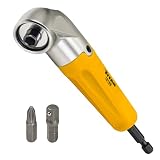


Quick comparison of affordable right-angle drills
| Model | Power and speed | Chuck capacity | Approx. head height | Overall length | Best use | Typical market range |
|---|---|---|---|---|---|---|
| Makita DA3010F | 120 V corded, 0–2,400 rpm | 3/8 in keyed | About 2-5/8 in | About 10-5/8 in | Cabinetry, electrical, finish work | $130–$190 |
| DEWALT DWD460K | 120 V corded, 0–1,400 rpm | 1/2 in keyed | About 5-1/2 in | About 17-1/2 in | Large holes in framing and joists | $250–$350 |
| Makita XAD03Z | 18 V cordless, up to 1,800 rpm | 1/2 in keyed | About 4-1/8 in | About 17-3/4 in | General construction without a cord | $200–$300 tool-only |
Dimensions can vary slightly by measurement method, chuck position, and whether a battery or side handle is fitted. Head height is the critical figure when the drill must pass between a cabinet side and a wall, while overall length matters when the operator has only a few inches of reach behind the drill.
Head-to-head: which drill fits your work?
Makita DA3010F: best compact budget choice
The DA3010F is the most practical pick when access is the main problem. Its short head and approximately 2.1-pound weight reduce wrist strain and make it possible to drill between cabinet partitions, under sinks, beside electrical boxes, and inside narrow stud bays. The 3/8-inch keyed chuck accepts common twist bits, brad-point bits, countersinks, and smaller hole saw arbors.
Its 0–2,400 rpm variable-speed trigger is useful for cabinet work. Start slowly to prevent a bit from skating across a finished panel, then increase speed once the cutting edges are established. The high top speed is especially useful for small-diameter wood bits, although it is less suitable for very large hole saws.
The limitation is torque and capacity. A 3/8-inch chuck does not accept many larger shank bits, and the drill is not the right tool for repeatedly boring 1-inch or larger holes through multiple framing members. It is also corded, so it needs a nearby outlet or an extension cord rated for the load.
DEWALT DWD460K: best budget framing option
The DWD460K is built for a different job. Its 1/2-inch chuck and lower-speed, high-torque design are better suited to auger bits and large holes through studs and joists. The long body and substantial side handles provide leverage when a large bit catches, but that same size makes it awkward inside cabinets or shallow openings.
Choose it when you routinely drill structural framing rather than occasional small holes. For example, running plumbing through a series of studs is far less frustrating with a 1/2-inch framing drill than with a compact 3/8-inch model. The trade-off is weight, reach, and price. It can be excessive for hanging doors, installing drawer hardware, or drilling pilot holes in furniture.
Makita XAD03Z: useful cordless middle ground
The XAD03Z combines a 1/2-inch chuck with cordless convenience. It is easier to use in unfinished buildings, crawlspaces, and remodels where running a cord is inconvenient. Its brushless motor and electronic speed control are advantages for repeated construction work, while the 1/2-inch capacity gives it more flexibility than a compact 3/8-inch drill.
It is not as physically small as the DA3010F, and the battery increases both length and weight. Budget carefully for a compatible 18 V battery and charger if you do not already own Makita LXT tools. A cordless drill can also become less economical when used continuously for large holes because several batteries may be needed for a full day.
Decision matrix by situation
| Your situation | Most sensible choice | Why |
|---|---|---|
| Lowest practical cost and occasional use | Makita DA3010F | One compact corded tool covers most small-hole work without battery expense. |
| Very tight cabinet or plumbing access | Makita DA3010F | Its short head is easier to position than a full-size framing drill. |
| Frequent holes through studs and joists | DEWALT DWD460K | Its 1/2-inch chuck and torque suit larger auger bits. |
| Already invested in Makita 18 V batteries | Makita XAD03Z | Battery compatibility can outweigh its higher tool-only cost. |
| New woodworker with limited experience | Makita DA3010F | Lower weight and a variable-speed trigger make control easier. |
Speed control and performance in wood
Speed should match bit diameter. Small twist bits generally work well at higher speed, while large augers and hole saws should run more slowly. A useful rule is to reduce speed as the cutting diameter increases: a 1/4-inch bit may tolerate roughly 1,500–2,400 rpm in softwood, while a 1-1/2-inch hole saw is usually more manageable around 300–600 rpm. Follow the bit manufacturer’s limits rather than treating these figures as universal settings.
For framing, torque and reaction control matter more than maximum rpm. Clamp or brace the work, keep both hands on the drill, and use the auxiliary handle when supplied. Large auger bits can grab suddenly as they break through the far side of a stud. In cabinetry, speed control and a sharp bit matter more than maximum torque. Use a sacrificial backing board to reduce breakout and stop as soon as the bit exits the workpiece.
A simple fit check before buying
Measure the narrowest opening, not the room around it. If the available height is 3 inches, a drill with a listed 2-5/8-inch head may fit, but the chuck, bit, and your hand still need clearance. Allow at least 1/4 inch of extra space for positioning and another margin if the bit must be angled.
For example, a 2-1/2-inch-wide cabinet gap with a 2-5/8-inch drill head is not workable, even if the drill’s overall length looks short. A compact head only helps when the opening exceeds the head’s widest dimension. Also check the bit length: a short drill can still be unusable if a long bit strikes the opposite panel before reaching the drilling point.
Ownership costs and common wear points
Right-angle drills usually wear first at the chuck, gear train, brushes on older corded designs, and power cord or battery interface. A keyed chuck is in