What's inside
- Best Electric Paint Sprayers for Smooth Coverage
- Quick comparison: which sprayer fits your project?
- Best electric paint sprayers by situation
- Spray patterns and flow-rate control matter more than advertised wattage
- Nozzle size and paint thinning: a practical matching guide
- Hose length, cup capacity, and ownership costs
- Decision matrix for choosing confidently
- Setup and cleanup steps that prevent most problems
- Final recommendation
- Best Electric Paint Sprayers for Smooth Coverage
- Quick comparison: which sprayer fits your project?
- Best electric paint sprayers by situation
- Spray patterns and flow-rate control matter more than advertised wattage
- Nozzle size and paint thinning: a practical matching guide
- Hose length, cup capacity, and ownership costs
- Decision matrix for choosing confidently
- Setup and cleanup steps that prevent most problems
- Final recommendation
As an Amazon Associate I earn from qualifying purchases. This post may contain affiliate links at no extra cost to you.
What we cover
- Best Electric Paint Sprayers for Smooth Coverage
- Quick comparison: which sprayer fits your project?
- Best electric paint sprayers by situation
- Spray patterns and flow-rate control matter more than advertised wattage
- Nozzle size and paint thinning: a practical matching guide
- Hose length, cup capacity, and ownership costs
- Decision matrix for choosing confidently
- Setup and cleanup steps that prevent most problems
- Final recommendation
Best Electric Paint Sprayers for Smooth Coverage
The best electric paint sprayers for most homeowners are a variable-flow HVLP sprayer with a 1.5–2.5 mm nozzle for furniture and trim, or an airless sprayer with a 0.013–0.017-inch tip for quickly covering walls and ceilings.
The right choice depends less on the motor’s headline power than on spray control, nozzle compatibility, cleanup, and how often you will use it. HVLP models are easier to control on small projects and usually create less overspray, while airless models apply wall paint much faster but require more masking and careful pressure adjustment.
As an Amazon Associate we earn from qualifying purchases at no extra cost to you.
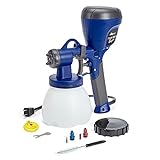


Quick comparison: which sprayer fits your project?
| Sprayer type | Typical flow rate | Common nozzle or tip sizes | Paint-thinning needs | Best uses | Typical cleanup time |
|---|---|---|---|---|---|
| Handheld HVLP | 0.1–0.25 gallons per minute | 1.0–2.5 mm | Often needed for latex paint | Small furniture, cabinets, trim, craft projects | 10–20 minutes |
| Turbine HVLP | 0.15–0.35 gallons per minute | 1.5–3.5 mm | Sometimes needed; depends on the material | Furniture, doors, built-ins, detailed finishing | 15–30 minutes |
| Airless electric | 0.20–0.50 gallons per minute | 0.011–0.021-inch tips | Usually unnecessary for standard wall paint | Walls, ceilings, fences, large rooms | 20–40 minutes |
| Air-assisted electric | 0.10–0.30 gallons per minute | Fine-finish tips, commonly 0.010–0.015 inch | Occasionally needed | Doors, cabinets, trim, larger fine-finish work | 20–40 minutes |
These are practical ranges rather than universal specifications. Actual performance changes with paint viscosity, tip condition, pressure setting, hose length, temperature, and the distance between the gun and the workpiece.
Best electric paint sprayers by situation
Best for furniture and cabinets: variable-flow HVLP
A turbine or handheld HVLP sprayer is usually the most forgiving choice for furniture. Its lower material flow makes it easier to avoid runs on table legs, drawer fronts, and cabinet edges. Look for separate controls for air volume and material flow, plus a 1.3–1.5 mm nozzle for thinner finishes and a 1.8–2.5 mm nozzle for many water-based paints and primers.
HVLP also makes it easier to build a smooth finish with several light coats. The trade-off is speed: a large dresser may need multiple refills, and thick latex paint may need straining and modest thinning. A model with a remote turbine and a 10–15-foot hose is more comfortable for furniture than a heavy handheld cup.
Best for walls and ceilings: electric airless
For a bedroom, living room, or exterior siding, an electric airless sprayer is usually the fastest option. It handles standard wall paint with little or no thinning and produces a wide fan pattern that covers broad surfaces efficiently. A 0.015-inch tip is a useful starting point for many interior latex paints, while a smaller 0.011–0.013-inch tip suits thinner materials and reduces output.
Airless speed comes with more overspray. Mask floors, windows, light fixtures, and adjacent walls thoroughly, and expect fine paint mist to travel farther than it appears to. Airless equipment also needs more careful flushing because dried paint can damage the pump, filter, or tip.
Best for trim and doors: fine-finish HVLP or air-assisted sprayer
Trim rewards control rather than maximum flow. A fine-finish HVLP sprayer with a 1.3–1.8 mm nozzle can produce an even fan on doors, baseboards, and built-ins when the paint is properly filtered. An air-assisted unit is a better choice for frequent trim work or multiple doors because it combines more consistent atomization with higher productivity.
For trim, the spray pattern should be narrow enough to keep material off nearby surfaces. A horizontal pattern is useful for vertical door stiles, while a vertical pattern works well across horizontal rails. Many guns can also produce a round pattern for corners and small parts.
Spray patterns and flow-rate control matter more than advertised wattage
Useful electric sprayers normally offer three pattern shapes: horizontal, vertical, and round. Horizontal and vertical fans are efficient on flat surfaces; the round pattern helps with narrow edges and irregular objects. The fan width should be adjustable or matched to the workpiece. A pattern that is too wide wastes paint, while one that is too narrow encourages moving the gun too slowly and causing runs.
Material-flow control determines how much paint leaves the nozzle. Begin with the lowest practical setting, then increase it until the coverage is solid without visible puddling. Airless pressure should also be kept as low as possible while still producing a complete fan. Excess pressure creates overspray, accelerates tip wear, and can make a finish look dry or textured.
A useful application speed is roughly 12 inches per second for many HVLP jobs, although the correct speed depends on the coating and nozzle. Keep the gun perpendicular to the surface, maintain a consistent distance of about 6–10 inches for HVLP, and overlap each pass by approximately 50 percent. Airless guns are often held about 12 inches away, subject to the manufacturer’s instructions.
Nozzle size and paint thinning: a practical matching guide
| Material | HVLP starting nozzle | Airless starting tip | Practical advice |
|---|---|---|---|
| Stain or clear coat | 1.0–1.3 mm | 0.009–0.011 inch | Use low flow and test on scrap first |
| Water-based enamel | 1.3–1.8 mm | 0.011–0.013 inch | Filter the coating; thinning may improve atomization |
| Latex wall paint | 1.8–2.5 mm | 0.013–0.017 inch | Airless usually avoids thinning; HVLP often does not |
| Thick primer | 2.0–3.5 mm | 0.015–0.021 inch | Check the paint label and sprayer limits |
Do not thin paint by guesswork alone. Add the manufacturer-approved thinner in small measured amounts, mix thoroughly, and spray a test panel. Excessive thinning reduces hiding power and can increase runs. Straining paint through a fine mesh filter is often more useful than adding more thinner, especially when a nozzle begins to spit.
Hose length, cup capacity, and ownership costs
Hose length affects comfort and finish quality. A 5–6-foot hose is adequate for a handheld HVLP sprayer, but a 10–15-foot hose makes a turbine unit easier to use around furniture. Airless hoses commonly range from 25 to 50 feet. Longer hoses reduce the need to move the machine but can slightly reduce responsiveness and add storage bulk.
Small 20–25-ounce cups keep a handheld sprayer light but require frequent refilling. A 1.5-quart container is more convenient for a dresser or several cabinet doors. For walls, a suction tube drawing from a larger paint container is more efficient than repeated cup refills.
Consider a simple cost-per-use calculation. Suppose a $150 handheld sprayer is used for ten projects, and each project consumes one $12 replacement nozzle or seal kit over its ownership life. The equipment cost is approximately ($150 + $120) ÷ 10, or $27 per project, before paint and masking materials. A $350 airless unit may be cheaper per use for frequent room painting, but poor cleaning can make an inexpensive-looking purchase costly through early pump or tip replacement.
Decision matrix for choosing confidently
| Your situation | Recommended type | Why |
|---|---|---|
| First-time user, one small project | Handheld HVLP | Lower initial cost and manageable flow |
| Several furniture projects each year | Turbine HVLP | Better balance, hose reach, and finish control |
| Painting multiple rooms quickly | Electric airless | Higher coverage rate and little thinning |
| Frequent doors, cabinets, and trim | Fine-finish HVLP or air-assisted | More consistent atomization and narrower control |
| Limited workshop or indoor space | Compact HVLP | Less equipment and overspray than most airless setups |
Setup and cleanup steps that prevent most problems
- Filter and mix the paint. Remove lumps before they reach the nozzle. Confirm the coating is approved for spraying.
- Test the pattern. Spray cardboard or scrap material before the project. Adjust viscosity, flow, air, or pressure one change at a time.
- Mask more than seems necessary. Overspray settles on floors, hardware, nearby tools, and unfinished surfaces.
- Keep the gun moving before pulling the trigger. Start each pass off the workpiece and release the trigger just before reaching the opposite edge.
- Clean immediately. Flush water-based paint with water while it is wet; use the coating manufacturer’s approved solvent for other materials. Remove and clean the nozzle, needle, guard, filters, and pickup tube.
- Inspect wear parts. Replace a worn tip, damaged seal, or clogged filter instead of compensating with excessive pressure.
The parts most likely to wear first are tips, needle seals, filters, and flexible pickup tubes. Dried paint is the common cause of failure, followed by using an incompatible solvent or storing the sprayer with paint still inside. A sprayer that takes five extra minutes to flush after every use may last far longer than one that is aggressively cleaned only when it finally clogs.
Final recommendation
Choose a variable-flow HVLP sprayer for furniture, cabinets, and trim where control and finish quality matter most. Choose an electric airless sprayer for walls, ceilings, and large exterior surfaces where coverage speed outweighs overspray. Whichever type you buy, prioritize replaceable nozzles, clear flow controls, accessible filters, and a hose long enough to work without constantly moving the machine. Those details have more effect on smooth coverage and long-term ownership than a larger motor rating alone.