What's inside
- Quick comparison of the best Simplehuman trash cans
- Best for most kitchens: the 45-liter Rectangular Step Can
- Best for narrow kitchens: the 40-liter Slim Step Can
- Best under low cabinets: the Butterfly Step Can
- Best for a corner: the 30-liter Round Step Can
- Best for combined trash and recycling: the Dual Compartment Recycler
- Best for bathrooms: 6- to 10-liter compact cans
- Liner compatibility and the real cost of capacity
- Decision guide by household and space
- Ownership details that matter after purchase
- Final recommendation
- Quick comparison of the best Simplehuman trash cans
- Best for most kitchens: the 45-liter Rectangular Step Can
- Best for narrow kitchens: the 40-liter Slim Step Can
- Best under low cabinets: the Butterfly Step Can
- Best for a corner: the 30-liter Round Step Can
- Best for combined trash and recycling: the Dual Compartment Recycler
- Best for bathrooms: 6- to 10-liter compact cans
- Liner compatibility and the real cost of capacity
- Decision guide by household and space
- Ownership details that matter after purchase
- Final recommendation
As an Amazon Associate I earn from qualifying purchases. This post may contain affiliate links at no extra cost to you.
The best simplehuman trash cans for most homes are the 45-liter Rectangular Step Can for a busy kitchen, the 40-liter Slim Step Can for narrow spaces, the 30-liter Butterfly Can for tight clearances, and the 6-liter or 10-liter cans for bathrooms.
Simplehuman’s cans are easier to choose when you compare more than appearance. Capacity, opening clearance, liner cost, lid design, and where the can will sit all affect whether a model remains convenient after the novelty wears off.
As an Amazon Associate we earn from qualifying purchases at no extra cost to you.



What we cover
- Quick comparison of the best Simplehuman trash cans
- Best for most kitchens: the 45-liter Rectangular Step Can
- Best for narrow kitchens: the 40-liter Slim Step Can
- Best under low cabinets: the Butterfly Step Can
- Best for a corner: the 30-liter Round Step Can
- Best for combined trash and recycling: the Dual Compartment Recycler
- Best for bathrooms: 6- to 10-liter compact cans
- Liner compatibility and the real cost of capacity
- Decision guide by household and space
- Ownership details that matter after purchase
- Final recommendation
Quick comparison of the best Simplehuman trash cans
| Model or type | Capacity | Approximate footprint or dimensions | Lid mechanism | Best placement |
|---|---|---|---|---|
| Rectangular Step Can | 45 L | About 18.7 x 13.8 x 25.7 in. | Foot pedal; slow-close lid | Primary kitchen waste |
| Slim Step Can | 40 L | About 14.5 x 10.1 x 25.2 in. | Foot pedal; slow-close lid | Narrow kitchen or apartment |
| Butterfly Step Can | 30 L | About 19.3 x 11.4 x 26.4 in. | Split butterfly lid; foot pedal | Under low cabinets or counters |
| Round Step Can | 30 L | About 15.7 in. diameter x 25.2 in. high | Foot pedal; slow-close lid | Open kitchen corners |
| Dual Compartment Recycler | 58 L total | About 23.3 x 13.8 x 25.4 in. | Two pedal-operated compartments | High-volume kitchen recycling |
| Bathroom or compact can | 6–10 L | Usually under 10 in. wide | Lift, swing, step, or sensor lid depending on model | Bathroom, office, or bedroom |
Dimensions are useful planning figures, not a substitute for checking the particular finish and configuration. Allow additional space for the pedal, lid movement, and removing the removable inner bucket.
Best for most kitchens: the 45-liter Rectangular Step Can
The 45-liter Rectangular Step Can is the safest all-around choice when you want one enclosed container for daily kitchen waste. Its rectangular shape uses wall space more efficiently than a round can, while the removable inner bucket makes it easier to replace a full liner without dragging the entire can across the floor.
The foot pedal keeps hands away from the lid, which is valuable when preparing food. The lid closes slowly rather than slamming, and the tight-fitting top helps contain ordinary household odors better than an open bin. It is not an odor eliminator: wet food scraps, leaking packaging, and a liner left for several days can still smell.
Choose this model when your household produces a full kitchen bag every two to four days. It is less suitable for a very small kitchen if the can must sit beside a dishwasher or in a narrow walkway. Measure the available width and the lid’s open height before buying.
Best for narrow kitchens: the 40-liter Slim Step Can
The Slim Step Can gives up some front-to-back and side-to-side room to fit beside cabinets, islands, or appliances. Its roughly 10-inch depth is the main advantage, not its capacity. A tall, narrow container can hold nearly as much as a wider can while preserving walking space.
The trade-off is stability and access. A narrow can may be more noticeable if the floor is uneven, and its opening can feel less generous when disposing of large boxes or bulky packaging. It is a strong choice for apartments, galley kitchens, and kitchens where a standard rectangular can would block a cabinet door.
Before choosing it, tape a rectangle approximately 14.5 by 10.1 inches on the floor. Open every nearby cabinet and appliance door. If any door overlaps that rectangle, the can will be irritating even if its capacity is right.
Best under low cabinets: the Butterfly Step Can
The 30-liter Butterfly Can uses two lids that separate near the center instead of lifting as one large panel. That design allows the top to open in a relatively low vertical space, making it useful beneath overhanging counters or cabinets.
It is a good fit for kitchens where a conventional lid would hit the counter. The downside is a smaller opening and more moving parts around the hinge area. Large pizza boxes, cartons, and bulky packaging may require more folding or compression. The 30-liter capacity also means more frequent bag changes than with a 45-liter can.
Select the Butterfly Can when clearance is the deciding problem. Do not select it merely because the split lid looks distinctive if you have ample space for a normal rectangular model.
Best for a corner: the 30-liter Round Step Can
The Round Step Can works well when the can stands in an open corner rather than flush against cabinets. Its circular body avoids sharp rectangular corners and offers a broad, familiar opening.
Its weakness is floor efficiency. A round container leaves unused triangular spaces around it, so it can occupy more practical kitchen area than its capacity suggests. It is also less convenient for sorting recyclables alongside trash. Choose it for a visible corner, utility room, or kitchen layout where its curved shape is easier to live with than a boxy can.
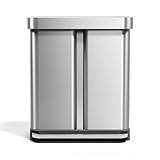
Best for combined trash and recycling: the Dual Compartment Recycler
A dual-compartment model is worthwhile when you regularly separate waste and recycling but do not want two freestanding bins. Simplehuman’s large dual-compartment configuration provides about 58 liters in total, divided into separate sections rather than offering 58 liters of unrestricted trash space.
That distinction matters. If one compartment fills quickly with packaging while the other remains partly empty, the total capacity will not feel like that of a single 58-liter bin. Measure each section according to your household’s waste pattern. A family that produces more trash than recycling may find the divided layout restrictive.
The main benefit is organization: one footprint, one coordinated lid system, and less visual clutter. The main ownership cost is buying the correct liner size for each compartment.
Best for bathrooms: 6- to 10-liter compact cans
Bathrooms usually benefit from a compact enclosed can rather than a kitchen-size model. A 6-liter can suits a powder room or lightly used bathroom. A 10-liter can is more practical for a shared bathroom, especially when tissues, packaging, and other dry waste accumulate throughout the week.
A small step can is preferable when you want hands-free opening. A slim lift-top or swing-top design may be better where there is almost no floor space, but check whether the lid can open without striking a vanity. Sensor-equipped versions can reduce contact, although batteries and electronics add another maintenance item and are unnecessary for many bathrooms.
Liner compatibility and the real cost of capacity
Simplehuman cans are designed around custom-fit liners identified by letter codes. The correct code is printed on the can, inner bucket, packaging, or product documentation. Do not assume that any liner advertised with the same liter capacity will fit properly: two 30-liter cans can have different shapes, rim dimensions, and liner requirements.
Custom-fit liners generally stay upright and tuck into the liner pocket without the excess plastic showing. Standard grocery bags may be cheaper, but they are often too short, too narrow, or prone to pulling down when filled. For a kitchen can, that inconvenience can outweigh the initial saving.
Use this simple sizing calculation before choosing a model. If your household fills a 45-liter liner every three days, it uses roughly 122 liners per year:
365 days ÷ 3 days = approximately 122 liners.
At a general market range of about $0.50 to $1.25 per custom-fit liner, annual liner cost could be approximately $61 to $153, before delivery or regional differences. A 30-liter can may lower the amount of waste held at once but could require more frequent changes. The cheapest can is not always the cheapest ownership choice.
Decision guide by household and space
| Your situation | Best starting choice | Why |
|---|---|---|
| One to two people, ordinary kitchen | 30-liter Round or Butterfly | Lower profile and less unused capacity |
| Family kitchen with frequent cooking | 45-liter Rectangular Step | Large opening and fewer bag changes |
| Narrow walkway or galley kitchen | 40-liter Slim Step | About 10-inch depth preserves floor space |
| Low cabinet above the can | 30-liter Butterfly | Split lid needs less overhead clearance |
| Trash and recycling must share one footprint | 58-liter Dual Compartment | Separate sections without two standalone cans |
| Powder room or lightly used bathroom | 6-liter compact can | Small footprint and modest liner use |
| Shared bathroom or home office | 10-liter compact can | Fewer overflow incidents than a very small bin |
Ownership details that matter after purchase
- Clean the inner bucket: Remove it periodically and wash it with mild dish soap and water. Dry it completely before inserting a new liner; trapped moisture encourages residue and odor.
- Wipe the lid and pedal: Grease and fingerprints accumulate around the handle, lid edge, and pedal. Avoid soaking hinges or electronic components.
- Do not overfill: A liner packed above the inner-bucket rim can catch on the lid mechanism and strain the bag-retaining ring.
- Keep liquids out where possible: Leaking food containers are a common source of persistent odor and can stain or corrode internal hardware over time.
- Expect consumables to wear first: Liners are the ongoing expense. Pedal linkages, lid dampers, hinge points, and sensor batteries are the components most likely to need attention before the metal body does.
- Check the floor: Sliding the can while it is full can stress the base or pedal. Lift it using the body or inner bucket rather than pulling hard on the pedal.
Final recommendation
For a primary kitchen, choose the 45-liter Rectangular Step Can unless its footprint or lid clearance is a problem. Choose the 40-liter Slim Step Can when width and depth matter more than a wide opening, and choose the 30-liter Butterfly Can when overhead clearance is the limiting factor. The 30-liter Round Step Can is best in open corners, while a 58-liter Dual Compartment model makes sense only when divided trash-and-recycling storage matches your disposal habits. For bathrooms, stay with the 6- to 10-liter range. Matching capacity and mechanism to the room will matter more than choosing the largest or most feature-heavy can.