What's inside
As an Amazon Associate I earn from qualifying purchases. This post may contain affiliate links at no extra cost to you.
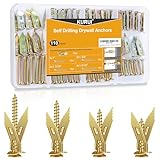
Self-drilling drywall anchors are useful for hanging light fixtures such as small frames, lightweight shelves, clocks and cable guides when there is no stud where you need one. They cut their own pilot hole and accept a screw, so you can usually install them with a screwdriver or drill. The trade-off is that they rely on the drywall itself: they are not a substitute for a stud or a rated toggle anchor when the load is heavy, valuable or likely to be pulled outward.
As an Amazon Associate we earn from qualifying purchases at no extra cost to you.


What we cover
Choose by load and pull direction
Check the fixture’s weight, then consider how it loads the wall. A picture frame mostly pulls downward; a shelf bracket, hook or projecting arm also creates leverage that can pull an anchor out. Use the anchor maker’s stated capacity as a limit, not a target. Ratings vary by drywall thickness, installation quality and load direction, and a package rating may assume several anchors sharing the load.
For a small frame or lightweight accessory, a basic nylon or plastic self-drilling anchor is often enough. For a somewhat heavier item, a metal self-drilling anchor can offer more bite, but it still depends on the drywall paper and gypsum holding together. If the fixture is heavy, sticks far out from the wall, gets bumped, or could injure someone if it falls, find a stud or use a properly sized toggle anchor instead.
Anchor types at a glance
| Type | Best for | Trade-off |
|---|---|---|
| Plastic self-drilling | Very light fixtures and small frames | Inexpensive and easy to remove; more prone to spinning or stripping if overtightened |
| Metal self-drilling | Light-to-moderate fixtures when a simple install matters | Usually grips more firmly than basic plastic, but can still tear out of damaged drywall |
| Toggle anchor | Heavier loads or greater pull-out resistance | Needs a larger hole and clearance behind the wall; installation is less convenient |
| Screw into a stud | Loads that need a dependable structural attachment | Requires locating the stud and may affect fixture placement |
For a small, low-risk job, plastic self-drilling drywall anchors are a sensible budget choice. Choose metal self-drilling drywall anchors when you want a sturdier-feeling anchor for a light fixture, but do not treat the material alone as proof that it is safe for a demanding load.
What to look for when buying
Read the package for the screw size, drywall thickness range and load information. Match the screw to the fixture’s mounting hole; an oversized screw can split a plastic anchor, while a screw that is too small may not engage properly. If the fixture has two mounting points, use both only if the bracket fits flat and the anchors are spaced as required by the manufacturer.
Anchor length matters too. A longer anchor is not automatically stronger if it does not suit the wall or the screw. Avoid installing into loose, cracked or previously patched drywall unless the anchor instructions specifically allow it. If you are shopping for a general-purpose kit, check that it includes screws of the correct size and that the anchors are intended for drywall rather than masonry.
Install without damaging the wall
First check for wiring and plumbing, especially near outlets, switches and sinks. Mark the hole, then follow the anchor instructions. Many self-drilling types go directly into drywall without a pilot hole; drilling one when the instructions say not to can make the hole too large and reduce grip.
Drive the anchor straight and slowly. A hand screwdriver gives good control. If using a cordless drill, use a low speed and light pressure; a clutch setting can help prevent overdriving. An impact driver is usually a poor choice here because its repeated impacts can strip the hole or crush the drywall before you notice. Stop when the anchor head is flush. Do not bury it, spin it in place or keep tightening after it meets resistance.
Then attach the fixture with the specified screw. Tighten until the fixture is secure, not until the screw is forcibly bottomed out. If the anchor turns with the screw, pulls out, or leaves a growing crater, stop. Remove it if possible and move to sound drywall, a stud or a different anchor type. Reusing an enlarged hole with another self-drilling anchor is likely to fail.
When to use something stronger
Choose a stud-mounted screw for a shelf, rail or fixture that will carry regular weight. A stud finder can help, but confirm the location before driving the fastener; studs are commonly spaced 16 inches on center, though layouts vary. For a hollow wall without a usable stud, toggle bolts for drywall spread load behind the panel and are often a better choice for heavier or more exposed fixtures. They need enough cavity depth and a larger opening, so check the instructions and wall conditions first.
Self-drilling anchors are best when convenience and a small hole matter more than maximum holding strength. For a lightweight fixture installed carefully into intact drywall, the cheaper plastic option is often perfectly adequate. For anything with leverage, repeated handling or meaningful consequences if it falls, spend the extra time to locate a stud or choose a fastening system designed for that load.