What's inside
As an Amazon Associate I earn from qualifying purchases. This post may contain affiliate links at no extra cost to you.
What we cover
Our Top Picks
 THETCHRY Teak Wood Cutting Board Set of 3Cutting Board Set of 317.52 x 12.4 x 2.95 inchesCheck on Amazon

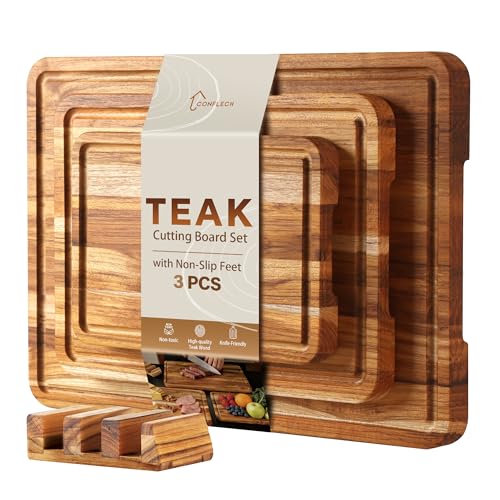

Best Teak Cutting Boards for Everyday Prep
The best teak cutting boards for everyday prep are thick, edge-grain boards sized to your counter and knife work: choose a 1-inch board for a lighter daily option, or about 1.5 inches if stability and resistance to warping matter more than easy lifting. Teak’s natural oils help it tolerate kitchen moisture, but they do not make it waterproof or maintenance-free.
What matters more than the wood name
Teak boards vary in construction, thickness, and finish. Those details affect how a board sits, feels under a knife, and holds up to repeated washing more than the word “teak” alone. Look for clearly stated dimensions, solid edge-grain construction, a flat working surface, and care instructions that permit food-safe oiling.
As an Amazon Associate we earn from qualifying purchases at no extra cost to you.



- Edge grain: Long strips of wood are joined with their edges facing up. It usually costs less than end grain, is stable when well made, and gives a firm, predictable cutting surface. Check that the seams are tight and evenly finished.
- Thickness: A thicker board is heavier and less prone to shifting, but can be awkward to move or wash. For a board that stays on the counter, extra mass is useful; for frequent sink trips, moderate thickness is more practical.
- Juice groove: A groove helps contain liquid from fruit, vegetables, or a roast. It also takes away usable cutting area, and a shallow or narrow groove may overflow. If you mostly chop dry ingredients, a flat board is easier to clean and use across the full surface.
- Knife feel: Teak is a durable hardwood, but its feel varies with grain and finish. Expect a firm surface rather than the cushioned feel of a softer wood. A sharp knife matters: forcing a dull blade increases slipping and roughens the board more quickly.
Size and thickness comparison
The figures below are practical selection ranges, not specifications for a particular product. Actual dimensions and weight depend on design and wood density, so confirm the maker’s listed measurements before buying.
| Board type | Typical dimensions | Typical thickness | Approx. weight | Best suited to |
|---|---|---|---|---|
| Compact prep board | 12 × 8 in | 0.5–0.75 in | 2–4 lb | Small counters, fruit, herbs, quick jobs |
| Everyday medium board | 16 × 12 in | 0.75–1.25 in | 4–8 lb | Most daily chopping and slicing |
| Large, heavy board | 18 × 14 in | 1.25–2 in | 8–14 lb | Frequent prep, larger ingredients, counter-top use |
For an everyday board, 16 × 12 inches is a useful starting point: it offers room to gather chopped ingredients without dominating a modest worktop. Measure the space where you plan to use and store it, and leave enough room to grip the board and clean around it. A large board that cannot be washed comfortably is less convenient than a medium one you will use regularly.
Choose by kitchen and routine
| Your situation | What to look for | Why |
|---|---|---|
| Limited counter or storage space | About 12 × 8 in and under 1 in thick | Easy to lift, wash, and put away; less room for a full meal’s prep |
| Regular home cooking | About 16 × 12 in, 0.75–1.25 in thick | A useful balance of cutting area, stability, and manageable weight |
| Board stays on the counter | At least 1.25 in thick, with nonslip feet or a damp towel underneath | More mass helps reduce movement; feet improve grip but can make both sides less usable |
| Frequent juicy prep | A large board with a clearly defined perimeter groove | More capacity reduces spill risk; the groove still needs prompt cleaning |
| Lowest upkeep and full cutting area | Flat, reversible board without a groove | Simpler to wipe and maintain, with more uninterrupted surface |
Grooved or flat?
A groove is most useful when you regularly cut tomatoes, citrus, or cooked meat and want to keep liquid off the counter. It is not a substitute for a rimmed tray: a board’s groove has limited capacity, and a crowded board can spill before the channel fills. For general vegetable prep, a flat board gives you more room to chop and scrape ingredients into a pan.
If you choose a grooved model, inspect whether the channel is broad enough to wipe clean and whether it runs around the working area without awkward gaps. A deep channel can be helpful for liquid, but its corners and edges need attention during cleaning.
Keeping a teak board flat and usable
Teak’s natural oils can slow moisture uptake, but uneven wetting and drying can still stress any solid-wood board. Consistent care matters more than leaving it untouched in hopes that it will stay flat.
- Before first use: Follow the maker’s instructions. If oiling is recommended, apply food-grade mineral oil to a clean, dry board, let it absorb, and wipe away the excess. Avoid cooking oils such as olive oil, which can turn rancid.
- After prep: Wash by hand with warm water and mild dish soap, then dry promptly with a towel. Do not soak the board or leave it sitting in a wet sink.
- Dry both faces: Stand the board on edge or use a rack so air can reach both sides. Drying one face against a damp counter while the other is exposed can encourage uneven moisture change.
- Maintain when dry: When the wood looks faded or feels dry, apply a thin coat of food-grade mineral oil. Frequency depends on use and household conditions; the board’s appearance is a better guide than a rigid calendar.
- Store sensibly: Keep it away from dishwashers, heaters, and prolonged direct sun. Heat and abrupt moisture changes can contribute to cracks, raised grain, or cupping.
Never put a solid teak board in the dishwasher. High heat, long exposure to water, and forced drying can loosen joints or warp and crack the wood. If a board begins to rock, check that the counter is level and that the underside is dry before assuming the wood has permanently warped.
Ownership trade-offs to expect
With regular use, the surface will develop knife marks; that is normal wear, not necessarily a defect. Deep grooves, rough patches, open seams, or persistent rocking are more concerning. A board that becomes slightly rough may be lightly sanded only if its manufacturer allows it, followed by thorough dust removal and re-oiling. For a laminated board, sanding too aggressively can expose glue lines or unevenly remove material.
Teak is not a “never oil” wood. Its natural oils can make it less thirsty than some alternatives, but washing gradually removes surface oil, and a dry-looking board benefits from a thin refresh. Also, teak is dense: a thick board may resist movement well in ordinary kitchen use, yet its weight can make daily cleaning a chore. If you know you will avoid lifting it, choose a size you can comfortably wash.
Bottom line
For most home cooks, the best teak cutting boards are medium-sized, edge-grain boards around 16 × 12 inches and roughly 1 inch thick. Choose a groove if containing juices is a frequent need; otherwise, a flat reversible surface offers more usable space and simpler cleanup. Go thicker if the board will live on the counter and you can manage its weight. Whichever style you choose, hand-wash it, dry both sides, and oil it when the surface looks dry to give it the best chance of staying stable over time.