What's inside
As an Amazon Associate I earn from qualifying purchases. This post may contain affiliate links at no extra cost to you.
Hex shank drill bits are convenient with an impact driver, but the wrong bit can break quickly or damage the workpiece. The best choice depends on the material, hole size, and whether you are drilling occasionally or making dozens of holes on a job. A 1/4-inch hex shank lets you change from drilling to driving without reaching for another tool, while an impact-rated bit is designed to tolerate the driver’s repeated torque pulses.
As an Amazon Associate we earn from qualifying purchases at no extra cost to you.


What we cover
What to Look for in an Impact-Driver Drill Bit
Start with the shank. Most impact-driver accessories use a 1/4-inch quick-change hex shank. It should lock securely into the driver’s collet, with minimal wobble. A three-flat shank can also work in a drill chuck, but it is not the same as an impact-rated accessory.
Look for bits specifically marked impact rated or for impact drivers. These usually have a reinforced hex base, a torsion zone, or a design intended to absorb shock. Standard high-speed steel bits may fit an impact driver, but their shanks can twist or snap under high torque. The cutting end can also overheat if you force the bit too hard.
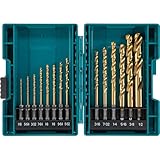
For ordinary wood and thin sheet metal, a good general-purpose bit set is often enough. If you regularly drill steel, masonry, or large holes, buying a specialized set is worthwhile. A compact impact-rated hex shank drill bit set is the most practical starting point for mixed household work.
Best Bit Types by Material
| Bit type | Best use | Typical limit or drawback |
|---|---|---|
| Twist bit, high-speed steel | Wood, plastic, and light-gauge metal | Small sizes can snap; needs slower speed in metal |
| Titanium-coated twist bit | Repeated drilling in wood and thin metal | Coating wears through if overheated or resharpened |
| Cobalt twist bit | Stainless steel and harder metals | Brittle; requires controlled pressure and cutting fluid |
| Brad-point bit | Clean, accurate holes in wood | Not intended for metal or masonry |
| Spade bit | Fast, larger holes in framing lumber | Rougher holes and more grabbing than a twist bit |
| Carbide masonry bit | Brick, block, and light concrete | Slow in an impact driver; not a substitute for an SDS hammer drill |
| Step bit | Enlarging holes in thin sheet metal | Limited depth and size range |
For Wood and Plastic
For clean holes in cabinet panels, trim, and furniture parts, hex-shank brad-point bits are usually better than generic twist bits. The center point prevents wandering, and the outer spurs score the edge before the main cutting edges remove material. Run the impact driver at low speed and use light pressure. A backing board beneath the work reduces blowout as the bit exits.
Spade bits are the economical choice for rough holes through studs and joists. Sizes from about 1/2 to 1 inch are common, and an impact-rated set handles occasional plumbing and cable work well. They can grab when the paddle breaks through, so release the trigger as the bit approaches the far side. For holes larger than about 1 inch, an impact driver may be slow and difficult to control; a drill or right-angle drill is generally more comfortable.
For Metal
Metal drilling is where cheap bits show their weaknesses. Use a sharp twist bit, slow the driver down, and keep steady pressure on the work. For mild steel, a few drops of cutting oil extend bit life and help prevent the cutting edge from turning blue. If the bit squeals, produces smoke, or stops making chips, it is too hot or dull.
Titanium-coated bits are a reasonable upgrade for occasional sheet-metal work, but the coating is not magic. They are still high-speed steel underneath, and overheating ruins them. For stainless steel or frequent metal drilling, choose cobalt bits if available in an impact-compatible hex-shank format. Cobalt bits are harder but less forgiving: do not flex them, and do not run them at high speed.
A cobalt hex shank bit set costs more, so it is unnecessary for putting a few holes in aluminum or thin flashing. It makes more sense when ordinary bits repeatedly dull on the same job.
For Masonry and Wall Anchors
Carbide-tipped masonry bits are suitable for brick, block, mortar, and occasional holes in soft concrete. Use the hammer function only if the bit manufacturer allows it. Many small hex masonry bits can tolerate an impact driver’s hammering action, but they are not designed for the sustained impact energy of an SDS rotary hammer.
For plastic wall anchors, match the bit diameter to the anchor package rather than guessing. A hole that is too large leaves the anchor loose; one that is too small can crush the anchor or prevent it from seating. Drill slightly deeper than the anchor length, then clear the dust before inserting it. In concrete or dense block, a rotary hammer with an SDS masonry bit is faster, straighter, and less punishing than an impact driver.
For occasional picture hooks and light shelves, an hex shank masonry bit set is convenient. Do not rely on a basic plastic anchor for cabinets, handrails, or other safety-critical loads; those require a properly selected anchor and sound substrate.
How to Use Them Without Breaking Bits
Use the lowest effective speed. Impact drivers deliver high torque, and a stuck bit can twist before the motor protection reacts. Keep the bit straight, especially in metal, and avoid leaning sideways on the hex shank. Side loading is a common cause of snapped small bits.
For larger holes, drill a pilot hole instead of forcing a 1/2-inch bit through solid material immediately. Withdraw the bit periodically to clear chips. If a twist bit binds, stop the tool rather than repeatedly reversing under full trigger. Inspect bits after use: a rounded cutting edge, blue discoloration, bent shank, or visible cracks means replacement is cheaper than a damaged project.
What to Buy
For most homeowners, buy an impact-rated mixed set containing twist bits from roughly 1/16 to 1/2 inch, a few brad-point or spade bits, and at least one masonry bit. Choose a smaller premium set over a huge box of anonymous bits if you drill often. The cheaper option is fine for occasional wood, plastic, and thin metal work, provided you use moderate speed and replace dull bits.
If your work centers on one material, specialize: brad points for clean woodworking, cobalt for hard metal, or carbide masonry bits for anchors. No hex-shank set turns an impact driver into a full replacement for a drill press or rotary hammer. Its advantage is speed of accessory changes and portability, not maximum drilling performance.