What's inside
As an Amazon Associate I earn from qualifying purchases. This post may contain affiliate links at no extra cost to you.
Toggle bolts are useful when a screw cannot bite into a stud and the wall has a hollow cavity behind it. For heavy items, the right choice depends less on the label “heavy duty” than on the wall material, cavity depth, bolt size, and how the load pulls on the anchor. A rating on a package is not a guarantee for every wall or installation.
As an Amazon Associate we earn from qualifying purchases at no extra cost to you.

What we cover
Choose by wall and load
Traditional spring-wing toggle bolts use two metal wings that fold to pass through a hole, then open behind the wall. They spread the load over a wider area than a basic plastic plug, but still rely on the wall facing staying intact. They are generally suited to drywall and hollow masonry only when the manufacturer lists that material.
For a heavy shelf, cabinet, or wall-mounted bracket, first look for studs. A stud-mounted screw or lag is usually a better choice than any hollow-wall anchor. If a stud is not available, consider a metal channel-style toggle, which stays in place while you position the fixture and lets you remove and reinstall its bolt. A conventional spring toggle is usually less expensive and works well for a one-time attachment.
Check the fixture’s total weight, how far it projects from the wall, and whether it may be bumped or pulled. A load that sticks out from the wall creates leverage; the force on the anchors can be much greater than the object’s weight. Use the fixture maker’s fastener instructions where available, and do not treat an anchor’s published rating as a safe working load unless the maker says it is one.
Toggle options compared
| Type | Best fit | Trade-off |
|---|---|---|
| Spring-wing metal toggle | Low-cost, one-time mounting in a hollow wall | Requires a relatively large hole; wings can fall into the cavity if the bolt is removed |
| Metal channel-style toggle | Heavier fixtures or jobs where the bolt may need to be removed | Costs more; needs enough cavity depth and a larger opening than some screw-in anchors |
| Self-drilling drywall anchor | Light-duty items in drywall, with modest loads | Not a substitute for a toggle on heavy or pull-out-prone loads |
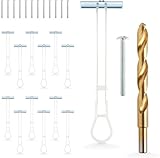
For a metal channel-style option, compare metal toggle bolts for hollow walls. If you only need to hang a light picture or small accessory, a correctly sized self-drilling drywall anchor may be cheaper and easier. Use it only within its stated application and load limits.
Size the bolt and check the cavity
Anchor size must match the fixture hole, wall thickness, and space behind the wall. A common mistake is buying a large toggle without checking whether its folded wings will pass through the fixture’s mounting hole. Another is choosing a bolt that is too short: it must pass through the fixture and wall, then engage the toggle mechanism fully.
Measure the wall thickness and check the anchor’s listed grip range. Make sure the cavity is deep enough for the wings or channel to open. Avoid drilling where you may hit wiring, plumbing, or a pipe; use a detector and check both sides of the wall when possible. If the wall is plaster, tile, or hollow block rather than standard drywall, use an anchor specified for that material. A drywall toggle rating does not automatically apply.
For a fixture with multiple mounting holes, use the number and spacing of fasteners specified by the fixture maker. Do not assume that two anchors rated at a certain load safely carry twice that load. Uneven holes, weak drywall, and leverage can concentrate force on one fastener.
Install without damaging the wall
Mark the hole carefully and drill the diameter specified on the anchor package. A cordless drill is enough for ordinary drywall; use a sharp bit and low speed as the bit breaks through so it does not tear the paper facing. Do not use a hammer drill on drywall. For tile or masonry, choose the appropriate bit and drilling mode for that surface rather than forcing a drywall anchor into it.
For a spring toggle, thread the bolt through the fixture and onto the folded wings before pushing the assembly through the hole. Hold the bolt outward while tightening so the wings stay flat against the back of the wall. For a channel-style anchor, follow its instructions for setting the channel and seating the strap; keep the bracket aligned before tightening. Tighten until the fixture is secure, not until the drywall dimples or cracks. Over-tightening can crush the wallboard and sharply reduce holding strength.
Keep the fixture flat against the wall and use a hand screwdriver for the final tightening. An impact driver can over-tighten a small fastener in an instant, strip threads, or crush drywall. If you use one to drive a suitable bolt, select a low setting and stop well before the fixture is fully snug.
Know the failure signs
Stop if the hole becomes oversized, the drywall face tears, the anchor spins, or the fixture will not sit flush. Do not cover a failed hole with a larger bolt unless the new anchor’s installation instructions allow it and the wall around the opening remains sound. Move the fastener to intact material or open the wall and add proper backing for a high-consequence load.
After installation, check for movement by applying gentle pressure to the fixture. Recheck it after loading, and periodically if it supports something valuable or is exposed to vibration. If the load could injure someone when it falls—such as a heavy overhead item—fasten into framing or install blocking rather than relying on hollow-wall toggles. A toggle bolt is a practical solution for a hollow wall, but it cannot make weak or damaged wallboard strong.