What's inside
As an Amazon Associate I earn from qualifying purchases. This post may contain affiliate links at no extra cost to you.
A step bit is usually the right tool for enlarging a round hole in a thin steel electrical panel, especially when you need a clean opening for a conduit fitting or cable connector. Its stepped cutting edges enlarge the hole in stages, so the bit is less likely to grab than a large twist bit. But step bits are not for every panel: thick steel, stainless steel, tight clearances, and holes near components call for a different plan.
As an Amazon Associate we earn from qualifying purchases at no extra cost to you.


What we cover
Choose a bit for the panel, not just the hole size
Check the fitting’s required knockout or clearance-hole size before buying a bit. Conduit trade size is not the hole diameter: for example, a 1/2-inch trade-size fitting commonly needs an opening close to 7/8 inch, but the fitting’s instructions take precedence. Look for a bit whose printed steps include the exact diameter you need. The step markings are typically in 1/8-inch increments, though that varies.
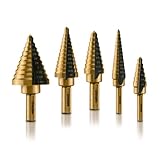
For ordinary mild-steel enclosures, a high-speed-steel (HSS) bit is often adequate. A titanium-nitride coating can help with wear, but it does not turn an inexpensive HSS bit into a bit for heavy production work. For repeated holes or tougher material, consider a cobalt HSS bit; it costs more and still needs suitable speed and lubrication. A basic HSS step drill bit is often the sensible buy for a one-off hole in a thin steel box.
Read the manufacturer’s stated capacity. Many general-purpose step bits are intended for sheet metal up to roughly 1/8 inch thick, but capacity differs by bit and material. If the panel is thicker than the bit’s rating, do not force it through.
Step bit or another hole-cutting method?
| Tool | Best use | Trade-off |
|---|---|---|
| HSS step bit | One or several holes in thin mild steel | Simple and versatile, but can wear quickly in thick or hard metal |
| Cobalt step bit | Repeated holes or tougher sheet, within the bit’s rated capacity | Higher cost; still vulnerable to excess speed and heat |
| Knockout punch | Clean, accurately sized holes for conduit fittings | Often cleaner than drilling, but needs access for the punch and die |
| Hole saw for metal | Larger holes or material beyond a step bit’s range | Can catch abruptly and needs a pilot hole and firm control |
A knockout punch is often the better choice for a clean, standard-size opening in a panel when you can get the die behind the work. A step bit is more convenient when access is limited or you need a nonstandard diameter. For a handful of holes in thin mild steel, paying extra for a premium bit may not improve the result enough to justify the cost.
Make the panel safe before drilling
Turn off the relevant circuit and verify that the enclosure is de-energized with an appropriate tester. Do not assume a breaker label is correct. If you cannot safely isolate the equipment or confirm it is dead, stop and have a qualified electrician handle the work. Remove internal components when the design allows; otherwise, protect them from metal chips with a secure barrier. Keep debris out of breakers, bus bars, and wiring.
Remove the panel cover or enclosure when practical, and clamp the work so it cannot spin. Check both sides for wiring, bus bars, mounting rails, and clearance for the fitting. A bit can break through suddenly, so leave room behind the panel and keep hands clear. Wear eye protection. Deburr the finished edge and use a listed fitting or bushing where required to protect conductors from sharp metal.
Drill slowly and stop at the required step
Mark the center with a center punch. This helps the bit start in the right place and reduces wandering on smooth sheet metal. Use a variable-speed drill, not an impact driver: the impact action can make the bit chatter, damage the hole, or snatch the tool. A corded drill or ordinary cordless drill with a clutch is suitable; select low gear if the drill has one.
Use moderate pressure and a low speed. A practical starting point for a handheld drill in thin steel is around 300–600 rpm, slowing down for larger diameters or harder material. The correct speed depends on bit diameter and the manufacturer’s guidance; if the bit squeals, smokes, or turns the chips blue, stop. Let the bit cool, reduce speed, and apply cutting fluid suitable for the metal. Do not run a hot bit faster to compensate for dullness.
Keep the drill square to the panel and advance one step at a time. Stop as soon as the opening reaches the required diameter. Going one step too far is a common failure: the fitting can become loose, and the panel may no longer support it properly. Test the fitting before removing the setup if possible. A light deburring tool or hand file can clean the edge without enlarging the hole appreciably.
What to look for when buying
Choose a bit with clear size markings, a shank compatible with your drill chuck, and a stated material and thickness capacity. A 3-flat shank can reduce slipping in a conventional chuck, but it does not prevent a loose chuck from spinning. If you expect regular electrical-panel work, compare a cobalt step bit set with a single bit that covers your target diameter. A set is useful when hole sizes vary; for one known opening, a single bit is usually cheaper and leaves fewer unused tools.
After use, wipe the bit clean and inspect its cutting edges. A dull bit tends to rub instead of cut, generating heat and leaving a ragged hole. Replace it when careful technique and lubrication no longer produce chips cleanly. For one thin mild-steel panel, a modest HSS bit and a slow, controlled drill are usually enough. For thicker stock, frequent work, or a hole that must be especially clean and precise, spend the time to choose a punch or a bit rated for the job rather than pushing a general-purpose step bit past its limits.