What's inside
As an Amazon Associate I earn from qualifying purchases. This post may contain affiliate links at no extra cost to you.
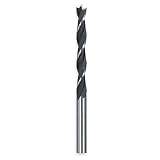
Brad-point bits are a good choice for drilling clean, accurately placed holes in hardwood. Their sharp center spur helps keep the bit from wandering, while the outer spurs score the wood fibers before the cutting edges remove material. That usually means a cleaner entry than a standard twist bit, especially in oak, maple, and cherry.
They are not the right answer for every hole. Brad points are intended for wood, and their long cutting edges can clog or burn if you force them through deep holes without clearing chips. The best set depends on the hole sizes you need, how often you drill, and whether you value a durable case as much as sharp cutters.
As an Amazon Associate we earn from qualifying purchases at no extra cost to you.

What we cover
What to look for in a set
For furniture work, shelving, and general shop use, a set covering roughly 1/8 to 1/2 inch in 1/16-inch increments handles many common tasks. Smaller bits are useful for pilot holes and hardware; larger ones suit dowels and clearance holes. If you regularly need holes above 1/2 inch, check whether the maker offers matching larger sizes rather than buying a set with gaps you will not use.
Look for a clearly marked, sturdy case that keeps each bit separated. Loose bits can rub against each other and dull their cutting edges. Ground brad points and sharp outer spurs matter more than a large piece count. A bargain set with many sizes can be fine for occasional work, but uneven grinding may leave some bits cutting cleanly and others tearing the surface.
For frequent use, consider a brad-point bit set for wood with common fractional sizes and a fitted case. A smaller, well-finished set is often a better buy than a large assortment of inconsistent bits.
Which bit suits the job?
| Bit type | Best use | Trade-off |
|---|---|---|
| Brad-point | Accurate holes in solid wood and plywood | Wood-focused; chips can pack in deep holes |
| Standard twist bit | General-purpose drilling in metal, plastic, and wood | Can wander and leave a rougher wood entry |
| Auger bit | Deep, larger holes in framing lumber | Bulky for small precision work; needs a capable drill |
| Forstner bit | Flat-bottomed holes and hinge cups | Needs careful speed and alignment, especially at larger diameters |
For most cabinet and furniture holes, a brad point is the practical middle ground: more control than a twist bit, without the bulk of an auger. For a flat-bottomed recess, such as a concealed hinge cup, use a Forstner bit instead. A brad point leaves a pointed bottom.
Match the bit to your drill
Most brad-point sets have round shanks and work in a standard drill chuck. Check the largest shank diameter against your drill’s chuck capacity; a 3/8-inch chuck cannot hold a 1/2-inch shank. A cordless drill is usually the right tool. Use its low-speed range for larger bits and hardwood, and keep the bit straight rather than leaning on it to correct the hole.
An impact driver can accept bits through a hex adapter, but it is a poor first choice for precise holes. Its impacts can make the cut feel uneven and increase the chance of a wandering or damaged entry. Use a drill with a three-jaw chuck when accuracy matters. A hammer drill’s hammer mode should be off: its percussion action is for masonry, not wood.
For a basic, lower-cost option, a fractional-size brad-point set is sufficient for occasional shelf pins, pilot holes, and light furniture repairs. Pay more only if you use the bits often enough to benefit from better edge life, tighter size consistency, or a more durable case.
How to drill clean, accurate holes
Mark the center carefully, then place the brad point directly on the mark. The center spur helps locate the bit, but it cannot compensate for a mark that is too broad or a drill that is held at an angle. For repeated holes, clamp a fence or use a drill press. Even a simple square beside the drill can help you hold it perpendicular to the surface.
Clamp the work whenever possible. On a through-hole, put scrap wood beneath the workpiece to support the exit fibers. Without backing, the bit can tear out a ragged crater as it breaks through. If you cannot use backing, stop when the center point begins to emerge, then finish from the opposite side using that small opening as your guide.
Feed steadily, but do not force the drill. In hardwood, a slow, firm cut is often cleaner than high speed and heavy pressure. Withdraw the bit every few seconds on deep holes to clear chips. Packed chips raise friction and heat; the warning signs are a squeal, darkened wood, smoke, or a bit that stalls. Stop, clear the flutes, and let the bit cool. A cordless drill with a variable-speed trigger gives useful control, but its clutch is not a substitute for sensible pressure.
Common mistakes and when to replace a bit
Using a dull bit is a common cause of torn grain and burn marks. If a bit needs noticeably more force than it used to, leaves a rough rim, or wanders despite a clear center mark, inspect its cutting edges. Do not try to sharpen a brad-point bit casually with a general-purpose grinder: changing the spur or cutting-edge geometry can make it drill off-center. Replace an inexpensive worn bit, or have a higher-quality one sharpened by someone equipped to preserve its geometry.
Also check the size before drilling a hole for a dowel or fastener. Nominal bit dimensions and actual fit can vary slightly, and a hole in dense hardwood may feel tight. Test on offcut material from the same board, especially for visible joinery. For a snug dowel fit, make a test hole and adjust the size or fit method before drilling the finished piece.
Choose a brad-point set for clean, located holes in wood; choose another bit type when the hole needs a flat bottom, a very large diameter, or a non-wood material. Buying only the sizes you use most is perfectly reasonable: a selection of individual brad-point bits can cost less than replacing an entire set with unused sizes.