What's inside
As an Amazon Associate I earn from qualifying purchases. This post may contain affiliate links at no extra cost to you.
For most television mounts, the best “wall anchor” is a screw driven into a wood stud. If the mount’s holes do not line up with studs, a properly rated toggle may work for a light, fixed mount—but many full-motion mounts put too much leverage on drywall anchors. Check the mount instructions and wall construction before buying hardware; an anchor’s advertised capacity alone does not tell you whether it is suitable for a TV.
As an Amazon Associate we earn from qualifying purchases at no extra cost to you.


What we cover
Start with the wall and mount
Find out whether the wall is standard half-inch drywall, thicker board, plaster, or masonry. A stud finder can locate likely framing, but confirm with a small pilot hole or by checking at several points: metal corner bead, pipes, wiring, and dense patches can fool some detectors. Studs are commonly spaced 16 inches on center, but do not assume that every stud is exactly where expected.
Read the mount’s installation guide for approved fasteners, hole spacing, and the required number of attachment points. A fixed or tilting mount holds the TV close to the wall, so it creates less leverage than an articulating arm. When an arm extends, the TV’s weight acts farther from the wall; pulling it sideways or swinging it can add still more force. That makes stud attachment especially important for full-motion mounts.
Which fastening option fits?
| Fastener | Best use | Trade-off |
|---|---|---|
| Lag screw into a wood stud | Most TV mounts; fixed, tilting, and full-motion | Requires accurate stud location and a suitable pilot hole |
| Metal toggle or strap toggle | Approved drywall-only mounting for a light, fixed mount | Needs a large, accurately placed hole; can damage drywall if overloaded |
| Plastic expansion anchor | Light accessories, not a TV mount | Low resistance to pull-out and poor performance under repeated leverage |
| Concrete or masonry anchor | Mounting into concrete or solid masonry | Requires the right masonry bit and installation method |
Wood studs: Use the lag screws specified by the mount maker, or compatible fasteners with suitable length and diameter. The screw must pass through the mount and drywall and still penetrate the stud adequately. Drill the specified pilot hole; too small can split the stud, while too large reduces the screw’s grip. Do not substitute ordinary drywall screws, which are brittle and are not structural mounting screws.
Drywall only: If the mount manufacturer permits anchors, choose a metal toggle or strap toggle rated for the drywall thickness and the intended load. A toggle spreads force behind the board, but the drywall itself remains the weak link. Its listed capacity may be for a single fastener under ideal conditions—not a guarantee for a TV mount with an extended arm. Use every required mounting point and follow the mount maker’s limits. If those instructions call for studs, do not override them with higher-rated anchors.
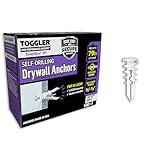
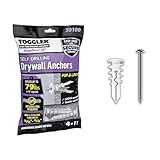
Plastic anchors: They are inexpensive and easy to install, but ordinary ribbed plastic anchors are for light-duty jobs such as small accessories. They can loosen, crush the drywall, or pull out under sustained load. Avoid them for television mounts, even if several are supplied in a generic hardware kit.
What to buy
For a TV mount that can reach framing, buy the correct lag screws and pilot bit rather than a general-purpose drywall-anchor kit. If the mount instructions explicitly allow a drywall-only installation, compare the required fastener size and drywall thickness with the toggle’s packaging. A metal strap-toggle anchor assortment can cover several hole sizes, but check that its ratings and instructions match the mount. Do not select by package weight rating alone.
For a stud installation, a cordless drill is usually enough for pilot holes. Use a sharp bit of the specified diameter and keep the drill square to the wall. A hammer drill is meant for masonry, not ordinary drywall and wood studs. If the mount calls for a large, deep pilot hole, a drill with a side handle can make control easier. A wood drill-bit set with pilot sizes is more useful here than a masonry bit set.
Install and check carefully
Mark the mount height, locate the studs, and verify their centers before drilling. Check for electrical cables and plumbing in the drilling area; avoid drilling directly above or below outlets and switches unless you know the cable route. Hold the mount level, mark its holes, and confirm that each intended stud attachment lands in framing. If the bracket has slots, use them to make small alignment adjustments rather than enlarging holes or forcing screws at an angle.
Drive lag screws with a socket or controlled drill setting, then finish by hand if needed. Stop when the bracket is snug against the wall. Over-tightening can crush drywall or strip the stud’s pilot hole. For toggles, drill the exact hole diameter on the package, seat the anchor as instructed, and tighten evenly. A toggle that spins, fails to clamp, or leaves crumbling drywall is not secure; remove it and reassess rather than tightening harder.
When to change the plan
If a full-motion mount cannot catch the studs at its required holes, use a mount designed to span the framing, install a properly rated plywood backer secured to multiple studs, or choose another location. A backer needs its own sound structural attachment; simply screwing plywood to drywall does not solve the problem. For plaster, metal studs, damaged drywall, or uncertain framing, follow the mount maker’s instructions for that wall type or ask a qualified installer. The cost of changing the plan is small compared with a TV and mount falling from the wall.
After installation, test the mount gently before hanging the TV, then follow the maker’s instructions for lifting and securing the set. Recheck fasteners if the mount develops movement, the drywall cracks, or the TV begins to sag. Do not treat a quick tug test as proof that an anchor can safely carry a long-term, leveraged load.