What's inside
As an Amazon Associate I earn from qualifying purchases. This post may contain affiliate links at no extra cost to you.
Step bits are useful for adding clean holes to thin HVAC sheet metal without changing bits several times. They are not the right tool for every duct job: a step bit works best on flat, relatively thin metal, while a hole saw is often faster for a large opening and a standard twist bit is cheaper for small holes.
As an Amazon Associate we earn from qualifying purchases at no extra cost to you.

What we cover
What to look for in an HVAC step bit
Most residential ductwork is galvanized steel around 26 to 30 gauge, roughly 0.015 to 0.019 inch thick. A quality high-speed steel step bit can cut that easily when sharp and used at a controlled speed. Check the bit’s listed diameter range and step increments against the job: a bit that stops at 7/8 inch will not help with a 1-1/8-inch fitting opening.
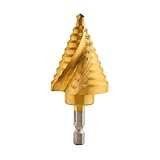
For regular installation work, look for a 1/4-inch hex shank, clearly marked steps, and a titanium-nitride coating or other stated wear coating. The coating can help with heat and wear, but it does not make a dull or poorly made bit perform well. A split-point tip can reduce walking, though a punch mark still helps on smooth sheet metal.
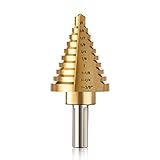
A single bit covering about 1/8 to 1-1/8 inches suits many control-wire, conduit, and small fitting holes. For larger penetrations, buy a bit sized for the opening rather than forcing a smaller one beyond its range. Compare single step drill bits in common HVAC sizes with the actual fittings and grommets you use.
Step bit, twist bit, or hole saw?
| Tool | Best use | Main trade-off |
|---|---|---|
| Step bit | Round holes in thin sheet metal, especially where several diameters may be needed | Can chatter or distort unsupported sheet; limited maximum diameter |
| Twist bit | Small holes, such as pilot holes and fastener holes up to about 1/4 inch | Needs a separate bit for each size; larger bits can grab thin metal |
| Hole saw | Larger openings for ducts, collars, or access, particularly when the diameter is fixed | Requires a pilot hole and can catch abruptly; usually leaves a slug and rough edges |
For occasional small holes, a basic twist-bit set may be the economical choice. For repeated holes at varied sizes, a step bit saves bit changes and often leaves a neat edge. A hole saw is the more practical option when you need a broad opening, such as 2 inches or larger. The right choice depends on diameter, metal thickness, access, and how many holes you need.
Best buy for most ductwork
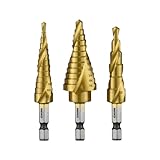
For a homeowner or HVAC installer making holes in light-gauge duct, a well-made, coated HSS step bit with a 1/4-inch hex shank is the most versatile starting point. A compact one-bit option costs less and is easier to carry. A two-bit set is worthwhile if it gives you overlapping size ranges or reaches larger diameters you regularly need; duplicate ranges add little value.
Check that the shank is compatible with your drill. A hex shank fits many cordless drills and impact drivers, but a step bit is generally better controlled in a standard drill. An impact driver can work for light sheet metal, but its hammering action may make the bit chatter, especially near a step transition. A variable-speed cordless drill with a side handle is a steadier choice for larger holes. Browse coated HSS step-bit sets with hex shanks and check the diameter range before buying.
How to drill a clean hole
Mark the center and use a center punch to make a small dimple. Support the back of the sheet with scrap wood when you can, and clamp loose duct securely. Set the drill to low gear. For thin duct, start around 500 to 1,000 rpm and adjust if the bit cuts smoothly without squealing or grabbing. Keep firm, even pressure; pushing hard creates heat and can distort the sheet.
Stop as soon as the desired step passes through the metal. Continuing to the next step enlarges the hole, and the ring-shaped marks on the bit make it easy to overshoot. If the bit stalls, release the trigger rather than twisting against the sheet. Deburr both sides with a hand deburring tool or file, then remove metal chips before installing the fitting. Wear safety glasses and gloves, and keep fingers clear of sharp duct edges.
Common failures and fixes
Ragged edges: The sheet may be vibrating, the bit may be dull, or pressure may be uneven. Clamp the work, slow down, and let the cutting edge do the work. Oversized holes: Stop at the correct step and check the diameter before drilling if the fitting has a close tolerance. Bit walking: Punch the mark first and begin slowly. Blue discoloration or smoke: The bit is overheating. Stop, let it cool, and reduce speed and pressure; a dull edge may need replacement.
Step bits are intended for thin material, not thick steel, stacked layers, or hardened metal. For thicker stock, use a suitable twist bit, cutting fluid where appropriate, and a drill press or other stable setup. If you make only a few holes in thin duct each year, a modest single bit is fine. For frequent installations, paying more for a sharp, accurately sized bit is usually cheaper than fixing rough or oversized openings.