We research everything we recommend. When you buy through our links, we may earn a commission. As an Amazon Associate we earn from qualifying purchases.
Best Die Grinders: Five Picks for Metal and Detail Work
Compare die grinders by power source, speed control and collet: Makita GD0601, DEWALT DWE4887 and DCG426B, Milwaukee 2486-20 and Ingersoll Rand 308B.
A die grinder is a slim, high-speed rotary tool built around a 1/4-inch collet: it spins carbide burrs, mounted points, small grinding wheels and cut-off wheels at speeds between roughly 20,000 and 25,000 RPM, and it does the work that lives between a drill and an angle grinder — deburring castings, dressing welds, porting and polishing metal, cleaning gasket surfaces, sharpening and shaping in places a 4-1/2-inch grinder cannot reach. This guide compares five straight die grinders that cover the category’s three power sources: the corded Makita GD0601 and DEWALT DWE4887, the cordless Milwaukee 2486-20 on the M12 platform and DEWALT DCG426B on the 20V MAX platform, and the pneumatic Ingersoll Rand 308B. They span fixed and variable speed, slide and paddle and rocker switches, and weights from about one pound to just under four. One boundary up front: every tool here is a straight die grinder with a 1/4-inch collet, not a right-angle model, not a bench grinder and not a small rotary tool of the hobby type; buyers who need a right-angle head for working inside frame rails or against flat panels are shopping a related but different shelf, and the notes below say where that split matters.
As an Amazon Associate, we earn from qualifying purchases.
Start with the Makita GD0601 if you want the default corded tool: a 3.5-amp motor at a fixed 25,000 RPM, a slim barrel, a slide switch that locks on, and the quietest published noise figure in this guide. The DEWALT DWE4887 is the corded step up in power — 4.2 amps at the same 25,000 RPM — with a paddle switch that stops the tool when your grip comes off, and it shares the Makita’s ability to run on AC or DC power from a welder or generator. The Milwaukee 2486-20 is the cordless pick for access work: a brushless M12 tool of about a pound and a fifth, with three speed modes under a variable trigger, built to replace an air grinder without the hose. The DEWALT DCG426B is the heavier cordless option for buyers already on 20V MAX batteries, with a brushless motor, three speed settings up to 25,000 RPM and an LED at the nose. The Ingersoll Rand 308B is the pneumatic route: a third of a horsepower, one pound, and a price of admission measured in compressor capacity rather than batteries.
Figures are the makers’ published numbers. Where a maker publishes no figure, the product sections say so rather than filling the gap from a reseller.
What to Look for in a Die Grinder
Power source is the first decision, and it is really three different tools. A corded die grinder runs at full speed for as long as the job lasts and asks nothing but an outlet; it is the bench and fabrication-shop default. A cordless model trades sustained output for freedom from both cord and hose, and its real specification is the battery platform you already own, because the tool-only box contains no battery. A pneumatic grinder is the lightest and slimmest of the three and the cheapest to buy as a bare tool, but it moves its cost into the compressor: the tool’s air consumption under load, not its average figure, decides whether your compressor keeps up or the grinder slows to a walk between tank cycles. Every comparison below this one — speed, switch, weight — sits inside the power-source choice, so make it first.
Speed control is the feature that separates the field. Four of the five tools here are judged by how they handle speed, because a die grinder’s fixed 25,000 RPM is right for carbide burrs in steel and wrong for a wire wheel in soft metal, a polishing bob, or a sanding drum in wood, all of which want less. The two corded tools in this guide are fixed-speed: simple, predictable, and matched to the metal-removal work most buyers do. The two cordless tools answer with electronics — mode switches that cap the top speed, under a trigger that meters it — which makes them the flexible picks for mixed work. The air tool answers with the throttle and the regulator: a lever throttle is close to an on-off switch at full pressure, and fine speed control on a pneumatic grinder is done at the compressor or with an inline regulator, not at the tool.
The collet is a system, and the sizes are not interchangeable. The professional standard is the 1/4-inch collet, which takes the full range of carbide burrs, mounted points and 1/4-inch-shank wheels. A 1/8-inch collet or reducing sleeve opens the door to the smaller hobby-rotary accessory world of fine bits and small drums. A 6 mm collet, included with the pneumatic pick here, covers metric-shank accessories common on imported burr sets. What matters at ordering time is which of these are in the box and which are separate purchases, because listings blur the line between a collet included and a collet available; the checks section below takes that up model by model.
Accessory limits are printed on the tool, and they are hard limits. Every die grinder here is rated for accessories up to 1-1/2 inches in diameter, and every accessory carries its own maximum speed rating. The rule that governs the category is simple: an accessory may only be run on a tool whose maximum speed is at or below the accessory’s rating. A bargain cut-off wheel or wire brush rated below 25,000 RPM does not become safe on a 25,000 RPM grinder because it fits the collet. Buyers building an accessory kit alongside the tool should read the speed printed on each wheel and brush as a specification, not as packaging.
Switch type is a working preference with a safety edge. A slide switch with a lock-on, as on the Makita, suits long grinding passes at a bench, where the tool runs continuously and both hands steer. A paddle switch, as on the corded DEWALT and the Milwaukee, stops the tool the moment the grip is released — the arrangement most buyers want overhead, on a ladder, or in any position where a dropped tool is a real possibility — with a lock-on button for the bench sessions. The DEWALT cordless uses a rocker that can be worked from more than one grip position, which matters on a long tool held at different points along its barrel. The air tool’s lever carries a safety lock that must be folded back before the throttle opens, the pneumatic answer to the same accidental-start problem.
Length and weight trade against each other. The corded tools here are about fourteen inches long; that length is reach into cavities and across engine bays, and it is also leverage against your wrist at the end of a long session. The Milwaukee cordless is the compact outlier at roughly ten inches and just over a pound bare, which is why it is the access pick. The air tool is shorter still and the lightest in the guide, because its motor is a vane and a housing rather than copper and a cord. None of these figures decides alone: a heavy tool that balances at the grip works longer than a light tool that is all nose.
Noise is a published number, and the sources disagree in an instructive way. Makita’s US documentation for the GD0601 puts it at 73 dB(A), the lowest figure in this guide, while its European manual declares a higher number under a named test standard. Milwaukee’s US documentation for the 2486-20 does not foreground a figure; its European page declares one without naming a standard. The lesson is not which tool is quietest on paper — it is that die grinders as a class run loud enough that hearing protection is part of the kit, and that a noise figure quoted without a test standard is a weaker claim than one quoted with it.
1. Makita GD0601 Die Grinder
Top Pick
1. Makita GD0601 Die Grinder
Power source: corded, AC/DC switch
Motor: 3.5 amp
No-load speed: 25,000 RPM, fixed
Collet: 1/4 in (6 mm capacity; other collet cones are accessories)
The GD0601 is the corded die grinder the rest of the category is measured against: a 3.5-amp motor turning a fixed 25,000 RPM, in a slim double-insulated barrel 14-1/8 inches long and 3.7 pounds in weight, with a slide switch that locks on for continuous work. It has been in Makita’s line for well over a decade with its specification essentially unchanged, which in this category is a feature — the collets, wrenches and wear parts are standard, and the tool a buyer orders today is the tool the documentation describes.
Two design details carry the tool. The first is the AC/DC switch: like the corded DEWALT below, the GD0601 runs from a welding machine’s auxiliary output or a generator as happily as from a wall outlet, which is why it turns up in field fabrication and pipeline work where the nearest receptacle is the welder itself. The second is motor protection. Makita seals the armature with a zig-zag varnish coating and labyrinth-style channels that keep grinding dust off the bearings, and vents the airflow directionally so exhaust moves away from the user’s face — the details that decide whether a die grinder in daily metal dust is a five-year tool or a one-year tool. The round collet nut is a smaller thought of the same kind: it is shaped to avoid gouging the workpiece when the nose of the tool brushes it.
The limits are the fixed speed and the switch philosophy. Twenty-five thousand RPM with no way down is the right answer for burrs and mounted points in steel and cast iron, and the wrong answer for accessories that want a gentler speed; the cordless tools below exist for that work. And a lock-on slide switch is a bench arrangement — a buyer whose grinding is mostly overhead or one-handed should weigh the paddle tools before this one. Within its brief, though, this is the guide’s default: the corded grinder to buy when the work is metal, the sessions are long and the outlet is near.
The DWE4887 is DEWALT’s corded answer at the same job: 4.2 amps — the strongest corded motor in this guide — at the same fixed 25,000 RPM, in a tool of about fourteen inches and 3.65 pounds, separated from the Makita by its switch. Where the GD0601 slides and locks, the DWE4887 paddles: the switch sits under the barrel where the gripping hand holds it closed, the tool stops when the hand comes off, and a lock-on button is provided for the continuous passes where holding a paddle is the tiring option.
The extra amperage over the Makita is the honest difference between the two corded tools: under load, pushing a burr or a wheel hard into steel, the DEWALT’s motor gives back less speed. In free running they are identical at 25,000 RPM, and both carry the AC/DC capacity that lets a die grinder run off a welder or generator on site — DEWALT states the capacity in the model’s name, and it is the reason this tool, like the Makita, is a fabrication-shop fixture rather than only a bench tool. The paddle layout also makes the DWE4887 the corded pick for work away from the bench: overhead, inside a machine frame, or anywhere a tool that stops when dropped is worth more than a tool that locks on.
Two cautions belong with this pick, and both are about the paper around it rather than the tool. Secondary roundups variously describe the DWE4887 as variable-speed and quote a higher amperage; DEWALT’s own specification is a fixed 25,000 RPM from a 4.2-amp motor, and the checks section below returns to the discrepancy, because a buyer shopping for speed control on the strength of those descriptions would be buying the wrong tool. The second is the 1/8-inch question: the tool ships around a 1/4-inch collet, and sources differ on whether a 1/8-inch sleeve is in the box or an accessory — confirm the listing’s contents if small-shank accessories are part of the plan.
3. Milwaukee 2486-20 M12 FUEL Straight Die Grinder
3. Milwaukee 2486-20 M12 FUEL Straight Die Grinder
Power source: M12 cordless, tool only (battery and charger sold separately)
Motor: brushless, 0.3 HP output, per the maker
Speed control: 3 modes with a variable-speed trigger
Top speed: 21,000 RPM, per the maker’s current documentation (see Checks)
The 2486-20 is the tool Milwaukee built to retire the air hose: a brushless M12 FUEL straight die grinder, tool only, rated at 0.3 horsepower of motor output — a figure Milwaukee publishes as an improvement over the pneumatic grinders it targets — in a body about ten inches long and 1.2 pounds without a battery. It is the lightest electric tool in this guide by a wide margin, and the only one whose running gear is a battery the buyer probably already owns.
The design logic is access. A ten-inch, one-pound grinder with no cord and no hose goes where the corded tools cannot — inside pipe runs, along frame rails, into the corners of a fabrication — and the paddle switch and three-mode speed control are arranged for that work: the modes cap the speed for the accessory in the collet, and the trigger meters within the cap, so a wire wheel or a polishing accessory can be run at its pace rather than at a fixed maximum. The maker rates the output against pneumatic tools deliberately; this is a grinder for a mechanic or fabricator whose comparison is an air tool, and whose shop question is whether the compressor can stay off.
The trade is sustained load. A 12-volt tool of this size protects itself: under prolonged heavy grinding the electronics will cut the tool before the motor cooks, and the working rhythm becomes a rotation of batteries on the charger rather than one continuous pull. Buyers whose die grinder work is an hour of weld dressing at a bench are better served by either corded tool above. Buyers whose work is twenty short jobs scattered across a shop or a site, on a platform whose batteries are already in the drawer, are exactly who this tool was drawn for — and for them the absence of a hose is not a convenience, it is the specification.
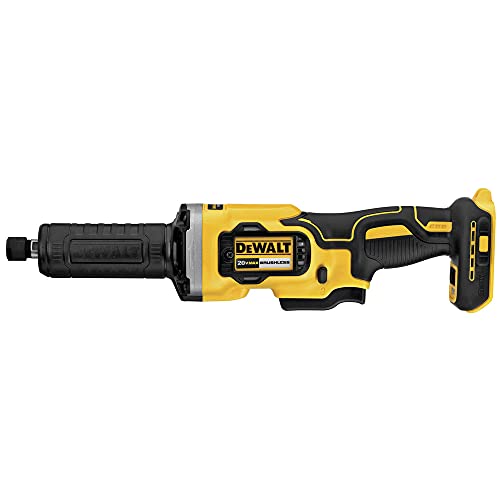
4. DEWALT DCG426B 20V MAX Die Grinder
The DCG426B is the full-size cordless entry: a brushless 20V MAX die grinder, tool only, with a variable-speed range up to 25,000 RPM — the highest ceiling among the cordless tools here — delivered through a three-setting speed selector and a variable trigger. At 3.4 pounds bare it is built like the corded tools rather than like the Milwaukee above, and that is its position in the guide: the cordless grinder for a buyer whose other yellow tools already fill a charger shelf, and whose grinding sessions are long enough that a bigger battery platform earns its weight.
Specs
Power source: 20V MAX cordless, tool only (battery and charger sold separately)
Motor: brushless, 500 MWO, per the maker
No-load speed: variable, up to 25,000 RPM
Speed settings: 3 (10,000, 17,500 and 25,000 RPM ceilings, per the maker’s manual data)
Collet: 1/4 in
Maximum wheel diameter: 1-1/2 in
Switch: rocker, two grip positions
Light: LED at the nose of the tool
Weight: 3.4 lb, tool only, per the US listing data reviewed (see Checks)
Model: DCG426B
UPC: 885911520515
Warranty: 3-year limited, per the maker’s published terms
The details that separate it are control and light. The three-step selector sets a ceiling — the low setting exists for accessories and materials that a full-speed start would damage — and the trigger then works underneath it, which is the most flexible speed arrangement in this guide. The dual-position rocker can be worked from a grip at the rear of the barrel or further forward, a real consideration on a tool this long, where the comfortable hand position changes with the work. The LED at the nose lights the point of contact inside cavities and engine bays, the places die grinders spend their lives. And the platform math is the familiar one: a 5-amp-hour 20V MAX pack gives this tool a working endurance the 12-volt Milwaukee cannot match, at the cost of carrying the pack’s weight at the back of the tool all day.
The cautions are weight and documentation. Published weights for this model run from about two and two-thirds pounds in the maker’s European manual, measured without a battery, to the 3.4-pound US listing figure quoted above, with early launch coverage higher still once a battery is counted — the checks section sets out the spread, and the practical reading is that this is a three-to-four-pound tool in the hand depending on the pack fitted, not a one-pound access tool. A buyer choosing between this and the Milwaukee is really choosing a platform and a session length; a buyer choosing between this and the corded DWE4887 is choosing between a battery’s freedom and a cord’s indifference to session length.
5. Ingersoll Rand 308B Air Straight Die Grinder
5. Ingersoll Rand 308B Air Straight Die Grinder
Power source: pneumatic
Motor: vane, 0.33 HP (0.25 kW)
Free speed: 25,000 RPM
Collets: 1/4 in and 6 mm, both included, with two wrenches
The 308B is the pneumatic standard: a vane-motor straight die grinder of 0.33 horsepower and 25,000 RPM free speed, in a composite housing that weighs 1.02 pounds — the lightest tool in this guide — with a safety-lock lever throttle and rear exhaust. Ingersoll Rand’s air grinders are the tools the cordless makers quote themselves against, and the 308B is the line’s straightforward straight model: no electronics, no battery, no cord, and a specification sheet that has stayed stable for years.
The virtues are the classic pneumatic ones. A pound of tool with the motor’s weight mostly absent can be worked one-handed, overhead and at arm’s length in ways the electric tools punish; the composite housing insulates the hand from the cold that exhaust air pulls through a metal body; ball-bearing construction and a rear exhaust that can be piped away keep the tool smooth and the work area clear; and when the tool eventually wears, it is a rebuildable air motor rather than a circuit board. The two-collet box is also the most generous in the guide — 1/4-inch and 6 mm shanks are both covered out of the carton.
The cost is written in the air figures, and it is the most misread specification in the category. Three CFM is the average consumption; eighteen CFM is the consumption under load, and a compressor is sized by the second number if the grinding is continuous. A small shop compressor will run this grinder in bursts and then fall behind, and the grinder will slow exactly when the work gets heavy. The throttle also offers little speed modulation — at full line pressure the lever is close to an on-off control, so delicate work is managed with an inline regulator. A buyer with a properly sized compressor gets the lightest, simplest tool in this guide. A buyer without one is not buying a budget grinder; they are buying a compressor project with a grinder attached.
Which Die Grinder Fits Your Work
Bench and fabrication work, corded, all day: the Makita GD0601. Fixed full speed, a lock-on slide switch, the guide’s best-documented dust protection and its lowest published noise figure. It is the tool the other four are compared against for a reason.
Corded power with a deadman switch: the DEWALT DWE4887. The strongest corded motor here and a paddle that stops the tool when your grip does, with the same welder-and-generator AC/DC flexibility as the Makita. Buy it over the GD0601 when the work happens away from the bench as often as at it.
Access work on the M12 platform: the Milwaukee 2486-20. A pound and a fifth, ten inches, three speed modes and no hose. It is the pick for mechanics and fabricators whose grinding is a series of short jobs in tight places, and the wrong pick for hour-long bench sessions.
Long cordless sessions on 20V MAX: the DEWALT DCG426B. The highest cordless speed ceiling, the most flexible speed control in the guide, an LED at the nose, and the endurance of the big battery platform — at three-plus pounds in the hand once a pack is fitted.
A plumbed shop with air to spare: the Ingersoll Rand 308B. The lightest tool here, two collets in the box, and nothing electronic to fail — provided the compressor is honestly sized to the under-load air figure, not the average.
Who should skip the category: anyone whose grinding is mostly flat-surface work — weld dressing on plate, paint and rust removal across panels — because that is angle grinder work, done faster and cheaper per hour by a tool built for it. Anyone whose rotary work is fine detail in wood, plastic or craft materials should look at the smaller hobby rotary tools, whose 1/8-inch accessories and lower speeds suit that material better than a 25,000 RPM industrial collet. And anyone planning to run large wheels should stop here entirely: every tool in this guide caps at 1-1/2-inch accessories, and a bigger wheel belongs on a bigger, guarded tool.
Working With a Die Grinder
Three habits decide most of a die grinder’s results. The first is the ring test and the rating check before any wheel goes on: a mounted wheel or cut-off wheel gets inspected for cracks and chips, its printed maximum speed gets read against the tool’s maximum speed, and anything unrated or underrated stays in the box. At 25,000 RPM a failed wheel does not crumble, it throws. The second is seating the shank properly — an accessory inserted only partway into the collet, or extended too far out of it, will bend and whip at speed; the shank goes in to the depth the collet is built to grip, and long-reach work uses accessories made for the reach rather than a short shank pulled halfway out. The third is letting the tool reach full speed before contact and lifting it clear before switching off, so the accessory is never dragged sideways across the work while it is slowing through its unstable speeds.
Dust and noise management are part of the tool, not accessories to it. Die grinder work throws fine metal and abrasive dust directly along the tool’s axis, which is why the corded tools here vent away from the face; eye protection is mandatory, a respirator is the right call for extended sessions, and hearing protection belongs on for any of the five — the quietest published figure in this guide is still a figure that assumes protection for long exposure. On the air tool, add two drops of air-tool oil at the inlet before a session and a drain of the compressor tank after it; a vane motor’s life is measured in oiled, dry air, and most premature pneumatic failures are water wearing a tool from inside.
Storage is simple and often skipped: a die grinder lives with its collet loosened, not clamped empty and tight, and its wrenches live with the tool rather than in a general drawer, because a collet changed with the wrong wrench flats is a collet nut rounded for life. Cordless tools store with the battery off the tool. Air tools store with a drop of oil in the inlet and the hose disconnected, so the vanes rest oiled instead of rusting against damp shop air.
Checks Before You Order
Model numbers split by switch and by market, so order by the maker’s model, not the headline. Makita’s corded line is the standing trap: the GD0601 in this guide is the slide-switch tool, the GD0600 beside it in the catalog is a paddle-switch variant with near-identical headline specifications, and the GD0800C is a larger variable-speed model with a smaller maximum wheel diameter. Listings and roundups mix the three freely. DEWALT’s pair splits by power source — DWE4887 is the corded tool and DCG426B the cordless — and the cordless also sells in a kit under a different model suffix with batteries included, which is a different listing from the tool-only one in this guide. Milwaukee’s M12 line splits by head: the 2486-20 here is the straight grinder, and its right-angle sibling carries an adjacent model number and a different speed specification, which is the source of the data conflict noted below. Ingersoll Rand’s 308B is the straight tool; the same brand’s 301B is an angle grinder, and the two are confused in marketplace listings often enough that the head shape in the listing photograph is worth a look before ordering.
Two specification conflicts in the published record are worth knowing before you rely on either number. Amazon’s listing data for the Milwaukee 2486-20 prints a maximum speed of 24,500 RPM, and some manual mirrors repeat it; Milwaukee’s current documentation for the tool puts the top of its three modes at 21,000 RPM, and the higher figure matches the speed specification of the right-angle sibling. This guide follows the maker’s documentation and treats the listing figure as a data error, but a buyer for whom the difference matters should confirm on the maker’s page for the exact model. DEWALT’s DCG426B shows the same pattern in weight rather than speed: published figures run from about 2.7 pounds in the European manual without a battery to 3.4 pounds in US listing data, with higher numbers in early coverage that counted a fitted battery. The tool-only figure in this guide’s Specs block is the US listing number; expect the in-hand weight to land between three and four pounds depending on the pack.
Roundup copy is not a specification sheet. Secondary coverage of the corded DEWALT in this guide variously describes it as variable-speed and quotes a higher motor amperage than DEWALT publishes; the maker’s specification — a fixed 25,000 RPM and 4.2 amps — is the one to plan accessories around. The same coverage occasionally describes the Makita GD0601 as variable-speed as well; it is a fixed-speed tool. When a listing’s feature list and the maker’s model page disagree, the model page wins.
Collet contents differ from collet compatibility. The Milwaukee includes its 1/8-inch collet; the Ingersoll Rand includes both 1/4-inch and 6 mm collets and its wrenches; for the two corded tools and the DEWALT cordless, treat any collet beyond the standard 1/4-inch as an accessory purchase until the specific listing’s contents say otherwise, because marketplace listings for these models have described accessory collets as included in some places and optional in others.
Recalls and warnings. A recall search for die grinders found no recall covering any tool in this guide. The adjacent records worth knowing are accessory records, and they are narrower than they sound: DEWALT’s Elite Series flap discs were recalled in 2025 (CPSC 25-367) — those are 4-1/2-inch angle-grinder discs, not die grinder accessories, and no pick here is affected. Bosch’s older Type 1 cut-off wheel recall (2004) does touch this category’s accessory shelf, since Type 1 wheels are run on die grinders; the standing discipline it argues for is the one in the usage section above — read the speed rating on every wheel, and retire any wheel whose rating cannot be read. The Dremel MICRO 8050 recall sometimes surfaced in searches for this category covers a hobby rotary tool, a different product class from every tool in this guide.
On arrival, whichever you buy: run the tool unloaded for a few seconds and listen for bearing roughness or collet wobble; fit each included collet and confirm it grips a known accessory shank without slipping; confirm the switch behaves as its type should — a paddle tool must stop when released — and check the box contents against the maker’s list rather than the listing’s headline, collets and wrenches first.
Frequently Asked Questions
What is the difference between a die grinder and a rotary tool?
Size, collet and intent. A die grinder is an industrial tool built around a 1/4-inch collet, sized to drive carbide burrs and mounted wheels against metal all day; the tools here run from about one to just under four pounds and are rated for accessories up to 1-1/2 inches. A hobby rotary tool is a smaller instrument built around a 1/8-inch collet for fine work in wood, plastic and craft materials, with a fraction of the torque. The accessories overlap at the small end — a die grinder with a 1/8-inch collet can run the small bits — but the tools are aimed at different materials, and a rotary tool pushed into fabrication work is as out of place as a die grinder at a craft bench.
Can a die grinder cut metal, or is it only for grinding?
It cuts, within its accessory limits. A reinforced cut-off wheel rated for the tool’s speed turns any of these five into a precise cutting tool for bolts, rod, sheet and tubing in places a larger cutter cannot reach — that is one of the jobs the category exists for. The limits are the wheel diameter, capped at 1-1/2 inches across this guide, which caps cutting depth with it, and the rating rule: the wheel’s printed maximum speed must meet or exceed the tool’s. For long straight cuts in plate, an angle grinder with a larger wheel remains the faster and more economical tool; the die grinder’s cutting case is access and precision, not volume.
How big a compressor does an air die grinder actually need?
Bigger than the average-consumption figure suggests. The Ingersoll Rand 308B in this guide averages 3 CFM and draws 18 CFM under load, and continuous grinding is load, so a compressor that cannot sustain delivery in the high teens of CFM will run the tool in bursts separated by recovery pauses. For intermittent work — a minute of grinding between other tasks — a mid-size shop compressor keeps up, because the tank buffers the bursts. For sustained fabrication grinding, size the compressor to the under-load figure or choose an electric tool; the corded pair in this guide exist precisely for shops whose air supply is spoken for.
Do I need variable speed, or is a fixed 25,000 RPM enough?
For the core die grinder work — carbide burrs, mounted points and cut-off wheels in steel, iron and other hard metals — fixed full speed is not a limitation; it is the intended operating point, and the two corded tools in this guide are fixed-speed for that reason. Variable speed earns its place at the edges of the work: wire wheels that shed wires when overspun, sanding drums and polishing accessories that load up or burn at full speed, and softer materials such as aluminum, brass, wood and plastic that cut cleaner slower. A buyer whose work is entirely metal removal can buy fixed speed without apology; a buyer whose bench work wanders across materials should take one of the cordless tools here, whose mode controls are the speed answer in this guide.
Conclusion
For most buyers, the Makita GD0601 is the die grinder to buy: a fixed 25,000 RPM, a protected motor, a lock-on slide switch and the category’s most settled documentation, in the corded format that suits the work die grinders mostly do. The DEWALT DWE4887 matches it with more motor and a paddle switch for work away from the bench. The Milwaukee 2486-20 is the access answer — a pound of brushless M12 tool with real speed control — and the DEWALT DCG426B is the same freedom built bigger, for long sessions on the 20V MAX platform. The Ingersoll Rand 308B remains the lightest and simplest tool in the guide for a shop whose compressor can feed it. Whichever you choose, decide the power source first, read the speed rating on every accessory before it spins, and order by the maker’s model number — in this category, the model number is the specification.
M
Miller the Driller Editorial Team
We compare specs, warranty terms, long-term owner feedback and street pricing before anything earns a spot. Rankings are never paid.
Affiliate disclosure. As an Amazon Associate we earn from qualifying purchases at no extra cost to you. Prices accurate as of the date shown.
Three wireless routers for small offices compared on device capacity, network separation, wired speed, and coverage, with specs taken from their Amazon listings.
Compare 5 mechanic tool sets for car repairs: a 247-piece DEWALT kit, a 450-piece CRAFTSMAN set, a drawer-box GEARWRENCH set, a 170-piece Crescent set and a 450-piece WORKPRO set.
Four splitting axes and mauls that actually split firewood: a long 36-inch axe for tall users, a shorter 28-inch option, and two 8 lb mauls for knotty rounds.
Learn whether a 20V rechargeable drill battery can be repaired, which faults you can check safely at home, and when replacing the pack is the safer choice.
A specs-based review of the officially licensed Retro-Bit Sega Saturn 2.4 GHz wireless controller: dual receivers, Genesis Mini and Switch support, battery, layout, limits, and FAQs.
Find the best drill battery for Power Wheels ride-on toys for families, with DeWalt, Milwaukee and Ryobi adapters, voltage and safety guidance in this guide.
Find the best hole saw for noching dom pipe: bi-metal saws, deep cups, and the right sizes for clean, tight notches in DOM tube for fabrication shops today.
Find the best diy tile saws for home tiling projects. Compare wet tile saws by blade size, cutting capacity, and features for ceramic and porcelain tile.


 5. Ingersoll Rand 308B Air Straight Die Grinder