We research everything we recommend. When you buy through our links, we may earn a commission. As an Amazon Associate we earn from qualifying purchases.
Best Long Nut Driver Bit Sets: Five Extended-Reach Picks
Compare the best long nut driver bit sets by size system, shaft length and magnet: Klein 32930, Wiha 70486 and 70487, Klein flip sockets and HORUSDY.
A long nut driver bit set is a set of magnetic nut setters on extended shafts — five to six inches of reach instead of the stubby two inches of a standard setter — and the extra length is the whole point: it puts the drill or impact driver body clear of the cabinet wall, duct, panel or machine housing while the socket reaches a hex nut or hex-head screw sitting deep inside it. This guide compares five extended-reach sets sold for drills and impact drivers: the Klein Tools 32930 six-piece SAE set, the Wiha 70486 six-piece SAE set, its metric sibling the Wiha 70487, the Klein Tools 32933KIT flip socket set with twelve sizes on two shafts, and the HORUSDY 87045 eighteen-piece set that covers both size systems in one case. They span four to eighteen pieces, two magnet philosophies and three formats — fixed sockets, color-coded sockets and reversible flip sockets. One boundary up front: every set here is a power nut setter on a 1/4-inch hex shank, not a handled nut driver, and none of them is a socket set for a ratchet; buyers who want handles or 3/8-inch drive are shopping a different category entirely.
As an Amazon Associate, we earn from qualifying purchases.
Start with the Klein Tools 32930 if you drive SAE hex fasteners all day: six sizes from 1/4 to 9/16 inch on 5-inch shafts, rare-earth magnets that grow with the hex size, and a color code you can read at arm’s length. The Wiha 70486 is the full 6-inch option in the same SAE ladder, impact rated to a published torque ceiling, in a black oxide finish. The Wiha 70487 is the same set built for metric hardware. The Klein 32933KIT takes a different route — six flip sockets carrying twelve SAE and metric sizes between them, mounted on two 5-inch shafts — and it is the pick when one pouch has to cover both systems. The HORUSDY 87045 is the budget route to full coverage: eighteen pieces across both systems on 6-inch shafts, in a storage case, from a value brand whose documentation is thinner than the trade brands above it.
Figures are the makers’ published numbers. Where a maker publishes no figure, the table says so rather than filling the gap from a reseller.
What to Look for in a Long Nut Driver Bit Set
Reach is two numbers, and listings mix them. A nut setter’s useful reach is its shaft length — the distance from the front of the drill’s chuck or the driver’s collet to the socket. Klein’s 32930 line is the honest example: the shaft is 5 inches and the overall length is 6.3 inches, and both figures appear in the maker’s own data for the family. Wiha quotes its sets at 6 inches overall. A set advertised as 6-inch may therefore put roughly the same working reach in your hand as a set advertised at 5, depending on which number the brand chose to print. Compare shaft to shaft where the data allows, and treat a bare headline length as approximate until the spec sheet settles it.
The size system decides the set before anything else. North American hardware splits cleanly: SAE hex heads in fractions of an inch on domestic machinery, appliances and construction hardware; metric hex heads on imported machinery, vehicles and most flat-pack and equipment bolts. The working SAE ladder for nut setters is 1/4, 5/16, 3/8, 7/16, 1/2 and 9/16 inch — the 5/16 and 3/8 sizes do most of the work on hex-head sheet metal screws and appliance fasteners. A buyer who meets both systems needs either two sets or a format that carries both, which is exactly the problem the flip socket set and the eighteen-piece set in this guide solve in opposite ways.
Magnets are the feature, and they are not all the same magnet. Every set here holds the fastener on the socket so it can be started one-handed in a hole you cannot reach into. Klein uses rare-earth magnets in its color-coded line and scales the magnet to the hex size, so the 9/16 setter grips harder than the 1/4 — a sensible arrangement, because the bigger fastener is the heavier one. The trade-off is housekeeping: a magnetic socket collects steel filings and swarf, and a socket packed with filings holds the next fastener crooked. Sets whose sockets can be cleaned out — or whose magnets sit where a pick can reach them — age better in a metal shop than sealed ones.
Impact rating is a ceiling, not a blessing. A setter marked impact rated is built to survive the hammering of an impact driver; one that is not can crack its socket or shed its magnet under the same tool. Wiha publishes a number for its color-coded setters — impact rated to 700 inch-pounds — which is the most useful kind of claim because it can be compared against the fastener, not just the tool. Most small hex fasteners need far less torque than any impact driver makes, so the practical discipline is the same across this guide: run hex-head screws and nuts with the driver’s low speed or a drill’s clutch, and treat the impact rating as insurance for the socket, not permission to lean on the trigger.
Socket depth decides which nuts you can actually run. A standard setter socket is shallow: it grips the nut, and a bolt end or threaded rod longer than the socket depth bottoms out and stops the nut from seating. None of the five sets here is a deep-well or hollow-shaft design, so all of them share the limit — a nut being run far down a long threaded rod is handled-nut-driver work, with a hollow shaft, not power-setter work. Within the limit, recess depth still varies, and a setter whose socket swallows the whole nut plus a washer stack behaves better than one that grips only the nut’s top edge.
Identification is a working feature at six inches. At the end of a long shaft, in a dark cabinet, the size marking on the socket is a long way from your eyes. Klein and Wiha both answer with color: each size carries its own color band or coded finish, so the size is chosen from the rail by color before it is read. Laser-etched or stamped size marks are the second system, and they wear; color coding survives handling better. This sounds cosmetic until the third trip back to the bench for the next size up.
Storage is where budget sets quietly win or lose. Eighteen loose 6-inch setters are a drawer problem. The HORUSDY set ships in a storage case, which is part of its value case; the trade-brand sets in this guide do not state case inclusion in the data reviewed, and their setters are commonly carried on rails or in a pouch bought separately. Factor the rail or case you will actually use into the comparison, because a long setter that lives loose in a bag is a long setter with a bent shaft by spring.
1. Klein Tools 32930 SAE Magnetic Impact Nut Setter Set
Top Pick
1. Klein Tools 32930 SAE Magnetic Impact Nut Setter Set
Total pieces: 6 nut setters
Sizes: 1/4, 5/16, 3/8, 7/16, 1/2 and 9/16 in (SAE)
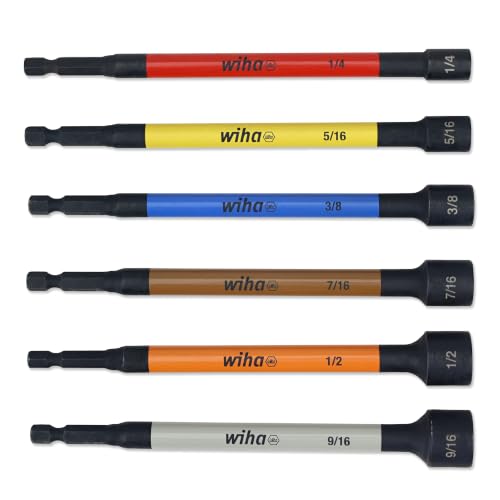
The Klein 32930 is the trade-default long SAE set: six color-coded power nut setters — 1/4, 5/16, 3/8, 7/16, 1/2 and 9/16 inch — on 5-inch shafts with a 6.3-inch overall length, built from high-grade impact steel for impact drivers and drills. It is the newest design in this guide, first available in May 2024, and it shows in the details: the rare-earth magnet in each setter is sized to its hex, so holding power scales with fastener weight instead of being one magnet shrunk or stretched across the range.
The color coding is the working feature. Each size carries its own color, the same code Klein uses across the power nut setter line, so a setter pulled from a pouch is identified before it is read — and the single replacement setters Klein sells individually carry the same code, which means a lost 5/16 is replaced by the same colored 5/16, not by a lookalike. The extended reach is honestly specified: five inches of shaft puts the socket past the side of a duct, through a cabinet back opening or down a channel while the driver body stays outside it, which is the entire reason this product class exists.
Two limits belong with the pick. The set is SAE only; the metric sibling exists in the same line under a different model number, and a buyer who orders by the headline alone can end up with the wrong system — the checks section below covers the model split. And six setters with no stated case means the storage question is yours to solve; on a rail they are a tidy line, loose in a bag they are not.
2. Wiha 70486 Color Coded Magnetic Nut Setter Set, SAE
Runner-Up
2. Wiha 70486 Color Coded Magnetic Nut Setter Set, SAE
Total pieces: 6 nut setters
Sizes: 1/4, 5/16, 3/8, 7/16, 1/2 and 9/16 in (SAE)
The Wiha 70486 is the full-length SAE option: six color-coded magnetic nut setters at a true 6 inches overall — 152 millimeters in the maker’s own datasheet — covering the same 1/4 to 9/16 inch ladder as the Klein set, in a corrosion-resistant black oxide finish. Wiha built its name on this category and calls the color-coded setter its original design; the practical difference from the Klein set is where the length sits and that Wiha publishes a torque ceiling for the line.
The published torque figure is the detail that separates this set’s documentation from the field. An impact rating without a number is a mood; 700 inch-pounds is a ceiling a buyer can reason with — far above what a 1/4-inch hex-head screw needs, low enough to say plainly that these are fastener setters, not lug tools. The black oxide finish is the other working difference: it is the corrosion answer for setters that live in a truck box or a damp plant room, where bright-finish setters in the budget sets will bloom with surface rust.
The cautions are about buying, not using. Wiha sells this set in SAE and metric versions with adjacent model numbers, and the two are confused constantly in listings — the metric set is the next product in this guide, and the checks section gives the split. The maker’s warranty language also excludes consumable bits, so treat the setters as wear items with a long life rather than as warranted tools; a rounded socket is a replacement, not a claim.
3. Wiha 70487 Color Coded Magnetic Nut Setter Set, Metric
3. Wiha 70487 Color Coded Magnetic Nut Setter Set, Metric
The 70487 is the metric half of Wiha’s color-coded line: the same six-piece format, the same 6-inch overall length, the same black oxide finish and color coding, built in the metric sizes that imported machinery, vehicles and equipment bolts actually use. It earns its own place in this guide rather than a footnote in the SAE set’s section for one reason: metric hex heads are not a translation of the SAE ladder, and a buyer who works on metric hardware with SAE setters rounds fasteners — the near sizes are close enough to start and wrong enough to slip under torque.
What the set shares with its SAE sibling is the system: color coding that matches across the line, so a user who owns both sets reads sizes the same way on both rails, and the same published impact discipline. For a shop that services imported equipment — HVAC units, European machinery, metric-framed vehicles — this is the primary set and the SAE version is the supplement, and the guide’s ordering should not be read the other way around.
The documentation gap is the size ladder itself: the regional listing data reviewed for this set confirms six metric sizes without printing the full ladder in the material available, so confirm the exact sizes on the listing before ordering if your work turns on one specific head — the 10 and 13 millimeter heads that dominate metric equipment work are the two to verify first. That is a thinner record than the SAE set’s, and it is flagged here rather than filled in from the maker’s general catalog.
The 32933KIT solves the two-systems problem by folding it: six flip sockets, each carrying a different hex size on each end, giving twelve nut driver sizes — SAE and metric together — mounted on two impact-rated 5-inch shafts, with a 1/4-inch bit holder in the set so the same shafts also drive standard insert bits. It is the only set in this guide whose piece count understates its coverage: six sockets, twelve sizes, one pouch.
Specs
Contents: 6 flip sockets, 2 impact-rated shafts, 1 bit holder
Sizes: 12 hex sizes, SAE and metric combined
Shaft length: 5 in (2 shafts included)
Shank: 1/4 in hex
Format: reversible flip sockets, two sizes per socket
Bit holding: shafts also accept standard 1/4 in insert bits via the included holder arrangement
Rating: impact rated
Model: 32933KIT
UPC: 092644329784
Warranty: not stated in the data reviewed
The flip format’s real advantage is not the count, it is the swap: a technician running mixed hardware on one machine pulls a socket, flips it, and keeps working, with no walk back to the case and no second set on the lift. The two-shaft arrangement matters more than it looks — one shaft can live in the impact driver and the other in the drill, each wearing the socket its task needs, instead of one shaft being passed between tools all day. As part of Klein’s color-coded power nut setter family, the sockets follow the line’s identification logic.
The format’s limits are structural. Twelve sizes across six sockets means the pairing is fixed: if your two sizes of the hour live on opposite ends of the same socket, you will flip constantly, and if they live on different sockets you gain nothing over fixed setters. The flip sockets are also their own ecosystem — a lost socket is replaced from this line, not from the single-setter rack — and the set’s documentation in the data reviewed does not state a storage case, so the pouch question is open just as it is for the 32930.
5. HORUSDY 87045 18-Piece Long Nut Driver Set
The HORUSDY set is the coverage play: eighteen pieces of 6-inch magnetic nut drivers spanning SAE and metric sizes in one storage case, in chrome vanadium steel with a painted black finish, at the budget end of this guide. Where the Klein and Wiha sets ask you to commit to a system, this set declines to ask — both ladders are in the box, which makes it the natural first set for a home shop whose fasteners arrive from everywhere.
Specs
Total pieces: 18 nut drivers
Sizes: SAE and metric, per the listing title data
Length: 6 in, extra long
Shank: 1/4 in hex, quick change
Material: chrome vanadium steel
Finish: painted, black
Magnet: magnetic
Rating: listed for impact drill use
Storage: case included
Item weight: 676 g, per the listing data reviewed (packaged)
Model: 87045
Warranty: not stated in the data reviewed
The case is a larger part of the value than it appears. Eighteen 6-inch setters are the bulkiest format in this guide, and the set that ships with its own case is the set that stays a set; the trade-brand picks above ask the buyer to solve storage separately. Chrome vanadium is the standard setter steel across the whole category, budget and premium alike, so the material line is not where the saving was made.
The saving shows in documentation and finish instead. The listing data reviewed does not print the full size ladder for the eighteen pieces, so the buyer is trusting the title’s SAE-and-metric promise rather than a published list — check the ladder on the listing against your fasteners before ordering. The painted finish will not age like black oxide in a damp box. And the set’s published record is thinner and older than the trade brands’ records in this guide; it is the pick where a glance at the live listing before ordering matters most.
Which Long Nut Driver Set Fits Your Work
SAE fasteners, daily trade use: the Klein Tools 32930. Sized rare-earth magnets, a color code that extends to individual replacements, and an honestly split shaft-versus-overall length spec. Buy the metric sibling from the same line when the second system arrives.
SAE fasteners, maximum reach and a published torque ceiling: the Wiha 70486. A true 6 inches overall, black oxide for damp storage, and the only stated impact ceiling in the guide. It is also the natural pick for a buyer who prefers the older, established line.
Metric hardware first: the Wiha 70487. The same set, the other system — with the one homework item of confirming the printed size ladder on the listing before ordering.
Both systems, one pouch, constant switching: the Klein 32933KIT. Twelve sizes on six flip sockets and two shafts is the format built for mixed-hardware service work, provided your common size pairs sit on different sockets.
First set, mixed home-shop fasteners, budget leads: the HORUSDY 87045. Both ladders, the longest count here and a case in the box, accepted with thinner documentation and a painted finish.
Who should skip the category: anyone whose hex work is mostly nuts run down long threaded rod — that job needs hollow-shaft handled nut drivers, because every socket in this guide is shallow — and anyone whose fasteners are large or structural, where the right tool is a socket on a ratchet or an impact wrench, not a 1/4-inch hex shank. A buyer with only open, bench-top hex work gains nothing from the length either; standard 2-inch setters are cheaper to replace and easier to control, and the long shaft only earns its keep when the fastener is recessed.
Working With Long Nut Setters
The long shaft changes how the tool behaves, and two habits make it behave well. First, start every fastener by hand-turning the setter a few revolutions with the drill off or the driver in your palm: at six inches, a cross-threaded start is harder to feel than at two, and the magnet will happily hold a crooked screw straight enough to ruin a threaded hole. Second, drive on the drill’s clutch or the impact driver’s lowest setting and let the magnet do the holding while the tool does modest turning — hex-head sheet metal screws and machine nuts need seating torque, not full impact output, and overdriving at the end of a long shaft twists the fastener or snaps it before your hand registers the resistance.
Keep the sockets clean. A magnetic socket in a metal shop fills with filings, and a filed-up socket seats the next nut off-center, which rounds it slowly and blames the fastener. A pick, a blast of air or a wipe on a rag at the end of the day is the whole maintenance routine; setters stored on a rail or in their case stay cleaner than setters loose in a bag of screws.
Watch the shaft, not the socket, for wear. The failure mode of a long setter is a sprung or bent shaft from being used as a pry or from a drop onto concrete, and a bent 6-inch shaft wobbles the socket in a circle that no magnet fixes. A setter that wobbles comes off the rail and out of the set; it will round more fasteners in a week than it drove in a year.
Checks Before You Order
Model numbers collide across this category, so order by the maker’s model, not the headline. Klein’s color-coded line splits three ways: the 32930 is the six-piece SAE set in this guide, the same line’s metric set carries an M suffix on the model, and the three-piece set of the three most common SAE sizes is a different model again — all three wear near-identical names. Wiha’s pair is adjacent by one digit: 70486 is SAE and 70487 is metric, and marketplace listings mix the two freely, so match the model on the box to the system you ordered. Wiha also sells a twelve-piece roll-up pouch set spanning both systems under another model; it is a different product from either six-piece set here. HORUSDY’s eighteen-piece set is model 87045, and the same brand sells larger mixed kits that add screwdriver bits and adapters — count what is in the box against the listing, because the headline piece counts in this category routinely include holders and adapters.
The flip socket set is its own format. The 32933KIT’s sockets fit its included shafts and the maker’s compatible holders; they are not interchangeable with the fixed setters in the other sets, and its twelve sizes are twelve ends of six sockets, not twelve separate drivers. Buy it for the format, with the pairing limit in its section in mind.
Recalls and warnings. A recall search for nut driver bits and nut setters found no recall covering any set in this guide. The standing cautions for the category are older and simpler: never use a setter that is not impact rated in an impact driver — sockets not built for impact can crack — and never use a magnetic setter as a pry or a punch, because the long shaft that makes it useful makes it a lever.
On arrival, whichever you buy: count pieces against the maker’s list rather than the headline, check each socket against a known fastener of its marked size before the set goes into service, test the magnet on the heaviest fastener you run, and confirm the shaft runs true by spinning it slowly in the drill and watching the socket for wobble.
Frequently Asked Questions
What is the difference between a nut driver bit and a socket?
A nut driver bit — a nut setter — is a socket permanently mounted on a 1/4-inch hex shank, made to chuck directly into a drill or impact driver. A socket is a separate cup that mounts on a ratchet, extension or impact wrench through a square drive. The setter is faster for the small hex fasteners it fits and needs no adapter; the socket covers larger sizes, deeper wells and far higher torque. The sets in this guide are all setters.
How much reach do I actually gain from a long set?
About three to four inches over a standard setter. A standard nut setter is roughly 2 to 2-9/16 inches long; the sets here run 5-inch shafts with about 6.3 inches overall, or a full 6 inches overall. That difference is what clears a drill body past a cabinet side, a duct wall or a machine cover while the socket stays on the fastener — on open work it gains nothing, which is why the guide’s skip note exists.
Can I use these sets in a regular drill, or only in an impact driver?
Both. Every set here uses the standard 1/4-inch hex shank, which chucks into any drill and locks into any impact driver’s collet. A drill with a clutch is often the better tool for the smaller sizes, because the clutch caps the seating torque that an impact driver would blow past. The impact rating on the sets matters when the driver is used; in a drill, any of the five can work.
Do I need both SAE and metric sets?
Only if your fasteners say so. Domestic construction and appliance hardware is overwhelmingly SAE; imported machinery and vehicles are overwhelmingly metric, and the near sizes across the systems are close enough to start a nut and wrong enough to round it under load. A one-system shop buys its system — Klein 32930 or Wiha 70486 for SAE, Wiha 70487 for metric. A genuinely mixed shop either pairs two fixed sets or buys the format that carries both, the Klein flip sockets or the HORUSDY eighteen-piece.
Conclusion
For most buyers, the Klein Tools 32930 is the long nut driver bit set to buy: six SAE sizes on honest 5-inch shafts, magnets sized to the fastener, and a color code that survives the pouch. The Wiha 70486 matches it size for size with a true 6-inch length, a black oxide finish and the guide’s only published torque ceiling, and the 70487 does the same work for metric hardware. The Klein 32933KIT is the format answer for mixed service work — twelve sizes folded into six sockets — and the HORUSDY 87045 covers both systems in one cased set for the least commitment. Whichever you choose, confirm the size system before the brand, compare shaft length rather than headline length, keep the sockets clean, and leave threaded rod to hollow shafts.
M
Miller the Driller Editorial Team
We compare specs, warranty terms, long-term owner feedback and street pricing before anything earns a spot. Rankings are never paid.
Affiliate disclosure. As an Amazon Associate we earn from qualifying purchases at no extra cost to you. Prices accurate as of the date shown.
Three wireless routers for small offices compared on device capacity, network separation, wired speed, and coverage, with specs taken from their Amazon listings.
Compare 5 mechanic tool sets for car repairs: a 247-piece DEWALT kit, a 450-piece CRAFTSMAN set, a drawer-box GEARWRENCH set, a 170-piece Crescent set and a 450-piece WORKPRO set.
Four splitting axes and mauls that actually split firewood: a long 36-inch axe for tall users, a shorter 28-inch option, and two 8 lb mauls for knotty rounds.
Learn whether a 20V rechargeable drill battery can be repaired, which faults you can check safely at home, and when replacing the pack is the safer choice.
A specs-based review of the officially licensed Retro-Bit Sega Saturn 2.4 GHz wireless controller: dual receivers, Genesis Mini and Switch support, battery, layout, limits, and FAQs.
Find the best drill battery for Power Wheels ride-on toys for families, with DeWalt, Milwaukee and Ryobi adapters, voltage and safety guidance in this guide.
Find the best hole saw for noching dom pipe: bi-metal saws, deep cups, and the right sizes for clean, tight notches in DOM tube for fabrication shops today.
Find the best diy tile saws for home tiling projects. Compare wet tile saws by blade size, cutting capacity, and features for ceramic and porcelain tile.