We research everything we recommend. When you buy through our links, we may earn a commission. As an Amazon Associate we earn from qualifying purchases.
Best Chainsaws for Firewood, Yard Work and Tree Care
Compare the best chainsaws for firewood, yard cleanup, and tree care, with corded and cordless picks matched to bar length, wood size, and safe cutting.
As an Amazon Associate I earn from qualifying purchases. This post may contain affiliate links at no extra cost to you.
⭐ Key Takeaways
Quick answer: Our top pick is Oregon CS1500 18-Inch Self-Sharpening Corded Chainsaw, with WORX WG303.1 16-Inch Corded Chainsaw as a strong alternative.
A chainsaw earns its keep on jobs no other yard tool handles well: bucking fallen logs into firewood, clearing storm-damaged limbs, pruning thick branches, and taking down small dead trees before they drop on a fence. Gas saws still dominate professional work, but modern electric models now cover most homeowner cutting without fuel mixing, pull cords, or engine maintenance.
This guide compares five widely sold electric chainsaws: two corded models for unlimited runtime near the house, and three cordless kits that trade a power cord for battery freedom. Bar lengths run from 14 to 18 inches, which spans everything from light limbing to serious firewood rounds. Just as important, the guide covers the sizing rules and safety gear that matter more than any single specification.
As an Amazon Associate, we earn from qualifying purchases.
For most homeowners, a 16-inch cordless saw covers firewood, storm cleanup, and pruning without fuel or cords. The Greenworks 40V and EGO CS1611 kits are the easiest starting points. If you cut near the house and want an 18-inch bar, the corded Oregon CS1500 adds self-sharpening. Makita LXT owners should look at the XCU03PT kit.
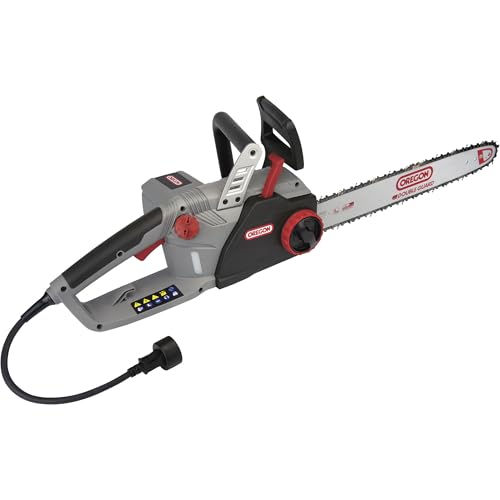
The CS1500 pairs a 15-amp motor with an 18-inch bar, the longest bar in this group, so it bucks thicker firewood rounds in a single pass than the 14- and 16-inch saws here. Its signature feature is the PowerSharp system: pull a lever for a few seconds and a built-in stone sharpens the chain right on the bar, which removes the files, guides, and guesswork that keep many owners from sharpening as often as they should.
An automatic oiler feeds bar oil as the chain runs, and chain tension adjusts without tools. The trade-off is the cord. Working range ends at the length of a suitable outdoor extension cord, and a 15-amp saw needs a heavy-gauge cord to avoid voltage drop. Weight is about 12.6 pounds, manageable for ground-level bucking on a sawbuck.
Specs:
– Power source: corded electric, 15 amp
– Bar length: 18 inches
– Chain: PowerSharp self-sharpening, low kickback
– Oiler: automatic
– Tensioning: tool-less
– Weight: about 12.6 lb
WORX WG303.1 16-Inch Corded Chainsaw
Runner-Up
WORX WG303.1 16-Inch Corded Chainsaw
Best for: first-time chainsaw owners who want correct chain tension handled for them and mostly cut within cord range of the house.
The WG303.1 runs a 14.5-amp motor and a 16-inch bar, a size that suits general property cleanup, storm limbs, and small to medium firewood. Its patented auto-tension system is the headline: a large knob sets and maintains chain tension automatically, preventing the over-tightening that wears bars and the under-tightening that lets chains derail, two of the most common beginner mistakes.
Automatic oiling with a visible level window and a 200 ml reservoir keeps the bar lubricated, and a built-in chain brake plus a low-kickback bar address the safety basics. At about 11 pounds it is light for a corded saw of this bar length. Like the Oregon, it needs a proper outdoor extension cord sized for its amp draw.
Specs:
– Power source: corded electric, 14.5 amp
– Bar length: 16 inches
– Tensioning: automatic auto-tension knob
– Oiler: automatic, with level indicator window
– Safety: built-in chain brake, low-kickback bar
– Oil tank capacity: 200 ml
Greenworks 40V 16-Inch Brushless Chainsaw (20312)
Greenworks 40V 16-Inch Brushless Chainsaw (20312)
Best for: homeowners already in the Greenworks 40V system, and anyone who wants cordless freedom for yard cleanup and moderate firewood.
The 20312 is a complete cordless kit: a brushless 16-inch saw, a 4.0Ah battery, and a charger. Greenworks rates the package at up to 120 cuts through 4×4 lumber per charge, which translates to a solid session of limbing and bucking before the battery needs a swap. Because it sits in the Greenworks 40V line, the same battery also runs that platform’s trimmers, blowers, and mowers.
Tool-less chain tensioning, an automatic oiler, and an electronic chain brake cover the convenience and safety checklist, and at about 9.3 pounds it is the lightest saw in this group, which matters during longer cleanup sessions. Runtime is the ceiling: a full day of firewood production means owning a second battery.
Specs:
– Power source: 40V battery, 4.0Ah battery and charger included
– Motor: brushless
– Bar length: 16 inches
– Tensioning: tool-less
– Oiler: automatic
– Safety: electronic chain brake, low-kickback chain
EGO Power+ CS1611 16-Inch Cordless Chainsaw Kit
EGO Power+ CS1611 16-Inch Cordless Chainsaw Kit
Best for: buyers who want a complete, well-supported cordless kit and may already own other EGO 56V tools.
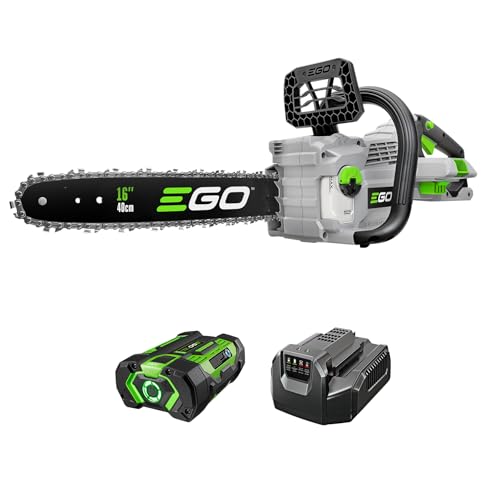
The CS1611 is EGO’s 16-inch kit on the 56V ARC Lithium platform, sold with a 2.5Ah battery and charger. A brushless motor drives the 16-inch bar and chain, and the saw uses the same batteries as the rest of the EGO outdoor lineup, so owners of EGO mowers or blowers can add runtime with packs they already have.
Chain tensioning is tool-free, oiling is automatic, and the housing carries an IPX4 weather-resistance rating, useful when cleanup follows a storm. The 2.5Ah pack keeps weight down for limbing and pruning; buyers planning long firewood sessions should budget for a larger EGO battery as a second pack.
Specs:
– Power source: 56V battery, 2.5Ah battery and charger included
– Motor: brushless
– Bar length: 16 inches
– Tensioning: tool-free
– Oiler: automatic
– Weather resistance: IPX4 rated housing
The XCU03PT runs two 18V LXT batteries in series to deliver 36V, and this kit bundles two 5.0Ah batteries with a dual-port rapid charger, so it arrives ready to work. The brushless motor drives the 14-inch bar at chain speeds up to 3,940 feet per minute, and the shorter bar keeps the saw compact and controllable for limbing, pruning, and bucking smaller logs.
Tool-less chain adjustment and an automatic oiler are standard, and weight is about 11.5 pounds with both batteries installed. The honest catch is platform math: this saw only makes sense if the included batteries fit your plans. The same saw is also sold bare as the XCU03Z for readers who already own LXT batteries and a charger.
Specs:
– Power source: two 18V LXT batteries (36V total), two 5.0Ah batteries and charger included
– Bar length: 14 inches
– Chain speed: up to 3,940 FPM
– Tensioning: tool-less
– Oiler: automatic
– Weight: about 11.5 lb with batteries
How to choose
Start with the power source. Gas saws still offer the most power and unlimited mobility, at the cost of noise, fumes, fuel mixing, and the most maintenance. Cordless saws start instantly, run quietly, and need only bar oil and chain care, but runtime ends with the battery and every brand locks you into its own battery platform. Corded saws are the simplest and lightest option with unlimited runtime, as long as your cutting stays within extension-cord reach of an outlet and the cord is heavy enough for the saw’s amp draw.
Next, match bar length to the wood. A saw cuts in one pass only through wood somewhat smaller than its bar, so choose a bar at least 2 inches longer than the diameter of the logs you cut most often. A 14-inch bar handles limbs and small firewood, 16 inches covers most homeowner work including medium rounds, and 18 inches suits regular bucking of larger logs. Longer bars add weight and cost, so buying bigger than your wood is a real downside, not insurance.
Then check the safety and maintenance hardware. A working chain brake and a low-kickback chain are essential, not optional extras. An automatic oiler keeps the bar and chain lubricated while you cut, and tool-free tensioning matters because a chain that is easy to adjust actually gets adjusted: a slack chain can jump the bar, while an over-tight chain accelerates wear.
Finally, the safety rules that outrank every buying decision. Chainsaws are among the most dangerous yard tools a homeowner can run, and kickback can injure in a fraction of a second. Chaps, a helmet with a visor or separate eye protection, hearing protection, gloves, and sturdy boots are essential gear, not accessories. Never cut above shoulder height, never cut from a ladder, and keep a firm two-handed grip with secure footing. Beginners should take a chainsaw safety course before felling anything, and tree work near houses, fences, or power lines belongs to professional arborists.
Who should skip
Skip a chainsaw if you are unwilling to wear the full set of protective gear on every cut; the injury statistics for unprotected users are unforgiving. If your only work is light pruning of branches you can reach from the ground, a manual pruning saw or a small pole saw is safer, quieter, and easier to store. Anyone facing large, leaning, or storm-damaged trees near structures should hire an arborist instead of buying a bigger saw. And if bar oil, chain sharpening, and tension checks sound like chores you will avoid, a neglected chainsaw is more dangerous than none at all.
Frequently Asked Questions
What size chainsaw do I need for firewood?
For most firewood, a 16-inch bar is the sweet spot: it bucks rounds up to about 14 inches across in one pass and stays light enough for long sessions. Choose 18 inches if you regularly cut larger logs, and 14 inches if your wood is mostly small limbs and stove-length splits from small trees.
Is a cordless chainsaw strong enough to cut down a tree?
A modern 16-inch cordless saw can fell small trees, roughly up to the diameter its bar handles in one or two passes, and buck them into firewood. Large hardwoods, leaning trees, and anything near a building are different work: that is where gas saws and, more importantly, professional training and experience matter most.
How often does a chainsaw chain need sharpening?
Sharpen when the saw starts producing fine dust instead of coarse chips, when it pulls to one side, or when you have to force it through the cut. Cutting into dirt, even briefly, dulls a chain immediately. Many owners touch up the chain every fuel refill or battery swap, which keeps cutting fast and reduces fatigue.
What protective gear does a beginner need?
At minimum: chainsaw chaps, a helmet with visor or safety glasses, hearing protection, gloves, and steel-toe or sturdy boots. Add a first aid kit in the work area and a second person nearby when possible. No item on that list is optional for a new user.
Final verdict
Match the saw to your wood pile and your outlets. The Greenworks 40V kit is the easiest all-round starting point for cordless yard work, the EGO CS1611 adds a strong 56V platform and weather resistance, and the Makita XCU03PT kit suits LXT owners who want a compact, fast chain. If your cutting happens near the house, the corded WORX WG303.1 removes tensioning guesswork, while the Oregon CS1500 adds the longest bar and self-sharpening. Whichever you choose, budget for chaps, head, eye, and ear protection alongside the saw.
M
Miller the Driller Editorial Team
We compare specs, warranty terms, long-term owner feedback and street pricing before anything earns a spot. Rankings are never paid.
Affiliate disclosure. As an Amazon Associate we earn from qualifying purchases at no extra cost to you. Prices accurate as of the date shown.
Three wireless routers for small offices compared on device capacity, network separation, wired speed, and coverage, with specs taken from their Amazon listings.
Compare 5 mechanic tool sets for car repairs: a 247-piece DEWALT kit, a 450-piece CRAFTSMAN set, a drawer-box GEARWRENCH set, a 170-piece Crescent set and a 450-piece WORKPRO set.
Four splitting axes and mauls that actually split firewood: a long 36-inch axe for tall users, a shorter 28-inch option, and two 8 lb mauls for knotty rounds.
Learn whether a 20V rechargeable drill battery can be repaired, which faults you can check safely at home, and when replacing the pack is the safer choice.
A specs-based review of the officially licensed Retro-Bit Sega Saturn 2.4 GHz wireless controller: dual receivers, Genesis Mini and Switch support, battery, layout, limits, and FAQs.
Find the best drill battery for Power Wheels ride-on toys for families, with DeWalt, Milwaukee and Ryobi adapters, voltage and safety guidance in this guide.
Find the best hole saw for noching dom pipe: bi-metal saws, deep cups, and the right sizes for clean, tight notches in DOM tube for fabrication shops today.
Find the best diy tile saws for home tiling projects. Compare wet tile saws by blade size, cutting capacity, and features for ceramic and porcelain tile.



 EGO Power+ CS1611 16-Inch Cordless Chainsaw Kit
 Makita XCU03PT 18V X2 (36V) LXT 14-Inch Chain Saw Kit









