What's inside
As an Amazon Associate I earn from qualifying purchases. This post may contain affiliate links at no extra cost to you.
A brick chimney is easy to damage with the wrong drill. The main risk is not that the hole is difficult; it is that a large hammer drill can crack a brick, loosen mortar, or punch through the chimney wall. For a few small anchor holes, a compact cordless hammer drill is usually the sensible buy. A rotary hammer is worth considering for repeated holes, hard masonry, or larger diameters—but it is not automatically the safer choice.
As an Amazon Associate we earn from qualifying purchases at no extra cost to you.


What we cover
Choose the right drill for the hole
For small holes about 1/4 to 3/8 inch across, a standard cordless hammer drill with a sharp carbide-tipped masonry bit is often enough. It uses a rotating bit with a rapid hammering action. This combination is slower than a rotary hammer in tough brick, but it is lighter and easier to control. A 18V or 20V-class tool with a side handle is a practical choice; voltage labels vary by brand and do not tell you how powerful the drill will be under load.
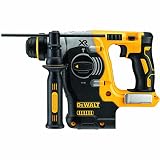
A rotary hammer uses a different impact mechanism and SDS-style bits. It generally drills faster into dense masonry and needs less pushing force. For multiple holes, holes larger than about 3/8 inch, or especially hard brick, consider an SDS-plus cordless rotary hammer. Its extra weight and impact energy can also make it easier to overdo the job on old or brittle brick.
Do not use an impact driver as a substitute. Its impacts turn the fastener; they are not designed to drill masonry holes. A regular drill in hammer mode is also not interchangeable with a rotary hammer, even if both tools are labeled “hammer.”
Which tool fits the job?
| Tool | Best use on a chimney | Trade-off |
|---|---|---|
| Cordless hammer drill | A few small anchor holes in sound brick | Slower in very hard masonry; requires steady control |
| SDS-plus rotary hammer | Several holes, larger holes, or hard brick | Heavier and more forceful; easier to damage fragile masonry |
| Drill-only cordless drill | Soft material or jobs where hammering would be risky | Can stall or overheat drilling ordinary brick |
If the job is one or two small holes, a well-made cordless hammer drill with a side handle is usually the cheaper, more manageable option. If you already own a capable drill, try it with the correct bit before buying another tool—provided the brick is sound and the hole is small.
Drill brick, not the mortar joint
For many wall anchors, the brick face is a better fixing point than a mortar joint. Mortar may be softer, crumbly, or weathered, and an anchor can loosen as it breaks apart. But brick is not always sound: cracked, spalled, or visibly flaking brick may not hold an anchor reliably. Avoid drilling near an edge, a corner, a crack, or a damaged area. As a working rule, keep the hole at least 1 inch from an edge when the layout allows, and follow the anchor maker’s spacing requirements.
Chimneys need extra caution. A hole can penetrate a thin wall or reach a flue, and drilling into the flue liner can create a serious safety problem. Do not guess at wall thickness or drill where the flue path is uncertain. If the attachment is heavy, exposed to wind, or safety-critical—or you cannot establish a safe drilling depth—ask a qualified mason or chimney professional.
Match the bit and anchor
Use a carbide-tipped masonry bit in a standard hammer drill, or an SDS-plus masonry bit in a rotary hammer. Check that the bit diameter matches the anchor instructions; a hole that is too wide may leave the anchor spinning, while an undersized hole can prevent it seating or split the brick. A quality carbide-tipped masonry bit set is useful if you need common sizes, but one suitable bit is enough for a single job.
Choose the anchor for the load and setting, not just the drill. Light-duty plastic masonry plugs suit modest loads in sound brick when installed to their stated limits. For heavier attachments, select an anchor specifically rated for the material and load; do not assume a generic expansion anchor is safe in old brick. Check whether the anchor is intended for solid brick, hollow material, or another substrate, and use the specified embedment depth.
Drill with control
Mark the hole and check for pipes, wiring, and other hazards before drilling. Set the depth stop, if supplied, to the anchor’s required hole depth, allowing only the extra clearance recommended by the anchor maker. Start slowly with the bit square to the wall. Once it is tracking straight, apply steady pressure rather than leaning hard on the drill. Excess pressure can overheat the bit, make the tool wander, and chip the brick face.
Clear dust from the hole as directed by the anchor instructions; packed drilling dust can keep an anchor from seating and reduce its grip. Wear eye protection, and use hearing protection for hammer drilling. Masonry dust can contain respirable silica, so avoid breathing it: use suitable dust collection or another effective dust-control method, and follow local safety guidance. If the bit binds, the brick starts cracking, or the tool’s clutch repeatedly slips, stop and reassess rather than forcing the hole.
When not to buy a stronger drill
A higher-powered tool will not fix a bad anchor choice, crumbling brick, or an unsafe location. For two small holes in sound brick, a basic cordless hammer drill and a fresh bit are usually enough. Pay extra for a rotary hammer when the job genuinely calls for faster drilling, larger holes, or frequent masonry work—not simply because the chimney looks tough. If the brick is fragile or the attachment could endanger someone if it comes loose, have the masonry and fixing specified by a professional.