We research everything we recommend. When you buy through our links, we may earn a commission. As an Amazon Associate we earn from qualifying purchases.
Best Nibblers for Cutting Sheet Metal Without Distortion
Compare the best nibblers for clean, flat sheet metal cuts, from cordless and corded models to drill attachments and air nibblers, with safety tips.
Cutting sheet metal with snips or a shear often leaves a curled, wavy edge that has to be hammered flat again, and an abrasive wheel throws sparks and heat into the panel. A nibbler takes a different approach: a fast-moving punch stamps out tiny crescent-shaped chips against a die, so the sheet stays flat, the edge stays clean, and the tool can turn curves and cut openings in the middle of a panel without a running start from the edge.
This guide compares five well-regarded nibblers across the main power types: a corded shop model, two cordless models for roof and site work, a drill attachment for occasional cutting, and a pneumatic model for shops with air on tap. Each pick below lists its gauge capacity by material, because that rating, more than any headline number, decides whether a nibbler suits the metal on your bench.
As an Amazon Associate, we earn from qualifying purchases.
For most sheet metal work, a 16-gauge cordless or corded nibbler is the sweet spot: it cuts mild steel, stainless and aluminum without bending the sheet or throwing sparks. Pick the Milwaukee M12 FUEL for compact cordless work, the Makita JN1601 for corded shop use, and a drill attachment or air nibbler for occasional cuts.
Makita JN1601 16 Gauge Nibbler
Top Pick
Makita JN1601 16 Gauge Nibbler
Best for: Shop users who want steady corded power for daily duct and panel work.
The JN1601 is Makita’s long-running corded nibbler, built around a 5.0-amp motor that drives the punch at 2,200 strokes per minute. That steady corded power suits bench work and fabrication shops where the tool runs for long stretches cutting duct sections, patch panels and equipment enclosures, with no battery to fade halfway through a long cut.
Its die can be repositioned to change cutting direction, which helps when a cut has to turn across a sheet without rotating the whole workpiece. Capacity covers the common sheet gauges used in HVAC and light fabrication, and the slim head profile reaches into corners and along flanges where bulkier cutters struggle to follow a line.
Milwaukee’s M12 FUEL nibbler squeezes full 16-gauge capacity into a compact 12-volt tool that weighs under 3 pounds as a bare tool. A brushless motor and a variable speed dial let you slow the punch for tight curves and control around cutouts, then open it up on straight runs, where it feeds at up to 7 feet per minute in rated material.
The capacity figures stand out for a tool this size: it is rated for 16 gauge mild steel, 18 gauge stainless and 12 gauge aluminum, and it handles the seams on spiral duct, a job that stalls many small cutters. Anyone already running M12 batteries can add it as a bare tool and keep a single charger on the truck.
Specs:
– Power: M12 REDLITHIUM batteries, tool only
– Motor: brushless with variable speed dial
– Speed: up to 2,200 strokes per minute
– Capacity: 16 gauge mild steel, 18 gauge stainless steel, 12 gauge aluminum
– Feed rate: up to 7 feet per minute
– Weight: 2.7 pounds, tool only
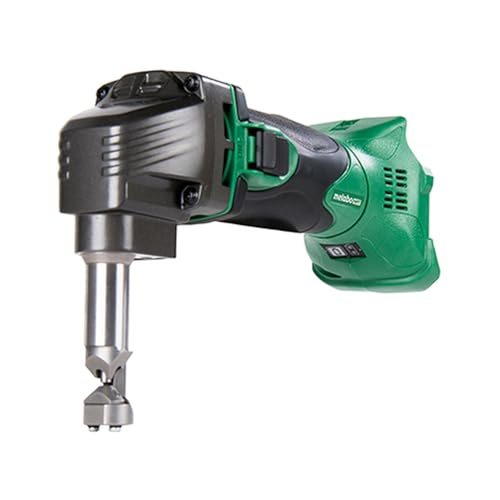
The CN18DSLQ4 is Metabo HPT’s 18-volt cordless nibbler, sold as a tool body that runs on the brand’s slide-style 18V and MultiVolt batteries. It was designed with profiled sheet in mind, so it is a natural fit for ribbed and corrugated metal roofing panels, where the cutting head has to ride up and over ribs without hanging up or flattening the profile.
Its die holder locks in three positions across a 180-degree range, letting you set the cutting direction for the panel in front of you instead of twisting your wrist to match the tool. That flexibility, plus cordless operation, suits it to work on ladders and rooftops where dragging a cord across sharp panel edges is a genuine hazard.
Specs:
– Power: 18V slide batteries, tool only
– Die holder: 3-stop design, rotates 180 degrees
– Capacity: 16 gauge mild steel
– Designed for: ribbed and corrugated metal panels
– Includes: 2.5 mm and 4 mm hex bar wrenches
REXBETI Double Head Sheet Metal Nibbler Drill Attachment
REXBETI Double Head Sheet Metal Nibbler Drill Attachment
Best for: DIY users who cut sheet metal occasionally and already own a suitable drill.
This double-head attachment turns a drill you already own into a nibbler, which makes it the lowest-commitment way into punch-and-die cutting. It clamps into corded or cordless drills, works best in the 1,500 to 3,000 RPM range, and carries two cutting heads that rotate a full 360 degrees, so you can switch orientation for curves, circles and straight runs without repositioning the sheet.
The listing rates it for steel up to 14 gauge, and the heads handle the usual sheet materials found in home and hobby work: flashing, duct offcuts, appliance panels and trailer skin repairs. A spare punch and die set is included in the box, a thoughtful touch on a tool whose cutting edges are wear parts. Control depends on the drill and a steady hand, so expect to move slower than with a dedicated nibbler.
Specs:
– Power: corded or cordless drill, 1,500 to 3,000 RPM recommended
– Heads: two cutting heads, rotate 360 degrees
– Capacity: up to 14 gauge steel
– Cuts: straight lines, curves and circles
– Includes: spare punch and die set
Astro Pneumatic Tool 727 ONYX Heavy Duty Air Nibbler
Astro Pneumatic Tool 727 ONYX Heavy Duty Air Nibbler
Best for: Fabrication and body shops with air lines that want a light, fast nibbler.
Astro’s 727 ONYX is a compact air nibbler built for shops that already run compressors. At just 2.1 pounds it is the lightest powered option here, and it cycles at 3,500 cuts per minute, feeding at over an inch per second through material up to 17 gauge cold rolled steel. That combination of low weight and high cycle speed suits overhead work and long sessions on vehicle panels.
Because it runs on air, there is no motor to overheat and no battery to manage; as long as the compressor keeps up at around 90 PSI, the tool cuts continuously. The trade-off is the hose, which trails behind you and can snag on panel edges, so it fits a fixed workstation or a fabrication bay better than a rooftop.
Specs:
– Power: pneumatic, about 90 PSI working pressure
– Speed: 3,500 cuts per minute
– Capacity: 17 gauge cold rolled steel
– Feed rate: over an inch per second
– Weight: 2.1 pounds
How to choose
Start with capacity, and read the rating for your material, not the headline number. Gauge capacity differs by metal: a nibbler rated for 16 gauge mild steel is usually rated for only 18 gauge stainless, because stainless is harder, while soft aluminum may be rated several gauges thicker. Remember that gauge runs backwards, so 14 gauge is thicker than 16 gauge. Match the tool to the thickest stock you cut regularly, and leave a little headroom if you work near the limit all day.
Next, plan for the waste. A nibbler does not slice metal apart; it punches out a narrow strip as thousands of small crescent chips, and those chips go everywhere. They are sharp enough to cut skin, work into shoe soles and scratch finished panels. Wear gloves and eye protection, keep a magnet or a broom moving during long cuts, and sweep the area before kneeling or leaning on the sheet. Cut edges are sharp too, so deburr or fold edges that hands will meet later, and support the sheet on a bench or sawhorses so it does not flap and vibrate as you cut; a flapping sheet makes a wandering line and tired hands.
Check the minimum cutting radius if your work involves curves, circles or cutouts. A smaller radius means tighter turns around vent holes, wheel arches and sink openings. For corrugated roofing, look for a head shaped to follow ribs and a die that rotates, so the tool tracks the profile instead of bridging across it.
Finally, pick the cutting method by job. Choose a nibbler when the sheet must stay flat, when cuts start mid-panel, or when sparks are not acceptable near fuel, insulation or finished paint. Choose double-cut shears for long, straight runs in flat sheet where speed matters and slight edge wave is acceptable. Keep aviation snips for short cuts, notches and thin stock; they are cheap and precise, but slow and hard on hands over any distance.
Who should skip
Skip a nibbler if your work is mostly plate thicker than 14 gauge; these tools are sheet tools, and plate belongs under a plasma cutter or a saw. Skip one if you only make a handful of short cuts a year, since snips will do that job for far less money and no cleanup. Production shops cutting the same straight line all day will also be happier with shears, and anyone without a compressor should cross the air model off the list rather than buying a compressor for one tool.
FAQ
Can a nibbler cut corrugated roofing panels?
Yes, and it is one of the tool’s best uses. A nibbler follows the ribs of corrugated and ribbed panels without flattening the profile, and the punch-and-die action leaves no sparks near roofing felt or insulation. Models with rotating dies make it easier to keep the head aligned as the panel profile rises and falls.
Why does the same nibbler have different gauge ratings?
Because gauge capacity depends on the hardness of the metal. Stainless steel resists punching more than mild steel, so the same tool is rated for a thinner gauge in stainless, while soft aluminum can be cut several gauges thicker. Always check the rating listed for the exact material you plan to cut.
Do nibblers leave a sharp edge?
The cut edge is clean and free of the curl that shears leave, but it is still freshly cut metal and it is sharp. The bigger hazard is the waste: the small crescent chips are sharp on every side. Gloves, eye protection and a magnet sweep after cutting keep both problems under control.
Can a nibbler start a cut in the middle of a sheet?
Yes. Drill a pilot hole large enough for the cutting head to pass through, set the head in the hole, and cut outward to your line. This is a major advantage over shears and snips, which can only start from an edge, and it makes window, vent and outlet cutouts straightforward.
Final verdict
For a single do-everything pick, the Milwaukee M12 FUEL 2476-20 pairs genuine 16-gauge capacity with a compact cordless body that goes anywhere. Bench-based shops will get more continuous duty from the corded Makita JN1601, roofing crews should look at the Metabo HPT CN18DSLQ4, occasional users are well served by the REXBETI drill attachment, and air-equipped shops will appreciate the light, fast Astro 727 ONYX. Match the gauge rating to your material first, and any of the five will cut clean, flat and spark-free.
M
Miller the Driller Editorial Team
We compare specs, warranty terms, long-term owner feedback and street pricing before anything earns a spot. Rankings are never paid.
Affiliate disclosure. As an Amazon Associate we earn from qualifying purchases at no extra cost to you. Prices accurate as of the date shown.
Three wireless routers for small offices compared on device capacity, network separation, wired speed, and coverage, with specs taken from their Amazon listings.
Compare 5 mechanic tool sets for car repairs: a 247-piece DEWALT kit, a 450-piece CRAFTSMAN set, a drawer-box GEARWRENCH set, a 170-piece Crescent set and a 450-piece WORKPRO set.
Four splitting axes and mauls that actually split firewood: a long 36-inch axe for tall users, a shorter 28-inch option, and two 8 lb mauls for knotty rounds.
Learn whether a 20V rechargeable drill battery can be repaired, which faults you can check safely at home, and when replacing the pack is the safer choice.
A specs-based review of the officially licensed Retro-Bit Sega Saturn 2.4 GHz wireless controller: dual receivers, Genesis Mini and Switch support, battery, layout, limits, and FAQs.
Find the best drill battery for Power Wheels ride-on toys for families, with DeWalt, Milwaukee and Ryobi adapters, voltage and safety guidance in this guide.
Find the best hole saw for noching dom pipe: bi-metal saws, deep cups, and the right sizes for clean, tight notches in DOM tube for fabrication shops today.
Find the best diy tile saws for home tiling projects. Compare wet tile saws by blade size, cutting capacity, and features for ceramic and porcelain tile.


 REXBETI Double Head Sheet Metal Nibbler Drill Attachment
 Astro Pneumatic Tool 727 ONYX Heavy Duty Air Nibbler









