What's inside
As an Amazon Associate I earn from qualifying purchases. This post may contain affiliate links at no extra cost to you.
Boring straight holes through fence rails is a tougher job than driving screws. The long bit needs steady torque, and a handheld drill can twist hard if the bit catches. For occasional fence repairs, a good 18V or 20V cordless drill is usually enough. For repeated large holes or green, knotty lumber, prioritize low-speed torque, a side handle and a sharp bit over extra features.
As an Amazon Associate we earn from qualifying purchases at no extra cost to you.


What we cover
Choose by hole size and workload
For pilot holes and holes up to about 1/2 inch, most current 18V/20V drills have ample power. A 3/4-inch auger bit asks more of the tool; a 1-inch bit can stall a compact drill, especially in wet wood or near a knot. If you need only a few holes, work slowly and clear the bit often. If you are making dozens of large holes, a full-size drill with a low-speed gear and auxiliary handle is a safer, less frustrating choice.
Check the drill’s speed range and chuck capacity before buying. A two-speed drill with a low gear around 0–500 rpm offers better control for large bits than a single-speed model. Many drills accept bits up to 1/2 inch, but the bit’s shank and the chuck must match. A drill with a 3/8-inch chuck may be fine for smaller holes, but it limits your bit choices.
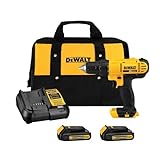
For a small repair kit or occasional fence work, compare 18V/20V drill kits with a 1/2-inch chuck. A compact model costs less and is easier to handle overhead, but it may have less reserve torque and no side handle. For larger bits, look at low-speed cordless drills with a side handle.
Which drill type makes sense?
| Tool | Best use on fence rails | Main trade-off |
|---|---|---|
| Compact 18V/20V drill | Pilot holes and occasional holes up to roughly 1/2 inch | Lighter, but easier to stall with a large auger bit |
| Full-size drill with side handle | Repeated holes, larger augers and dense or damp wood | Heavier and often more expensive |
| Hammer drill | The hammer setting is useful for masonry, not wood | Can be a good drill, but hammer action offers no benefit here |
| Impact driver | Driving screws and bolts with compatible bits | Not the right first choice for boring clean holes |
A hammer drill can bore wood when set to drill mode, but its hammer function should be off. An impact driver’s hex chuck is built for driving, not controlled boring with common round-shank auger bits. Some hex-shank bits work in impact drivers, but the tool is harder to control and can make rough holes. Buy a drill for drilling; add an impact driver if you also have a lot of fence screws to drive.
Bits, batteries and useful features
For clean holes in rails, use a sharp brad-point bit for small, precise holes or an auger bit for deeper holes and faster chip removal. A spade bit is inexpensive and works for rough clearance holes, but it can chatter and tear the exit side. For a tidy hole through a rail, clamp a scrap block behind the exit face, or stop when the point just breaks through and finish from the other side.
Match the bit to the hole. A 1/2-inch hole for a bolt does not need a 1-inch auger. Larger bits remove more wood, take longer and raise the chance of the drill twisting. Keep a large bit sharp: a dull edge generates heat, stalls more often and can burn the hole. Pull an auger out periodically to clear packed chips, especially in a deep hole.
A 2.0Ah battery is fine for a handful of holes and keeps the drill light. A 4.0Ah or larger battery is more comfortable for a long run of holes, though it adds weight. Brushless motors generally use battery energy efficiently and can hold up well to regular work, but a brushed drill is a sensible cheaper buy for occasional repairs. A belt clip, work light and multiple clutch settings are convenient; they matter less than a good low gear, a secure chuck and comfortable grip.
Bore straight without losing control
Mark the hole center and clamp the rail if possible. Hold the drill square to the face in both directions; a small bubble level or a drill guide helps when alignment matters. Set the drill to low gear, use the drill setting rather than the screw clutch, and start slowly. Let the bit cut instead of leaning hard on the drill. Excess pressure can bend a thin bit, bind an auger or pull the drill into the wood.
Keep both hands on the tool when using a large bit. If the bit snags in a knot, the drill can kick your wrist or shoulder. A side handle gives you more leverage against that reaction. Stop if the drill repeatedly stalls, smells hot or the battery and tool become unusually warm; let them cool, clear the bit and reassess. Do not hold a loose rail with one hand while drilling with the other.
For a few holes in ordinary fence lumber, a basic 18V/20V drill and a sharp bit are enough; spending extra for a heavy-duty model will not make a small job meaningfully easier. Pay more when you regularly bore holes larger than 1/2 inch, work in dense or wet rails, or need sustained use. In those cases, the extra control of a full-size drill and side handle is worth more than a long list of electronic modes.