Key takeaways
- Torque tiers, speed modes, bit choice and the trigger discipline that keeps deck screw heads clean, from a driller who has sunk more than his share.
What's inside
As an Amazon Associate I earn from qualifying purchases. This post may contain affiliate links at no extra cost to you.
A deck is a fastener job pretending to be a carpentry job. Between joist hangers, ledger screws, blocking, decking and railings you are driving somewhere between 800 and 2,000 fasteners, and every one is a chance to strip a head, snap a bit, or split a board two inches from the end. Choosing an impact driver for building decks has less to do with the torque number on the box than with how precisely the tool lets you stop driving at the right moment.
Short version, the one I give guys on site: a brushless 18V or 20V max compact impact driver with at least three speed modes will build the entire deck, and a drill on its own will not, at least not without leaving your wrist aching by lunch. The rest is bit choice and trigger discipline. Here is how the classes sort out.
As an Amazon Associate we earn from qualifying purchases at no extra cost to you. Product prices and availability are accurate as of the date shown and are subject to change.


| Driver class | Where it earns its keep | The tradeoff |
|---|---|---|
| 12V subcompact | Blocking, stair stringers, railing hardware, tight bays | Runs out of breath on long structural screws |
| 18V/20V compact brushless | Decking, hangers, ledger screws, the whole job | Almost none, which is why it is the default |
| High-torque or 4-mode 18V | Long structural screws through doubled framing | Longer nose, easier to overdrive soft pine |
| 1/2-inch impact wrench | Lag bolts and concrete anchors | Wrong bit interface for screws |
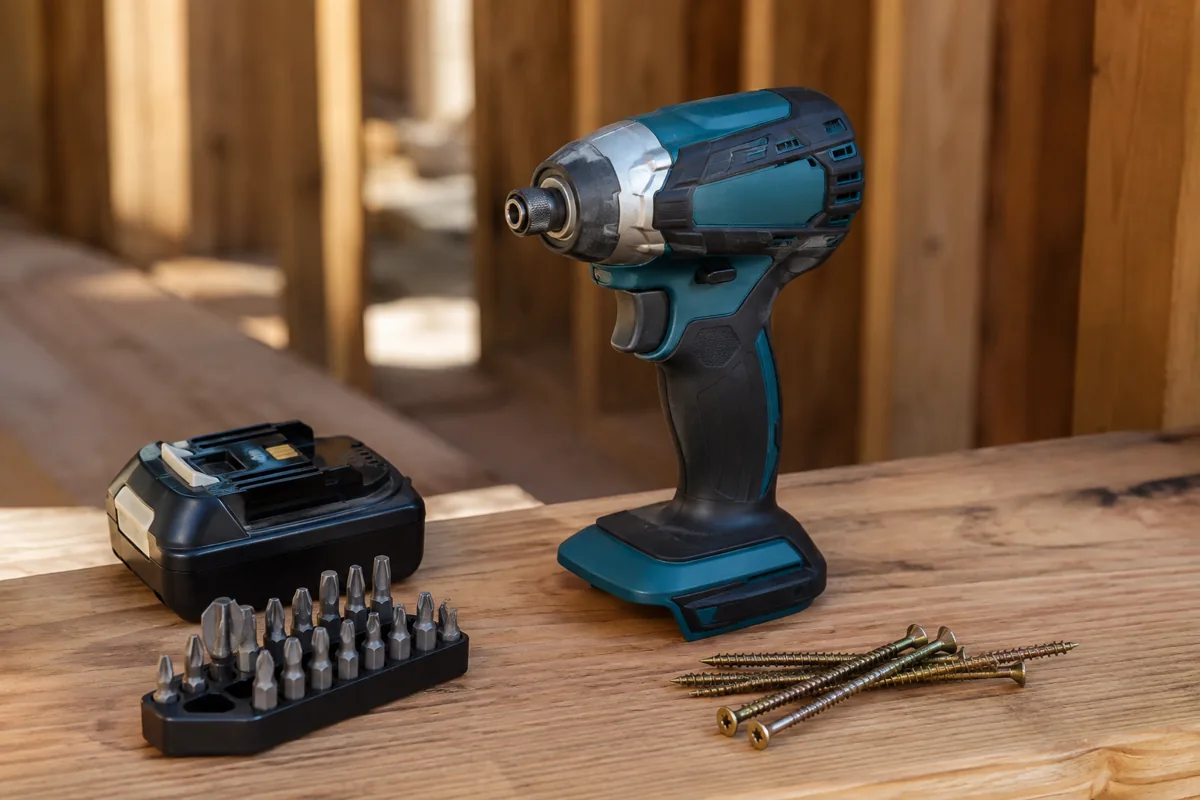
Why an impact driver for building decks beats a drill
Two reasons, and the first is your wrist. A drill applies steady rotation, so when a 3-inch structural screw binds in wet pressure treated lumber that torque comes straight back through the handle. An impact driver does the same work in thousands of small rotational hammer blows, so the bit turns and your wrist mostly does not. On a day spent on your knees driving decking, that is the whole ballgame.
The second is the bit interface. A 1/4-inch hex collet holds the bit in positive engagement, dead in line with the fastener. A three-jaw chuck holds by friction, and friction is what lets a bit walk under load. Cam-out is what turns a T25 recess into a circle, and it starts with a bit that is not seated square and deep. A drill still wins for pilot holes and countersinks, so I carry both.
Compact brushless 18V impact driver kit
Buy into the battery platform you already own, then look for three or four speed modes, a short nose, and a collar of LEDs rather than a single bulb down by the battery. Two smaller packs beat one fat pack on a driver.
The specs worth paying for
Speed modes. The one feature I would not frame a deck without. Full-size brushless drivers already advertise far more torque than a screw into softwood needs, so control is the spec that matters. Mode 1 for composite decking and hardware, mode 2 for the run of 2-1/2 and 3-inch screws, mode 3 for long structural screws. A self-tapping or precision mode that starts slow, bites, then ramps up earns its keep on fasteners you cannot pre-drill.
Head length. Between joists and up under a ledger, nose length decides whether the screw goes in straight or crooked. Today’s compact families, DeWalt XR, Milwaukee FUEL, Makita LXT and their peers, are all short enough. The old brushed bricks are not.
Battery and light. A 2.0Ah pack keeps the tool balanced and lasts longer than you would expect; save the fat packs for the saw. On cold mornings keep the spare inside your jacket, because a chilled pack gives up punch and then recovers as it warms.
Technique: a thousand screws, no stripped heads
Pilot holes where they count
In the field of a pine or cedar board, a self-drilling deck screw needs no pilot. Within two inches of a board end, or anywhere near a butt joint, pre-drill every time or you will split it. Hardwoods like ipe get a pilot and a countersink for every screw, and they will chew through bits doing it.
Trigger discipline
Feather the trigger for the first half second so the screw finds its bite, run full speed through the middle, then come off the trigger as the head nears the surface. I stop by ear: the impact mechanism changes pitch the moment the head seats. Hold the trigger down instead and you will pull the head through the top of the board and leave a dimple no sander will fix.
Square and steady
Keep the driver in line with the screw. Ten degrees off axis is where recesses die. Push firmly but do not lean on the tool; the impacts do the work and body weight only heats the bit. If a screw stalls halfway, back it out and drill a pilot instead of fighting it.
Bits, holders and the parts that fail first
Deck screws run mostly T25 Torx or #2 square drive, and the bit that came in the driver’s box is not the one to run 900 fasteners with. Use impact-rated bits, made from a more forgiving steel that flexes instead of shattering, and treat them as consumables. Once a tip looks polished or rounded it is done, because a worn bit is what wrecks screw heads, and the screw head is what you are stuck with.
Impact-rated T25 Torx bit multipack
The cheapest insurance on the whole job. Get 2-inch power bits rather than short inserts, keep three or four in the pouch, and retire any tip that starts to look shiny.
Two-inch power bits tolerate misalignment better than short inserts, and a magnetic bit holder lets you start a screw one-handed. On composite decking, a depth setter matched to the screw system pays for itself in undamaged caps. For 1/4-inch structural screws use the hex driver the fastener maker supplies, and for genuine 1/2-inch lag bolts put the driver down and pick up an impact wrench; hex-shank socket adapters twist off at lag torque and they take a knuckle with them.
1/2-inch cordless impact wrench
If the build involves lag bolts into a rim joist or sleeve anchors into concrete, this is the tool, not a bigger driver. Same battery platform, different job.
- ✔ Drives long structural screws one-handed with almost no wrist kickback
- ✔ Hex bits seat deeper and cam out far less than a drill chuck
- ✔ Short nose reaches into joist bays and under stair treads
- ✔ Speed modes let you baby composite caps, then bury framing screws
- ✘ No clutch, so depth control is all trigger finger
- ✘ Loud enough that I wear plugs from the first screw
- ✘ Will happily snap a cheap bit or shear a small brass screw
- ✘ You still need a drill alongside it for pilots and countersinks
Frequently asked questions
Can I build an entire deck with just an impact driver? You can drive every fastener with one, but keep a drill for pilot holes, countersinks and round-shank bits. Two tools, two jobs, and no bit swapping every thirty seconds.
Is a 12V impact driver enough for decking? For decking screws, hardware and railings, usually yes, and the small size is a pleasure in tight spots. For a long run of structural screws through doubled framing, an 18V class tool finishes the day without complaining.
How do I stop overdriving screws into composite boards? Drop to the lowest speed mode, use a depth setter made for that screw system, and stop by sound rather than feel. If caps still mushroom, your bit is worn or you are off axis.
If you are buying one tool for the deck, get the compact brushless driver on the platform you already own and spend the change on bits. The driver is the easy decision. Nearly everything that goes wrong on a deck goes wrong in the last quarter inch of the screw, and that is technique, not specs.
Check prices on Amazon →