What's inside
As an Amazon Associate I earn from qualifying purchases. This post may contain affiliate links at no extra cost to you.
What we cover
What hard brick demands from a drill
Hard, dense brick can turn a quick anchor job into a slow one. The drill needs to keep the bit turning while delivering repeated blows, and the bit needs a carbide tip made for masonry. A cordless hammer drill is usually the practical choice for a few holes or regular home repairs; a rotary hammer is faster for many large holes, but is a bigger, more specialized purchase.
First identify what you are drilling. Brick faces are often easier to drill than mortar joints, but drilling the brick can leave visible damage if the hole chips or the bit wanders. Mortar is softer and easier to patch, though it may be a poor anchor location if it is crumbly. Check for wiring and plumbing, and follow the anchor maker’s instructions for hole diameter and depth.
As an Amazon Associate we earn from qualifying purchases at no extra cost to you.


Choose the right drill for the workload
A regular cordless drill in rotation-only mode is not the right tool for hard brick. A hammer drill adds short axial impacts while the bit spins. For occasional holes around 6–10 mm (about 1/4–3/8 inch), a competent 18V-class hammer drill with a sharp masonry bit is generally enough. Expect progress to be slower than in soft brick or concrete, and avoid forcing the tool: excess pressure can overheat the bit or stall the motor.
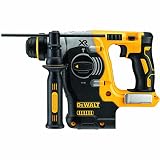
For repeated holes, larger diameters, or work in very dense masonry, consider a corded or cordless rotary hammer with an SDS-Plus chuck. Its piston mechanism hits harder than the gear-driven hammer action in a standard hammer drill. The trade-off is more weight, cost, noise and vibration. Dozens of holes or holes above roughly 12 mm (1/2 inch) are good reasons to compare rotary hammers; one or two small anchor holes usually are not.
Compare the main options
| Tool | Best fit | Trade-off in hard brick |
|---|---|---|
| 18V cordless hammer drill | Occasional small and medium anchor holes | Portable and versatile, but slower under sustained load |
| Corded hammer drill | Longer sessions where an outlet is available | No battery limit; hammer action can still be modest |
| SDS-Plus rotary hammer | Many holes or larger masonry bits | Faster drilling, but heavier and less useful for ordinary screwdriving |
If you already own a quality cordless hammer drill, try it with a fresh bit before buying another tool. If you are shopping for one, compare 18V cordless hammer drills by chuck capacity, battery platform, low-speed control and how comfortably you can hold the tool. Published impact counts do not tell the whole story; sustained performance and bit quality matter more on dense brick.
Bits and anchors matter as much as the drill
Use a masonry bit with a carbide tip, sized to match the anchor. A worn or overheated tip can polish the hole rather than cut it, making progress painfully slow and leaving an oversized, dusty opening. Replace it when the cutting edges look rounded, the bit repeatedly wanders, or drilling takes much longer than it did in comparable material. For a rotary hammer, use the correct SDS-Plus bit; a standard round-shank bit will not fit its chuck.
Choose the anchor before drilling. Plastic expansion plugs suit many light- and medium-duty indoor fixings when installed in sound masonry, but holding capacity varies with the brick and installation. Heavy fixtures may need a masonry screw or a rated anchor system designed for the load. Never assume that a larger drill or longer screw automatically makes a safer fixing. Use the specified bit diameter, embedment depth and edge distance. For general-purpose carbide options, see carbide masonry drill bits.
Drill clean holes without cooking the bit
Mark the center and start slowly to keep the bit from skating. If the tool has a clutch, use drill mode rather than a low clutch setting; select hammer mode for masonry and a low or middle gear that gives controlled torque. Hold the drill square to the wall with both hands. Let the hammer action work, using steady pressure rather than leaning your body weight into it.
Drill to the anchor’s specified depth, adding a little allowance for dust if the instructions call for it. Every few seconds, ease the bit out to clear debris and let the tip cool. If the bit stops advancing, do not keep squeezing the trigger while forcing it. Withdraw it, clear dust, check for a damaged tip and try again. A sudden stop can mean you have hit a hard aggregate, steel or another obstruction; do not assume more pressure will solve it. A depth stop or a piece of tape on the bit helps prevent drilling too deep.
Wear eye protection, and use hearing protection for extended hammer drilling. Brick dust is irritating; avoid blowing it toward yourself, and clean the hole with a suitable brush or vacuum as the anchor instructions require. Dust left in the hole can reduce anchor grip, even when the hole diameter is correct.
When the cheaper option is fine
A budget hammer drill can be adequate for a few small holes if it has hammer mode, a sound chuck and a battery with enough charge. The inexpensive tool is less attractive if it bogs down, overheats, or needs repeated breaks to finish one hole. Before upgrading, try a new, correctly sized bit and confirm you are not using rotation-only mode. Those mistakes are often cheaper to fix than buying a new drill.
If the job involves a row of holes, frequent work in hard masonry, or large anchor diameters, a rotary hammer is the more useful upgrade. Compare SDS-Plus rotary hammers and check that the tool accepts the bit sizes you need. For a couple of 1/4-inch holes, however, paying for one may save little time. Match the tool to the number and size of holes, then spend attention on the bit, anchor and drilling technique.