What's inside
As an Amazon Associate I earn from qualifying purchases. This post may contain affiliate links at no extra cost to you.
Lag bolts—also called lag screws—need a pilot hole and steady driving force. An impact driver can install them quickly in timber, but more torque is not automatically better: a bolt can snap, its head can strip, or the wood can split before the tool stalls. For occasional deck, shed, or framing work, a compact 18V or 20V impact driver is usually enough. The better buying decision is often about control, battery compatibility, and having the right socket adapter—not choosing the highest torque figure.
As an Amazon Associate we earn from qualifying purchases at no extra cost to you.



What we cover
What to look for in an impact driver
For most lag bolts up to about 3/8 inch in diameter, choose a 1/4-inch hex impact driver with variable speed and at least two speed or power settings. A lower setting makes it easier to start the fastener without cross-threading or damaging the head; a higher setting is useful once the bolt is seated. Brushless models tend to run longer per battery charge and have fewer wear parts, but a brushed model is a reasonable buy for occasional use.
For bolts around 1/2 inch or larger, especially long ones, tool control and setup matter more than a headline torque number. A 1/2-inch impact wrench with a socket is a better fit for repeated heavy fastening, but it can be too forceful for small lag screws. If most of your work is wood screws and a few ordinary lags, a cordless impact driver kit with variable speed is the more versatile purchase.
Impact driver or impact wrench?
| Tool | Best use | Trade-off |
|---|---|---|
| 1/4-inch impact driver | Common lag bolts, structural screws, and general fastening | Needs a hex-to-square-drive adapter for sockets; easy to overdrive fasteners |
| 1/2-inch impact wrench | Frequent large lags, heavy timber work, and other socket fasteners | Bulkier and often excessive for smaller bolts in wood |
| Drill/driver | Drilling pilot holes and careful, low-speed installation | May struggle as bolt diameter or length increases |
An impact driver accepts 1/4-inch hex accessories. To drive a lag bolt with a hex head, use a quality hex-to-square-drive adapter and a correctly sized six-point socket. A six-point socket grips the flats better than a twelve-point one and is less likely to round the head. Keep the socket straight on the bolt; a wobbling adapter can damage the fastener or slip off under load.
Pilot holes matter more than extra torque
Drill a pilot hole before driving a lag bolt into timber. Without one, the bolt displaces a lot of wood, which raises the chance of splitting—especially near an edge, at the end of a board, or in dry, dense lumber. As a starting point, the pilot hole through the part being fastened should clear the bolt’s smooth shank, while the hole in the receiving timber should be close to the lag’s root diameter. Check the fastener maker’s chart for the exact size; species and moisture affect the result.
For example, a 3/8-inch lag has a nominal outside diameter of 0.375 inch, but its root diameter is smaller. Do not assume a 3/8-inch bit is the right pilot for the threaded section. Use a depth stop or tape on the bit to avoid drilling too deep, and clear chips from a deep hole so the bolt does not bind at the bottom. A dab of wax or suitable lubricant on the threads can reduce driving resistance in hardwood. Avoid using lubricant that could compromise a structural connection unless the fastener instructions allow it.
Use a socket adapter rather than a hex bit holder for hex-head lags. A set of impact-rated socket adapters is useful if you already own a driver, but adapters are wear items: replace one if it is visibly twisted, cracked, or loose. Do not use chrome hand sockets with an impact tool; use impact-rated sockets.
Drive the bolt without damaging the timber
Clamp the pieces together and line up the holes before fastening. Start the bolt by hand for a few turns, then hold the driver square to the head. Begin on the lowest setting and use short trigger pulls. Once the bolt has engaged cleanly, increase speed gradually. Stop when the washer or head is firmly seated. Continuing to hammer after that point can crush the wood fibers, bury the head, loosen the joint, or snap the bolt.
If the driver slows sharply or the bolt stops advancing, do not keep pulling the trigger. Back it out, check for a blocked or undersized pilot hole, and inspect for misalignment. A lag that binds near the end may be bottoming out in a blind hole; a longer pilot hole or shorter fastener may be needed. If the head begins to deform, stop before the socket slips and rounds it. Repositioning the socket or switching to a fresh fastener is cheaper than extracting a damaged one.
Choose by the work you actually do
For a handful of 1/4- or 5/16-inch lags in softwood, an existing cordless drill/driver may be adequate if it has a low-speed gear and a sound chuck. It also gives you more gradual control, though it may stall on longer bolts. Buying an impact driver solely for a few small bolts is hard to justify if your drill already handles the job.
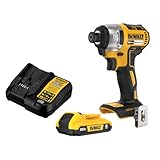
For repeated 3/8-inch lags, deck framing, or general fastening, a midrange impact driver with a compact battery is a practical all-rounder. A 2.0Ah battery keeps the tool light; a larger battery adds runtime but can make overhead work tiring. If you often install large fasteners in hardwood or heavy timber, consider a cordless 1/2-inch impact wrench kit instead, and use it cautiously on wood.
Finally, treat structural fasteners as part of a system. Use the specified fastener type, diameter, length, washers, and spacing for the connection; a powerful driver cannot make an undersized or incorrectly installed bolt safe. For a nonstructural project, a basic impact driver and properly sized pilot holes are usually enough. For load-bearing work, follow the plans or fastener manufacturer’s installation guidance rather than relying on feel alone.