Key takeaways
- Weight and head length decide more home projects than torque ratings do. Here is how I would choose a lightweight impact driver for DIY work, and how to drive screws with it.
What's inside
As an Amazon Associate I earn from qualifying purchases. This post may contain affiliate links at no extra cost to you.
Most people buy their first impact driver off the torque number on the box, then spend a Saturday holding it overhead to hang cabinets and wonder why their shoulder quits before the job does. After enough years putting holes in other people’s houses, I’ll say it plainly: what most home projects call for is a lightweight impact driver for DIY duty, not the biggest one on the shelf. Fastener speed is almost never the bottleneck at home. Your wrist is.
The other half of the problem is reach. A stubby driver fits between a cabinet stile and a wall, or up inside a joist bay, where a full-size tool bumps framing and stops short. Head length and weight decide whether a screw gets seated properly or driven halfway and cammed out. Torque numbers sell tools; those two specs finish jobs.
As an Amazon Associate we earn from qualifying purchases at no extra cost to you. Product prices and availability are accurate as of the date shown and are subject to change.


Round numbers for the three classes, bare tool without a battery:
| Class | Approx. Bare Weight | Head Length | Best For |
|---|---|---|---|
| 12V subcompact | Around 2 lb | Roughly 4 to 5 in | Cabinets, furniture, trim, overhead work |
| 18V/20V compact brushless | Around 2.2 to 2.8 lb | Roughly 4.5 to 5.5 in | General DIY, decks, fencing, framing screws |
| 18V/20V full size | 3 lb and up | 5.5 in and up | Lags, ledgers, structural screws, daily pro use |
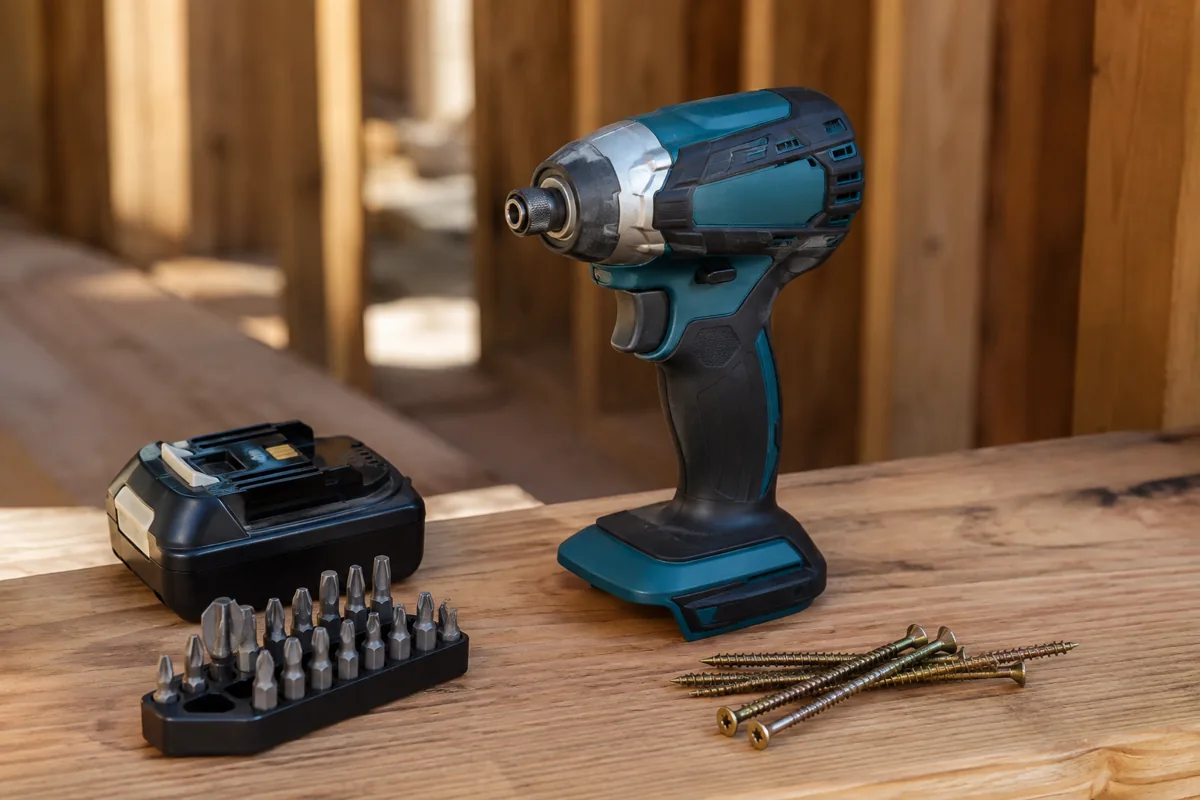
How To Pick A Lightweight Impact Driver For DIY
Weigh the tool the way you’ll actually hold it: driver plus battery. A 12V subcompact with its pack in place lands close to what a full-size 18V tool weighs bare, which tells you the real story. You aren’t just buying a smaller motor, you’re buying a smaller power source.
Head length. Chuck face to the back of the housing. Under five inches gets you inside cabinet boxes and between studs, and it matters more often than raw power does.
Brushless motor. On a small tool this isn’t bragging rights. It’s how you get usable torque out of a short housing without cooking the motor every time you bog it down.
Two or three speed modes. A genuine low mode keeps you from pulling screw heads through 3/4-inch plywood. Far more useful than a fourth setting nobody ever selects.
Battery platform. Already own DeWalt XR, Milwaukee FUEL, Makita LXT, or Ryobi ONE+ packs? Buy the bare tool in that family and end the debate right there.
12V Subcompact Impact Driver
If your projects are cabinets, furniture, shelving, and trim, this is the class I’d point you toward. You give up grunt on long structural screws and gain a tool you can run one-handed above your head. Look for a brushless model with a compact slide pack rather than the cheapest brushed kit on the shelf.
The Battery Is Half The Weight Problem
A high-capacity 18V pack can weigh more than the driver hanging off it, and it parks that mass behind your hand, which is the wrong direction for overhead work. A compact pack keeps the balance forward where you can steer it. For DIY volume that’s usually all you need: hanging wall cabinets or building a bench isn’t a run-time problem, and a pack swap costs ten seconds. Buy a second compact battery instead of one giant one.
One caveat on 12V platforms. They drive beautifully and struggle at sustained torque. If you expect to bore 1-inch holes or sink 6-inch structural screws even occasionally, take the compact 18V and the extra half pound.
Compact 18V/20V Brushless Impact Driver
The sweet spot for most homeowners. Still light enough for overhead work, but it won’t stall on deck screws or on lag screws with a socket adapter. Run it on a compact battery day to day and keep one larger pack for long sessions.
Technique Beats Torque
Most complaints that a light driver lacks power are pilot hole problems wearing a disguise.
Pilot holes. In pine, self-drilling deck and construction screws usually go in bare. In oak or maple, or anywhere near an edge or end grain, drill a pilot roughly the diameter of the screw’s shank without the threads. Too small and the tool hammers itself silly until the head snaps; too big and the threads have nothing to hold.
Clamping two boards. Drill a clearance hole the full screw diameter through the top piece and a smaller pilot into the bottom piece. That’s what lets a screw pull a joint tight instead of jacking the boards apart.
Trigger control. Start slow so the tip bites and the screw stands straight, squeeze through the middle, then ease off as the head reaches the surface. An impact driver has no clutch. Your finger is the clutch.
Square and loaded. Keep the tool axis on the screw axis and push steadily behind the bit. Cam-out is nearly always a bit that isn’t square, not a weak tool. Use impact-rated bits, prefer star drive fasteners where you have the choice, and retire a worn #2 Phillips early rather than late.
Two jobs to keep away from it: drywall, which wants a depth-setting gun or a drill/driver with a dimpler, and small brass or fine machine screws, which the hammer mechanism will twist off without apology. Wear plugs, too. These things are loud in a closed room.
Impact-Rated Driver Bit Set
The cheapest way to make any light driver perform better. Get impact-rated shanks, duplicates of the two or three sizes you actually use, and at least one magnetic bit holder for overhead work. Skip the hundred-piece bargain kits; most of that is filler you’ll never touch.
Honest Trade-Offs
- ✔ Comfortable one-handed and overhead, so you’ll actually reach for it
- ✔ Short nose gets inside cabinets and between studs
- ✔ Compact batteries keep the balance ahead of your grip
- ✔ Plenty of muscle for the 1-inch to 3-inch screws that make up most home work
- ✔ Easier for smaller hands and less grip strength to control
- ✘ Runs out of steam on long lag and structural fasteners
- ✘ Shorter run time per charge than full-size packs
- ✘ 12V platforms offer fewer tools to grow into
- ✘ Still loud, and still no clutch, so it can overdrive soft material
Lightweight Impact Driver FAQ
Do I need an impact driver if I already own a drill/driver? For a dozen screws, no. For dozens of long ones, yes. A drill/driver feeds all the reaction torque back into your wrist and cams out when it stalls, while the impact mechanism absorbs that twist in short bursts. Most people end up using both: the drill for holes, the impact for fasteners.
How much torque is enough for home projects? Advertised inch-pound figures aren’t comparable between brands because each measures its own way, so treat them as a class indicator rather than a spec. Anything in the four-figure inch-pound range handles the fasteners typical of home work. Budget brushed tools below that will let you know about it on 3-inch screws in hardwood.
Can a 12V subcompact build a deck? It will drive 2-1/2 and 3-inch deck screws through the boards, with more battery swaps and more heat than an 18V. For ledger fasteners, framing connectors, and lag screws, step up to a compact 18V with a socket adapter, or use an impact wrench.
If I were kitting out a homeowner from scratch, I’d take a compact brushless driver on whatever platform your neighbor already lends batteries for, one compact pack for daily work, one larger pack for long sessions, and a decent set of impact-rated bits. That combination hangs cabinets, builds furniture, and screws down a deck without turning every project into a forearm workout.
Check prices on Amazon →