What's inside
As an Amazon Associate I earn from qualifying purchases. This post may contain affiliate links at no extra cost to you.
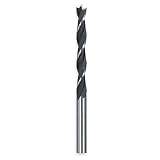
Brad-point bits are made to start cleanly on a mark and cut a flat-bottomed hole with less wandering than a standard twist bit. They are a useful choice for shelf-pin holes, dowel joints, cabinet hardware and other work where placement matters. The center spur locates the bit; the two outer spurs score the rim before the cutting edges remove the waste.
They work best in wood and wood-based sheet goods. They are not a substitute for a Forstner bit when you need a wide, especially clean flat-bottomed recess, or a masonry bit for brick and concrete. For most accurate woodworking holes, the buying decision comes down to shank size, bit material, the diameter range you need and whether you will use a drill press or a handheld drill.
As an Amazon Associate we earn from qualifying purchases at no extra cost to you.
What we cover
What to look for when buying
For occasional furniture repairs and general woodworking, a basic set of high-speed-steel (HSS) brad-point bits is usually adequate. Look for a set that includes the diameters you actually use, rather than paying for a large range that will sit in a drawer. Common useful sizes include 1/8, 3/16, 1/4, 5/16 and 3/8 inch. Check that the set is clearly marked and comes in a case that keeps the cutting edges from knocking together.
For regular work, especially repeated holes in hardwood, consider a better-finished HSS set or bits with a wear-resistant coating. A coating may help with durability, but it does not fix poor geometry or careless use. If you need a matched set for dowels or hardware, verify the actual diameters: nominally similar metric and fractional sizes are not interchangeable for a close fit.
Most small brad-point bits have round shanks sized to suit a standard drill chuck. Larger bits may have reduced shanks, which let them fit a smaller chuck but can limit how much torque they can take. Before buying, check the maximum chuck capacity of your drill. A typical cordless drill accepts a 3/8- or 1/2-inch shank, but the chuck’s rating is the limit, not the bit’s cutting diameter.
Which type suits the job?
| Bit option | Best for | Trade-off |
|---|---|---|
| Basic HSS brad-point set | Occasional holes in softwood, plywood and light hardwood work | Lower cost; cutting edges may dull sooner with frequent use |
| Higher-quality HSS brad-point set | Repeated, accurately sized holes and regular shop use | Costs more; still needs careful sharpening or replacement when dull |
| Long brad-point bit | Reaching through thicker stock or drilling a deep hole | More flex and greater risk of wandering than a short bit |
| Forstner bit | Wide, clean, flat-bottomed holes and shallow recesses | Usually slower to clear chips; often benefits from a drill press |
If you are setting up a basic kit, compare brad-point drill bit sets for wood by size range, shank diameter and case quality, not just the number of pieces. A cheaper set is fine for occasional use if its spurs are sharp and the sizes match your work.
Choose length and capacity carefully
Use the shortest bit that reaches through the work. Long bits can flex under side pressure, so a hole that starts on center may exit off line. For stock around 3/4 inch thick, a standard-length bit is generally easier to control than an extra-long one. When drilling deep holes, withdraw the bit periodically to clear chips; packed chips create heat and can burn the wood or stall the drill.
For holes deeper than the bit’s cutting length, do not assume that the overall bit length is the usable depth. The flutes must be long enough to carry chips out of the hole. Forstner bits are a better choice for larger-diameter blind holes, while an auger bit is often more suitable for deep holes where chip removal matters more than a neat, small-diameter entry.
How to drill a clean, accurate hole
Mark the hole center clearly and let the center spur sit directly on the mark. Clamp the workpiece to a bench or sacrificial backing board; a handheld drill can catch as the bit breaks through and spin the stock. A drill press gives the most consistent angle and depth, but a square, guide block or steady two-handed grip can improve handheld results.
Start at a controlled speed and keep the bit perpendicular to the surface. Do not force the drill. If the motor slows, ease off and clear the chips. High speed with pressure can overheat the cutting edges, while too little feed can rub and burn the wood. In hardwood, a steady moderate feed is safer than leaning hard on the drill. Set a depth stop or wrap tape around the bit when holes must be consistent; tape is a visual guide, not a hard stop.
For a clean exit, clamp a backing board tightly against the underside. The outer spurs score the entry edge, but they cannot prevent tear-out when the bit breaks through unsupported fibers. On delicate veneer, drill from both sides: make a small pilot hole or partial-depth hole from one face, then finish from the other using the exit mark to align the bit.
Using brad-point bits with cordless drills
A standard cordless drill is suitable for most brad-point bits. Use the drill’s normal drilling mode, not hammer mode. A hammer drill’s impact action is intended for masonry and can damage wood, the bit or the hole edge. Impact drivers are also a poor first choice: their rapid rotational impacts make it harder to control a clean, accurate cut, particularly with small bits.
For larger diameters, a drill with a side handle and enough torque is easier to manage. If a bit catches, release the trigger rather than twisting against the drill. Do not use a brad-point bit in a quick-change hex holder unless the holder is rated for the shank and the connection is secure; a conventional three-jaw chuck is the usual choice. For a shop kit, a quality HSS brad-point set is a sensible upgrade if you drill often enough to notice dull edges or inconsistent sizing.
Care, sharpening and common mistakes
Keep bits dry and store them so the spurs do not strike other tools. Resin buildup can make a bit cut poorly; clean it with a product intended for cutting tools, then dry it. A dull bit often leaves fuzzy edges, needs extra pressure, squeals or produces scorch marks. Stop when you see those signs. Sharpening the center spur or outer spurs by eye can change the hole size and cutting geometry, so replacement is often the practical choice for small bits.
Do not use brad-point bits on metal, tile, glass or masonry. They are also not ideal for every wood hole: for a larger hinge cup or a broad, flat-bottomed recess, choose a Forstner bit; for a clearance hole through thin stock where the finish is unimportant, a cheaper twist bit may be entirely adequate. Match the bit to the job, clamp the work, and let the cutting edges do the work rather than forcing the drill.