What's inside
As an Amazon Associate I earn from qualifying purchases. This post may contain affiliate links at no extra cost to you.
A hand towel ring puts modest weight on a wall, but repeated pulling can loosen a poor fixing. Tile-backed drywall adds two complications: the tile can crack if drilled or tightened carelessly, and an anchor that grips only the tile has little to hold once the surface layer gives way. The best choice depends on what is behind the tile, the ring’s mounting plate, and whether you can locate a stud.
As an Amazon Associate we earn from qualifying purchases at no extra cost to you.



What we cover
Check the wall before buying anchors
Look for a stud with a stud finder, then confirm its position against the ring’s mounting holes. A screw into a stud is usually the most dependable fixing, especially if the ring will be used for more than a light hand towel. If the mounting plate does not line up with a stud, use a suitable hollow-wall anchor or a toggle that can pass through the tile and drywall.
Also check the ring’s instructions. Some mounts have one small screw that locks the decorative ring to a wall plate; that screw is not the wall fastener. Remove the cover and identify the actual mounting holes and available space. Avoid drilling near plumbing, electrical wiring, or the edge of a tile where the risk of cracking is higher.
Anchor options for a towel ring
| Fixing | Best use | Main trade-off |
|---|---|---|
| Wood screw into stud | Mounting holes align with a stud | Strong and simple, but alignment may not suit the ring |
| Plastic expansion anchor | Light-duty ring where the tile and drywall hole are properly sized | Inexpensive, but can loosen under repeated pulling |
| Self-drilling drywall anchor | Non-tiled drywall, when the mount allows it | Usually unsuitable through hard tile; its large threads can chip tile or fail to seat flush |
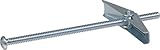
| Metal hollow-wall toggle | Tile over a hollow drywall cavity with enough room behind it | More secure than a basic plastic plug, but needs a larger, accurate hole and clearance behind the wall |
| Snap toggle | Hollow wall where a reliable clamp is wanted and the toggle fits through the tile hole | Costs more and needs a larger hole; the crossbar must sit flat behind the drywall |
For a light ring used gently, a correctly installed plastic anchor can be enough. It is the cheap option, and there is little reason to buy a heavy toggle if the wall is sound and the ring is not likely to be yanked. If the mount is on a busy family bathroom wall, a toggle or a stud fixing is a better bet. Consider metal hollow-wall toggle anchors when there is an open cavity behind the drywall and the anchor’s stated thickness range covers the wall.
Drill the tile without cracking it
Use a carbide-tipped tile bit for ceramic tile or a diamond bit for porcelain and hard stone. A standard twist bit can skate across the glaze; a hammer drill’s hammer mode can crack tile. Set a cordless drill or hammer drill to rotation-only, use low speed, and let the bit cut without pressing hard. A piece of masking tape over the mark can help keep the bit from wandering.
Keep the bit and tile cool. For a small hole, pause often and use a little water if appropriate for the bit and work area; protect nearby electrical devices and keep water away from the drill. Once the bit has passed through the tile, change to a bit suited to the drywall or substrate and the anchor instructions. Do not switch on hammer mode while the bit is still in tile. A diamond tile drill bit is useful for porcelain, while a carbide tile bit is often the less expensive choice for softer ceramic.
Choose the hole size from the anchor maker’s instructions, not by guesswork. Too small a hole can split tile as the anchor is forced in; too large a hole leaves the anchor loose. If the anchor requires a hole larger than the ring’s mounting plate can cover, pick a different fixing before drilling.
Install and tighten the mount
Mark the holes, check them for level, and drill through the tile slowly. Clear dust from the hole before inserting an anchor. For a toggle, make sure the wings or crossbar open fully behind the drywall; pipes or blocking can prevent this. For a plastic anchor, it should fit snugly without hammering it so hard that the tile chips.
Seat the wall plate and tighten its screws until it is secure, not until the plate bends or the tile creaks. Overtightening can crack tile, crush drywall, or strip the anchor. Install the ring and give it a firm, controlled pull. If the plate moves, stop and correct the fixing rather than tightening harder. A common failure is an anchor rotating in an oversized hole; another is a toggle that never opened behind the wall.
What to buy for this job
For an ordinary ceramic-tile bathroom and a lightly used ring, a tile bit plus the supplied anchors may be adequate if the instructions allow those anchors for the wall construction. If the supplied plastic plugs are short or intended only for solid masonry, do not assume they will grip tiled drywall. Buy anchors labeled for hollow drywall and check their grip range against the combined tile and drywall thickness.
For a more secure hollow-wall installation, a snap-toggle anchor kit can be a practical upgrade, provided its bar fits through the drilled hole and has room to turn behind the wall. If a stud is available, use an appropriate screw into it instead; an anchor cannot improve on a sound stud fixing. When the wall is stone, unusually thick, or the hole location is close to a tile edge, pause and reassess rather than forcing a standard drywall-anchor approach.