What's inside
As an Amazon Associate I earn from qualifying purchases. This post may contain affiliate links at no extra cost to you.
Drilling pilot holes in deck boards is a modest job, but a drill that is too bulky or runs out of charge halfway through can make it tedious. For most decks, you do not need a hammer drill or a high-torque impact driver. You need a controllable cordless drill with a clutch, a comfortable grip, and enough battery capacity for the board count.
As an Amazon Associate we earn from qualifying purchases at no extra cost to you.


What we cover
What matters for pilot holes
Deck screws commonly call for a pilot hole around 1/8 to 3/16 inch, but follow the screw maker’s guidance and adjust for the wood. A hole should be slightly narrower than the screw’s shank so the threads still bite. Dense hardwoods and board ends are more likely to split than softwood boards; drilling near an end deserves extra care. A countersink bit can also help the screw head sit flush without crushing the surface.
For this work, variable-speed control matters more than headline torque. Starting slowly helps keep the bit on the mark, while a two-speed gearbox gives a useful low-speed setting for larger bits. A clutch is handy if you also drive screws, though it does not control drilling torque. If you are drilling dozens of holes, a second battery saves more time than a small increase in motor power.
Choose a drill with a 3/8-inch or 1/2-inch chuck that accepts the bits you plan to use. A 1/2-inch chuck is more versatile, but a compact 3/8-inch drill can be lighter and entirely adequate for ordinary pilot holes.
Drill types at a glance
| Type | Best fit for deck work | Trade-off |
|---|---|---|
| Compact 12V drill | Occasional repairs and a small deck | Light and easy to handle; less reserve for large bits or long sessions |
| 18V/20V drill-driver | Most homeowners and larger projects | More capacity and battery options; usually heavier than necessary for a few holes |
| Hammer drill | Deck work plus masonry drilling elsewhere | Extra function adds weight and cost; hammer mode is not for wood |
| Impact driver | Driving compatible screws after drilling | Excellent at fastening, but lacks the drill chuck and smooth control most useful for pilot holes |
Best choice for most deck owners
A midrange 18V/20V drill-driver is the sensible pick if you build or maintain a deck regularly, or already own batteries in that platform. It has enough capacity for repeated holes, accepts common drill bits, and can do general household drilling. Compare bare-tool and kit prices: if you need batteries and a charger, a kit may be the better value. If you already have compatible batteries, buying the bare tool can avoid paying twice.
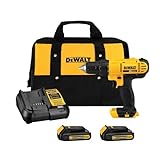
Look for a two-speed drill with variable trigger control, a keyless chuck, and a comfortable side-to-side balance. A belt clip and work light are convenient, not essential. For a broad selection, compare 18V/20V cordless drill-driver kits by included battery capacity, warranty, and weight rather than torque claims alone.
When a compact 12V drill is enough
If the job is a handful of pilot holes on an existing deck, a compact 12V drill is often the more comfortable tool. It is lighter overhead and less tiring when working from a ladder or reaching between joists. With a sharp bit and sensible pressure, it can drill typical pilot holes in common deck boards without trouble. Choose a larger drill if you expect frequent use with larger bits, hard tropical hardwood, or many boards in one sitting.
A lower-cost drill is fine for occasional maintenance if its chuck holds bits securely and its trigger allows a slow start. Check whether the price includes a battery and charger, and whether replacement batteries are readily available. A cheap tool with a weak or discontinued battery system can be a false saving. For a compact setup, browse 12V cordless drill kits and compare the complete kit, not just the tool.
Bits, technique, and common failures
Use a sharp drill bit suited to wood, such as a brad-point bit for accurate starts or a standard twist bit for general work. A dull bit wanders, overheats, and needs more force, increasing the chance of splitting the board or breaking the bit. Keep a spare bit nearby if the work is extensive. A simple depth stop or a strip of tape on the bit helps prevent drilling farther than needed.
Mark the hole, hold the drill square to the board, and start at low speed. Let the bit cut rather than leaning hard on the drill; excessive pressure can stall a small drill or snap a thin bit. Back the bit out occasionally to clear chips, especially in a deep hole. If a board end still splits, move the hole farther from the end, use a smaller pilot hole only if the screw maker permits it, or predrill more carefully. Do not force a screw into a hole that is too small.
For screws, an impact driver can speed up fastening, but it is not a substitute for a drill when you need controlled pilot holes. Use a matching driver bit and stop when the head is seated. Driving too far can crush the board surface or strip the screw head. If you want one battery platform for both tasks, consider a drill and impact-driver combo kit; it costs more than a drill alone, but makes sense for a deck build involving many screws.
Make the buying decision
For a few repair holes, use a drill you already own or buy a basic compact drill with a usable battery. For a new deck or regular woodworking, choose an 18V/20V drill-driver kit with two batteries or budget for a spare. Skip hammer mode unless you also drill masonry, and do not buy an impact driver as your only tool for pilot holes. The right drill is the one that controls a small bit cleanly, stays charged through the job, and fits your other likely projects.