What's inside
As an Amazon Associate I earn from qualifying purchases. This post may contain affiliate links at no extra cost to you.
A lightweight wall-mounted cabinet can still pull hard on its fasteners. The load sits away from the wall, creating leverage, and doors or stored items add movement. Before buying anchors, check the cabinet’s loaded weight, depth, mounting-hole spacing and the wall construction. If you can catch a stud, that is usually stronger and simpler than relying on drywall anchors.
As an Amazon Associate we earn from qualifying purchases at no extra cost to you.

What we cover
Choose the right support
Find studs with a stud finder, then confirm their position by probing discreetly or checking for a consistent line of fasteners. A cabinet rail or mounting strip that spans two studs is a sound choice. Use screws long enough to pass through the cabinet rail and drywall and engage the stud by about 1½ inches. Avoid relying on a short screw that only bites into the edge of a stud.
If the mounting holes do not line up with studs, a plywood or solid-wood cleat screwed into two studs can provide a continuous surface for the cabinet. This often beats asking several drywall anchors to carry a cabinet’s full weight. Check that the wall has no wiring or plumbing where you plan to drill.
Anchor types and trade-offs
For a cabinet that must attach to drywall alone, metal cavity anchors and toggle-style anchors generally offer a more dependable grip than basic plastic expansion plugs. Their published ratings vary by size, drywall thickness, installation method and test conditions, so treat package ratings as a guide—not a guaranteed cabinet capacity.
| Anchor type | How it holds | Best use | Main trade-off |
|---|---|---|---|
| Plastic expansion plug | Expands in the drilled hole | Very light loads with little leverage | Weak in drywall; easy to loosen or pull out under repeated loading |
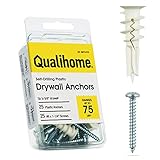
| Self-drilling plastic anchor | Coarse threads bite into drywall | Light fixtures or small accessories | Fast to install, but limited holding area and vulnerable to over-tightening |
| Metal hollow-wall anchor | Metal legs spread behind the drywall | Light to moderate loads with suitable clearance behind the wall | Needs a correctly sized hole and can be awkward to remove |
| Toggle bolt or strap toggle | A bar or wings bear against the back of the drywall | Loads where a broad bearing surface helps | Requires a larger hole and clear space behind the wall |
What to buy
For a small, shallow cabinet with a low loaded weight and several well-spaced fixing points, a quality metal hollow-wall anchor may be adequate if the manufacturer permits the intended load and drywall thickness. A metal hollow-wall anchor kit is a reasonable starting point when you can access the back of the wall cavity and install the anchors squarely.
For a heavier or deeper cabinet, or one that will be opened frequently, use studs or a cleat where possible. If the cabinet genuinely must be supported by drywall, consider strap-toggle anchors sized for the drywall thickness and mounting holes. Their broad bar bears behind the panel, but it still loads the drywall paper and gypsum; it is not equivalent to fastening into framing.
Basic plastic anchors are cheaper and can be fine for a very light object with minimal leverage, such as a small accessory. They are a poor default for a cabinet, especially if the door will be opened often or the cabinet may be loaded later.
Estimate the load—and its leverage
Weigh the empty cabinet if the manufacturer does not provide its weight, then estimate the contents. Use the total, not just the weight of one shelf. A 15-pound cabinet loaded with 10 pounds of items is already supporting 25 pounds before accounting for the force of opening the door.
Depth matters. A deep cabinet pulls outward at its top edge, putting more leverage on upper fasteners than a shallow cabinet of the same weight. Keep heavy contents low and close to the wall. Do not assume that four anchors carry one quarter of the load each: uneven holes, a twisted rail or imperfect contact can concentrate force on one or two fasteners.
Drill and install carefully
Read the anchor instructions for the required hole diameter, drywall thickness and installation tool. For a drilled anchor, use a sharp bit of the specified size and drill perpendicular to the wall; an oversized or ragged hole reduces grip. A cordless drill is useful, but start slowly and stop if the bit meets unexpected resistance. Do not use an impact driver to seat delicate anchors: its repeated impacts can strip drywall, spin an anchor or over-tighten the screw.
Set metal anchors with the specified setting tool when required. Tighten the mounting screw until the cabinet is secure, not until the paper face dimples or the anchor spins. If an anchor turns in the hole, comes away from the wall, or leaves crushed drywall, stop and repair or relocate the fixing rather than tightening harder. Do not reuse a damaged hole for another anchor of the same size.
Check before loading
Support the cabinet while fastening it, and use all intended mounting points. Check that it sits flat and that the screws are snug. Apply gentle pressure by hand to spot obvious movement, but do not treat a pull test as proof of a safe working load. Recheck the fasteners after a few days and after the first period of use.
If the cabinet is heavy, deep, above a bed or seating area, or likely to hold breakable or valuable items, do not depend on drywall anchors alone. Add a cleat fixed to studs or choose a cabinet location where its mounting rail can engage framing. The extra work is worthwhile when a failed anchor could let the cabinet fall.