What's inside
As an Amazon Associate I earn from qualifying purchases. This post may contain affiliate links at no extra cost to you.
For small holes in concrete—wall anchors, cable clips, Tapcon-style screws, and plastic plugs—a cordless hammer drill is usually the better buy. It is lighter, cheaper, and easier to control than a rotary hammer. A rotary hammer becomes worthwhile when the concrete is hard, the holes are numerous, or you need larger diameters and faster drilling.
As an Amazon Associate we earn from qualifying purchases at no extra cost to you.



What we cover
The short answer
Choose a cordless hammer drill for occasional holes up to about 3/8 inch (10 mm), especially in brick, block, or ordinary poured concrete. Use a rotary hammer when drilling several dozen holes, working in reinforced concrete, or drilling holes around 1/2 inch (13 mm) and larger.
For one or two 1/4-inch holes to mount a shelf, either tool can work. The hammer drill is normally the sensible choice because it costs less and can also serve as your everyday driver and drill. The rotary hammer is not automatically “better” for every small hole; its extra impact power can make a small hole harder to start cleanly.
How the two tools make holes
A hammer drill uses a toothed clutch to create a rapid, vibrating hammer action as the chuck rotates. The impact is relatively light, but it happens at a high rate. You can switch the hammer mode off and use the tool as a regular drill.
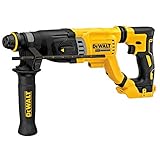
A rotary hammer uses a piston and air chamber to deliver much harder blows through the bit. Most use SDS-Plus bits, which slide into a dedicated holder rather than being clamped in a normal three-jaw chuck. Rotary hammers generally have rotary-only, hammer-drill, and sometimes chisel modes.
The difference is noticeable at the bit. A hammer drill makes you supply much of the pressure and can bog down in dense concrete. A rotary hammer does more of the breaking work itself, so the hole progresses faster with less effort.
Hammer drill versus rotary hammer
| Factor | Hammer drill | Rotary hammer |
|---|---|---|
| Best small-hole range | 3/16 to 3/8 inch | 1/4 to 1 inch and beyond |
| Typical chuck or holder | Keyless chuck | SDS-Plus, sometimes SDS-Max |
| Weight and control | Lighter and easier to steer | Heavier, with stronger kickback |
| Noise and vibration | High noise, moderate vibration | Higher impact and vibration |
| Other uses | Driving screws and ordinary drilling | Drilling and, on some models, light chiseling |
| Best reason to buy | General-purpose value | Fast, repeated masonry drilling |
When a hammer drill is enough
A hammer drill is fine for installing a few wall anchors, mounting conduit, attaching a hose reel, or fastening a small bracket to concrete. With a sharp masonry bit and a charged battery, a 1/4-inch hole in typical concrete may take roughly 20 to 60 seconds. Softer block and brick can take much less time.
It is also the better choice when hole placement matters. The lower impact makes it easier to start on a smooth surface without the bit skating. Put the drill in hammer mode, use moderate pressure, and begin slowly until the tip has formed a small depression. Then increase speed and pressure while keeping the bit straight.
Do not expect a compact 12-volt drill to behave like a concrete tool. It may handle a couple of small holes, but a full-size 18-volt or 20-volt hammer drill is a safer recommendation for repeated work. A masonry drill bit set for concrete should include carbide-tipped bits, not ordinary twist bits.
When a rotary hammer is worth it
Buy or rent a rotary hammer when the concrete is dense, the slab contains aggregate, or you have more than about 10 to 20 holes to drill. It is especially useful for 3/8-inch and 1/2-inch anchor holes, sleeve anchors, railing mounts, and larger fasteners. A typical SDS-Plus rotary hammer can drill a small hole in seconds rather than minutes.
The tool also saves your wrists. Instead of leaning hard into the work, you mainly guide the machine and keep it aligned. That matters when drilling overhead or making a row of holes. Many rotary hammers include a clutch that limits reaction if the bit catches, but you should still use the side handle and maintain a firm two-handed grip.
The drawbacks are real: an SDS rotary hammer is bulkier, louder, more expensive, and less useful for ordinary screwdriving. SDS bits also cost more than basic masonry bits. If you only need four 1/4-inch holes once a year, renting a rotary hammer may make more sense than owning one. For frequent concrete work, a cordless SDS-Plus rotary hammer is the practical upgrade.
Bits and drilling technique
Use a bit matched to the tool. A hammer drill accepts standard round-shank masonry bits, while an SDS rotary hammer needs SDS-Plus bits. Do not run an SDS bit in a normal chuck unless the manufacturer provides a proper adapter; adapters reduce performance and can introduce wobble.
Mark the hole, check for pipes and wiring, and wear eye protection, hearing protection, and a dust mask suitable for masonry dust. Drill at a controlled speed rather than holding the trigger wide open from the start. Pull the bit out every few seconds to clear dust, particularly in a deep hole. A clogged hole can overheat the bit and prevent the anchor from seating fully.
Keep the hole slightly deeper than the anchor’s required embedment—about 1/4 inch extra is a useful margin—and blow or vacuum out the dust before installing the anchor. Stop if you hit steel. Forcing a masonry bit against rebar can overheat it; switch to a bit designed for reinforced concrete or move the hole if the installation allows.
What commonly goes wrong
The cheapest hammer drill often fails through heat, not lack of advertised voltage. Long, continuous holes can overheat the motor, battery, or bit. Work in short intervals and let the tool cool. A blunt bit causes more pressure, more wandering, and a larger damaged opening around the anchor.
A rotary hammer can also cause problems. Its impact may chip tile, blow out the back of a block, or enlarge the entry hole if you push too hard. For tile over concrete, drill through the tile with the hammer function off and a suitable tile bit, then switch to masonry mode after reaching the concrete.
For occasional small holes, spend the money on sharp bits and a capable 18-volt hammer drill. Choose a rotary hammer when speed, hole size, or the number of holes justifies its extra cost and bulk.