What's inside
As an Amazon Associate I earn from qualifying purchases. This post may contain affiliate links at no extra cost to you.
What we cover
Hilti Hammer Drills: Top Models for Concrete and Masonry
The best Hilti hammer drill depends on the hole size and workload: choose the compact TE 2-22 for light anchoring, the TE 4-22 or TE 6-22 for general cordless masonry work, and a higher-energy TE 30, TE 7, or TE 70 when large holes and repeated concrete drilling are the priority.
Quick comparison of Hilti hammer drills
The figures below are representative published specifications; exact weight, chuck configuration, and drilling range can vary by regional package and whether a battery is included. Battery-tool weights generally refer to the tool without the battery.
As an Amazon Associate we earn from qualifying purchases at no extra cost to you.
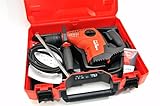

| Model | Power source | Impact energy | Typical concrete capacity | Tool weight | Best suited to |
|---|---|---|---|---|---|
| Hilti TE 2-22 | 22V cordless | About 2.3 J | 4–16 mm | About 2.7 kg | Light anchors, fixings, and overhead work |
| Hilti TE 4-22 | 22V cordless | About 2.6 J | 4–28 mm | About 3.3 kg | General-purpose drilling and occasional chiseling |
| Hilti TE 6-22 | 22V cordless | About 2.6 J | 4–28 mm | About 3.3 kg | Frequent cordless concrete drilling |
| Hilti TE 30-22 | 22V cordless | About 3.6 J | 4–28 mm | About 4.0 kg | Demanding drilling and moderate chiseling |
| Hilti TE 30-AVR | Corded | About 3.3 J | 4–28 mm | About 4.2 kg | Continuous site work with mains power |
| Hilti TE 7 | Corded | About 7.3 J | 8–32 mm | About 4.9 kg | Large holes and heavier chiseling |
| Hilti TE 70-AVR | Corded | About 14.5 J | 12–40 mm | About 9.5 kg | High-volume, heavy-duty concrete work |
Which Hilti model fits the job?
For light anchoring: TE 2-22
The TE 2-22 is the sensible choice for installing small shelf brackets, cable trays, conduit clips, light fixtures, and similar anchors. Its SDS-Plus chuck accepts common masonry bits, while roughly 2.3 joules of impact energy is enough for routine holes in brick, block, and concrete.
Its lower weight matters more than maximum power when drilling overhead or from a ladder. The trade-off is capacity: it is not the right tool for repeatedly drilling 20–28 mm holes or for breaking out substantial concrete. Use rotary-only mode for masonry or tile where hammering could cause unnecessary damage, if the selected accessory and application permit it.
For general construction: TE 4-22 or TE 6-22
The TE 4-22 and TE 6-22 occupy the useful middle ground. Both are intended for SDS-Plus drilling in the low-to-mid-size range and offer more reserve than a compact two-mode drill. They are better choices for installers who regularly drill anchor holes, pipe penetrations, and fixing points in concrete.
The difference is less about headline impact energy than the complete tool design, operating modes, ergonomics, and the type of work schedule each model is intended to support. Choose between them by comparing the exact regional specification, vibration value, included modes, battery compatibility, and service package rather than assuming that the higher model number automatically means a dramatic increase in drilling speed.
For demanding cordless work: TE 30-22
The TE 30-22 is the stronger cordless option in this group. Its approximately 3.6 J impact energy gives it more useful reserve when drilling larger holes, working in harder concrete, or performing moderate chiseling without a power cord.
That extra capability comes with more weight and greater battery consumption. It is a good fit for contractors who need cordless mobility but cannot justify stopping at a compact drill. For a day of repeated large holes, carry at least one charged spare battery and select a high-capacity pack; runtime varies substantially with bit diameter, concrete hardness, drilling depth, and battery size.
For continuous power: TE 30-AVR
The corded TE 30-AVR is appropriate where mains electricity is readily available and uninterrupted drilling is more important than cordless convenience. Its active vibration reduction system is particularly relevant for users who spend long periods drilling or chiseling.
A corded machine also avoids battery rotation and the performance drop that can occur when a battery becomes cold, depleted, or overloaded. The disadvantages are cable management, dependence on a suitable electrical supply, and less freedom around scaffolding or unfinished sites.
For large holes and chiseling: TE 7 and TE 70-AVR
The TE 7 moves into a heavier SDS-Plus class, with approximately 7.3 J of impact energy and a typical concrete range extending to about 32 mm. It is better suited to large anchors, penetrations, and material removal than the compact models.
The TE 70-AVR is a substantially heavier SDS-Max machine. Its approximately 14.5 J impact energy is intended for demanding concrete drilling and serious chiseling, not occasional household fixing. It can make large jobs faster, but its weight, vibration exposure, accessory cost, and transport requirements make it excessive for small anchors.
Decision matrix: capacity versus ownership cost
| Your situation | Recommended class | Why | What to avoid |
|---|---|---|---|
| Fewer than 20 small holes per week | TE 2-22 | Low weight and adequate power for common anchors | Buying a heavy SDS-Max tool for occasional work |
| Daily installation work, mostly 6–18 mm holes | TE 4-22 or TE 6-22 | Better productivity and broader useful range | Using a compact drill continuously at its limit |
| Large cordless holes or moderate chiseling | TE 30-22 | Higher impact energy without a power cord | Expecting compact batteries to last all day without spares |
| Many holes in one location with mains power | TE 30-AVR | Consistent output and no battery rotation | Ignoring cable routing and residual-current protection |
| Large penetrations or sustained chiseling | TE 7 or TE 70-AVR | Higher impact energy and larger accessory systems | Using a high-energy tool for delicate masonry |
Impact energy, vibration control, and drilling capacity
Impact energy is not the same as motor wattage. It describes the energy delivered by each hammer blow and is one indicator of how readily a tool can break hard concrete. Higher energy can improve progress in large holes, but it also increases weight, noise, accessory wear, and the risk of damaging brittle masonry.
Vibration control matters most during repeated drilling and chiseling. Hilti models carrying AVR are designed to reduce transmitted vibration, but no system removes it completely. Use sharp, correctly sized SDS bits, keep both hands on the tool, take sensible breaks, and follow workplace exposure requirements.
Also check the chuck standard. SDS-Plus is convenient for common anchor holes and lighter chiseling; SDS-Max accepts larger, more robust accessories for heavy concrete work. An adapter does not turn a compact SDS-Plus mechanism into an SDS-Max breaker.
Setup and maintenance that affect performance
- Select the correct bit. Use a quality carbide-tipped concrete bit for reinforced or hard concrete, and match its diameter to the anchor manufacturer’s specification.
- Set the depth stop. Add the required embedment depth plus clearance for drilling dust. A practical starting point is to allow roughly 5–10 mm beyond the anchor’s specified embedment, then confirm the anchor instructions.
- Start slowly and keep the tool square. A tilted bit enlarges the hole and can reduce anchor holding performance. Let the hammer mechanism work rather than forcing excessive downward pressure.
- Clear deep holes. Withdraw the bit periodically to remove dust. Packed dust increases friction and can leave an undersized effective hole even when the bit diameter is correct.
- Clean the shank. Wipe SDS shanks and apply the manufacturer-approved grease sparingly. Dirt in the chuck accelerates wear and can prevent full bit engagement.
- Inspect consumables. Replace rounded, cracked, or overheated bits. A worn bit makes the motor work harder, drills more slowly, and can produce poor anchor holes.
A simple capacity check illustrates why tool choice matters. If a job requires 80 holes at 12 mm diameter and the compact drill completes each in 20 seconds, drilling time alone is about 27 minutes. If harder concrete or a worn bit increases that to 45 seconds, the same operation takes 60 minutes before marking, cleaning, and anchor installation. A more powerful model may reduce drilling time, but only if its extra weight and battery or cord requirements suit the site.
Bottom line
Choose the TE 2-22 for portability and light anchoring, the TE 4-22 or TE 6-22 for everyday SDS-Plus work, and the TE 30-22 when cordless drilling must handle larger or tougher holes. Select the TE 30-AVR for sustained corded production, the TE 7 for larger SDS-Plus drilling and chiseling, and the TE 70-AVR for genuinely heavy concrete work. Before buying, compare the complete kit price, battery requirements, vibration specification, service support, and the cost of the bits you will use most often—not just the impact-energy figure.