What's inside
- What beginners actually need from an impact driver
- Best beginner impact drivers by situation
- Control, kickback, and noise: what to expect
- Bit changes and the accessories that matter
- A simple setup method that prevents most beginner mistakes
- Ownership costs and durability realities
- Final recommendation
- Related Guides
- What beginners actually need from an impact driver
- Best beginner impact drivers by situation
- Control, kickback, and noise: what to expect
- Bit changes and the accessories that matter
- A simple setup method that prevents most beginner mistakes
- Ownership costs and durability realities
- Final recommendation
- Related Guides
As an Amazon Associate I earn from qualifying purchases. This post may contain affiliate links at no extra cost to you.
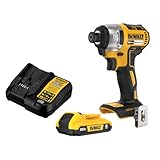
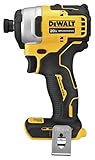
The best impact driver for beginners is the DEWALT DCF845 20V MAX because its three speed settings, compact body, and moderate trigger response make it easier to control than many high-torque models. It is not the only sensible choice, though: the Milwaukee M12 FUEL 3453 is the better pick for light-duty work in tight spaces, while the Makita XDT16 is the more refined option for users who expect to build furniture, decks, and other projects regularly.
As an Amazon Associate we earn from qualifying purchases at no extra cost to you.


What we cover
- What beginners actually need from an impact driver
- Best beginner impact drivers by situation
- Control, kickback, and noise: what to expect
- Bit changes and the accessories that matter
- A simple setup method that prevents most beginner mistakes
- Ownership costs and durability realities
- Final recommendation
- Related Guides
What beginners actually need from an impact driver
An impact driver is useful when a drill starts to struggle with long screws, structural fasteners, or repeated driving. Its hex chuck accepts impact-rated bits, and its hammering action delivers rotational force without transferring as much twisting force to your wrist as a conventional drill.
That extra force can also make mistakes happen faster. A beginner-friendly model should therefore provide:
- A low speed or assist mode for starting screws without stripping the head.
- A short, balanced body that is easy to hold one-handed.
- A responsive variable-speed trigger rather than an abrupt on/off feel.
- A tool-free 1/4-inch hex chuck that locks bits securely and releases them easily.
- Enough power for common screws without encouraging excessive torque on delicate materials.
For most first-time buyers, four modes and the highest advertised torque are less important than a good low-speed setting. Maximum torque figures are measured under particular conditions and are not directly comparable between brands.
Best beginner impact drivers by situation
| Model | Best for | Published maximum torque* | Length | Weight with compact battery | Control features |
|---|---|---|---|---|---|
| DEWALT DCF845 20V MAX | Best overall beginner choice | 1,825 in-lb | 5.3 in | About 2.9 lb | 3 speeds; Precision Drive in low speed |
| Milwaukee M12 FUEL 3453 | Small repairs and light-duty work | 1,500 in-lb | 5.0 in | About 2.2 lb | 4 modes; self-tapping screw mode |
| Makita XDT16 18V LXT | Frequent DIY and finish-sensitive work | 1,600 in-lb | 4.6 in | About 2.9 lb | 4 speeds; assist modes; electronic controls |
| Bosch GDR18V-1400B12 | Compact general-purpose use | 1,400 in-lb | 5.1 in | About 2.7 lb | 3 speed ranges; brushless motor |
*Torque figures are manufacturer claims and should be treated as a rough indication of capability, not a laboratory comparison. Weights vary with battery size and kit configuration.
Best overall: DEWALT DCF845
The DCF845 is a strong first purchase because it combines a short head with enough power for framing screws, deck screws, cabinet hardware, and general repair work. Its three speed settings provide a useful progression: low for small screws and fragile materials, medium for ordinary construction screws, and high for long fasteners where speed matters more than finesse.
Its Precision Drive behavior in the lower setting helps reduce overdriving when a screw begins to seat. That does not make it foolproof, but it gives a beginner more usable trigger range. The 20V MAX battery platform also has a broad selection of compatible tools, which can lower ownership costs if you later add a saw, light, or drill.
Best for tight spaces: Milwaukee M12 FUEL 3453
The M12 FUEL 3453 is substantially lighter with a compact 12-volt battery. That makes it comfortable for assembling furniture, installing shelves, tightening brackets, and working overhead. Its four-mode control includes a self-tapping screw mode that slows the tool as the fastener seats, helping reduce stripped threads and broken screws.
Its limitation is not control but capacity. It is less suitable for driving dozens of long structural screws into dense lumber or for replacing a full-size impact driver on a deck project. Choose it when low weight, low fatigue, and maneuverability matter more than maximum speed.
Best refined option: Makita XDT16
The Makita XDT16 is a good choice for a beginner who already expects to use an impact driver frequently. It has four speed settings and electronic assist features designed to moderate speed during screw starting and seating. Its compact 4.6-inch length is useful inside cabinets and between framing members.
The extra settings are valuable only if you use them. A new user who leaves the tool in the highest mode may not experience much benefit over a simpler model. It is also worth comparing the price of the bare tool and batteries, since the Makita platform can cost more at the initial purchase than a basic kit.
Control, kickback, and noise: what to expect
Speed control
Use the trigger as a control, not merely as a switch. Start with a light squeeze until the bit engages the screw head, then increase pressure after the screw has formed or entered its pilot hole. Select the lowest mode that completes the task at a reasonable pace.
For cabinet screws, small wood screws, and hardware, low speed is usually appropriate. Medium speed suits general-purpose screws roughly 1-1/2 to 3 inches long. High speed is better reserved for long fasteners in sturdy material, where the workpiece can tolerate rapid seating.
Kickback behavior
Impact drivers generally produce less sustained wrist twist than drills, but they can still jerk when a bit slips, a fastener bottoms out, or the impact mechanism engages against a hard obstruction. The most common beginner mistake is holding the tool loosely while using a high setting.
Keep the bit aligned with the screw, brace the handle with your whole hand, and stop as soon as the head reaches the intended depth. Electronic assist modes reduce some overshoot; they do not replace correct pressure and alignment.
Noise
The impact mechanism is loud. Depending on material, fastener size, distance, and mode, an impact driver can produce roughly 85 to 100 dBA near the operator. That sharp rattling sound is normal, but it is a reason to wear hearing protection, especially during repeated driving indoors.
Bit changes and the accessories that matter
A standard impact driver uses a 1/4-inch quick-release hex chuck. Pull the collar forward, insert a 1/4-inch hex bit, and release the collar. Tug the bit lightly to confirm it has locked. To remove it, pull the collar forward again.
Use impact-rated bits. Their torsion zones are designed to flex under impact loading, whereas ordinary drill-driver bits can snap. A beginner’s useful starting set includes:
- Phillips number 2 and number 3 bits for common construction screws.
- Square-drive and star-drive bits if those fasteners are common in your area.
- A magnetic bit holder for longer reach and easier bit changes.
- Nut drivers sized for common hex-head screws.
- A short, stiff bit for work in confined spaces.
Do not use the impact driver as a drill unless you install a suitable impact-rated hex-shank drill bit or chuck adapter. For clean holes, a drill is usually easier to control.
A simple setup method that prevents most beginner mistakes
- Charge the battery and inspect the bit. A rounded or damaged bit slips more easily and damages screw heads.
- Match the bit exactly to the fastener. A loose fit causes cam-out, especially with Phillips screws.
- Drill a pilot hole when the wood may split. For a screw in hardwood or near an end grain, use a pilot hole slightly smaller than the screw’s solid-shank diameter.
- Choose low mode first. Drive until the screw is stable, then increase speed only if necessary.
- Stop at flush or at the specified depth. Releasing the trigger early is better than trying to reverse an overdriven screw.
- Check the workpiece. Look for splitting, crushed fibers, stripped heads, or a screw that has not fully penetrated the intended material.
For example, if a 3-inch screw is going into a 2-by-4 through a 1/2-inch board, approximately 1/2 inch passes through the board and about 2-1/2 inches enters the lumber. That is a task for medium speed on most full-size models, with a pilot hole recommended near an edge.
Ownership costs and durability realities
The tool itself is rarely the first item to wear out. Bits round over, battery packs lose capacity after repeated charging and heat exposure, and the chuck collar can collect dust. Keep the driver dry, blow dust from the vents, and remove the battery before cleaning. Do not oil the hex chuck unless the manufacturer specifically recommends it; excess oil attracts abrasive dust.
Battery cost also changes the real price. A bare tool may look inexpensive, but a usable starter setup needs a battery and charger. General market ranges in 2026 are approximately $120–$220 for a compact 12-volt kit and $180–$320 for a full-size 18- or 20-volt kit, depending on battery capacity and included accessories. A 2.0Ah or 2.5Ah battery keeps weight down; a 4.0Ah or 5.0Ah pack is more practical for long sessions.
Buy the platform that matches your likely future tools. The cheapest driver becomes expensive if you later need a second battery, charger, and unrelated system. For occasional furniture assembly, choose the lightest suitable model. For repeated construction projects, a full-size 18- or 20-volt platform is the better long-term decision.
Final recommendation
Choose the DEWALT DCF845 if you want one beginner-friendly impact driver for the widest range of home projects. Choose the Milwaukee M12 FUEL 3453 for light work and tight spaces, or the Makita XDT16 if you value fine electronic control and expect frequent use. Whichever model you select, low speed, a properly fitting impact-rated bit, hearing protection, and a pilot hole when appropriate will make more difference than a higher torque number.