What's inside
As an Amazon Associate I earn from qualifying purchases. This post may contain affiliate links at no extra cost to you.
Step drill bits are one of the fastest ways to make clean holes in electrical boxes, knockout panels, junction boxes, and thin sheet metal. A single bit can replace several twist bits, and its wide flutes clear chips well in thin material. The trade-off is that step bits are not general-purpose bits: they are built for thin metal, and they wear quickly if used on thick steel, stainless, or hardened material.
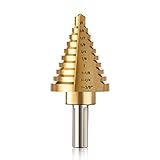
For most electrical work, buy a high-speed steel (HSS) step bit with clearly marked steps and a 1/4-inch hex shank. If you use an impact driver, choose a bit specifically rated for impact use rather than assuming any hex-shank bit is suitable. A conventional drill is smoother and easier to control, but an impact driver is useful when you are working from a ladder or in a cramped panel.
As an Amazon Associate we earn from qualifying purchases at no extra cost to you.


What we cover
What to Look For in a Step Drill Bit
The most useful feature is a size range that matches the holes you actually make. Electrical boxes commonly need holes for cable clamps, conduit fittings, and connectors. A bit covering roughly 1/8 to 1/2 inch handles many cable-entry jobs. A larger bit reaching 7/8 inch or 1-1/8 inches is more useful for conduit and larger fittings.
Look for laser-etched or deeply stamped size markings. Painted markings can disappear after a few holes, especially when the bit gets hot. A split-point or self-starting tip reduces wandering on smooth box steel, but you should still make a small starter dimple with a center punch when accuracy matters.
HSS is adequate for ordinary galvanized electrical boxes and mild sheet steel. Cobalt-alloy HSS costs more and is worth considering for repeated work or tougher stainless sheet. Coatings such as titanium nitride can reduce friction, but a coating does not make a poorly made bit durable. Sharp cutting edges, consistent step geometry, and a secure shank matter more.
For cordless tools, these impact-rated step drill bits are the right category if you regularly switch between a drill and an impact driver. For a regular drill, a standard HSS step bit set is usually the better value.
Best Types for Electrical Boxes and Sheet Metal
| Type | Best use | Advantages | Limitations |
|---|---|---|---|
| Basic HSS step bit | Occasional holes in steel boxes and aluminum | Low cost, clean cuts, easy to find | Can dull quickly with heat or heavy use |
| Impact-rated hex step bit | Electrical work from a ladder or tight spaces | Works with impact drivers; fast bit changes | Usually costs more; impact use can still damage thin material |
| Cobalt HSS step bit | Frequent work or tougher sheet metal | Better heat resistance and edge life | More brittle; expensive if used only occasionally |
| Large-range step bit | Conduit fittings and oversized cable entries | Replaces multiple smaller bits | Longer, heavier, and easier to over-enlarge a hole |
Choosing the Right Size Range
A small step bit that ends around 1/2 inch is convenient for low-voltage cable, small cable glands, and pilot holes. For residential electrical boxes, a bit that reaches at least 7/8 inch is more versatile. It can make openings for several common fittings, although the exact required hole size depends on the connector manufacturer.
Do not use the next step by guesswork. Read the fitting instructions or measure the connector. A hole that is only slightly too large may leave a clamp unable to lock onto the box. An oversized hole can also weaken the box wall and create a sharp edge that damages cable insulation.
For larger conduit work, a step bit reaching 1-1/8 inches or more can be useful, but it is not always the best tool. In thicker metal, a knockout punch makes a rounder, cleaner hole with less heat. For occasional large holes, a large step drill bit is cheaper than a punch set and works well in thin panels.
How to Drill Clean Holes
Clamp or firmly support loose sheet metal before drilling. Thin stock can grab the bit and spin like a propeller, bending the panel or cutting your hand. Wear safety glasses; step bits throw small, sharp chips even when the hole looks clean.
Set the drill to low or medium speed and use moderate pressure. For thin mild steel, roughly 500 to 1,000 rpm is a sensible starting range for larger steps; smaller steps can run faster. The important rule is to avoid high-speed squealing and blue discoloration. Those are signs of excess heat, which softens the cutting edge and shortens the bit’s life.
Use cutting oil on steel, especially when making a large hole or drilling several boxes in succession. Do not flood an energized electrical enclosure with oil. De-energize the circuit, remove the cover when practical, and clean residue before installing wiring. Aluminum usually cuts dry, though a light lubricant can reduce sticking.
Start with the tip centered in a punch mark. Keep the bit straight and stop as soon as the required step passes through the metal. Continuing to push after reaching the target size only removes useful material and can leave a rough, oversized opening. Deburr the hole with the next light contact of the bit, a deburring tool, or a file.
Common Failure Modes
The most common mistake is using a step bit on material that is too thick. Step bits work best in thin sheet, generally around 1/16 inch or less. On thicker plate, they cut slowly, overheat, and may chip at the step transitions. Use a twist bit, annular cutter, or knockout punch when the metal is thick.
Another failure is using an impact driver at full trigger speed. The hammering action can fracture a cheap bit, enlarge the hole unevenly, or damage the box. An impact-rated bit reduces the risk, but it does not eliminate it. Use the lowest practical speed and switch to a drill when you need control.
Cheap sets are fine for a homeowner making a few holes in galvanized boxes. Buy a better bit if you install boxes regularly, work in stainless or heavy-gauge panels, or cannot afford a dull bit halfway through a job. A single quality bit covering your common size range is often a better purchase than a large set with unused sizes. For replacement pieces, replacement HSS step bits let you replace the worn size instead of discarding an entire set.